Forging the Future: Inside the G.I. Joe Classified 3D Printing Customs Community
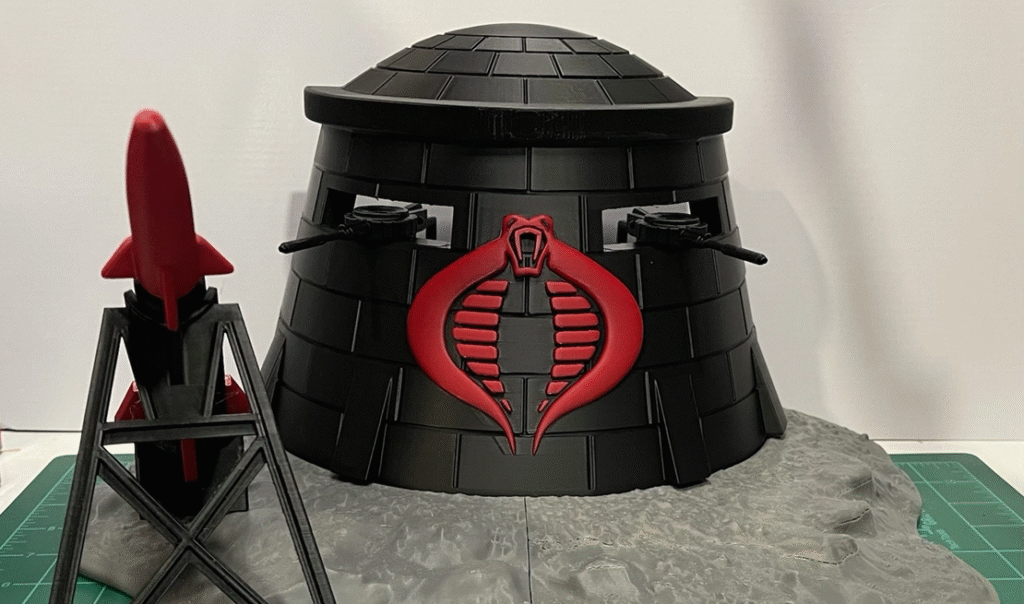
In the ever-evolving world of G.I. Joe collecting, one of the most exciting and creatively rich corners of the fandom can be found in the G.I. Joe Classified 3D Printing Customs Facebook community. This group has become a hub for innovation, passion, and technical skill as fans bring their dream vehicles, gear, and diorama pieces to life in 1:12 scale — all thanks to the power of 3D printing.
The Rise of 3D Customization for G.I. Joe Classified
When Hasbro revived the G.I. Joe line in the highly detailed 6-inch Classified scale, long-time collectors were thrilled. But one thing was missing — vehicles. Unlike the 3.75″ era, where tanks, choppers, and playsets were abundant, the Classified line focused primarily on figures. That’s where the 3D printing community stepped in, taking matters into their own hands — literally.
Fans with a knack for design and engineering started creating and sharing digital 3D models of classic vehicles, weapons, and accessories scaled up for the 6-inch Classified figures. And thus, a new DIY renaissance was born.
From CAD to Classified: How It Works
The process of creating a custom 3D-printed G.I. Joe vehicle is no small feat. It begins with designing digital files, typically using CAD (Computer-Aided Design) programs like Fusion 360, Blender, or TinkerCAD. Creators often reference original blueprints, photos, or vintage toys to ensure accuracy. Some even reverse-engineer original 3.75” vehicles by scanning parts and scaling them up proportionally.
Once the design is complete, the file — usually in .STL or .OBJ format — is prepped in slicing software (like Cura, PrusaSlicer, or Lychee) to generate the instructions a 3D printer needs. Depending on the piece’s size and complexity, it might be broken into multiple parts to fit standard print beds.
Next comes the printing itself. Members of the community use both FDM (Fused Deposition Modeling) and resin printers, with FDM being more common for large vehicle shells and resin reserved for small, high-detail components. Printing can take anywhere from a few hours to a few days.
After printing, parts are cleaned, sanded, and sometimes chemically smoothed. Many users fill seams with modeling putty, prime the parts, and paint them using acrylics, airbrushes, or even spray cans. Some take it a step further with weathering, custom decals, and LED lighting to make their projects museum-worthy.
A Creative Collaboration Space
What makes the G.I. Joe Classified 3D Printing Customs Facebook group so special is the spirit of sharing and collaboration. Members trade tips, offer print settings for tricky files, and celebrate each other’s builds. Many designers generously share their STL files for free or at low cost on platforms like Cults3D, Gambody, or Patreon.
The group is also a goldmine of modders, painters, diorama builders, and photographers who all feed into each other’s creativity. Some members even launch small businesses, offering printed kits, upgrade parts, and fully assembled customs for those without access to a printer.
Bridging the Gaps in the Line
3D printing has not only allowed fans to recreate beloved classics like the VAMP, HISS, and Trouble Bubble at Classified scale — it’s also brought never-before-seen concepts to life. Original designs inspired by comic books, unused prototypes, and even crossover vehicles (think Aliens-style dropships or Mad Max-esque battle rigs) have emerged from this vibrant scene.
As Hasbro slowly trickles out official vehicles for the Classified line, the community continues to charge ahead at full throttle — proving once again that G.I. Joe was always “a real American innovation.”