G.I. Joe Goes Neuralace: From Dr. Venom’s Brainwave Scanner to Real BCIs in 2025
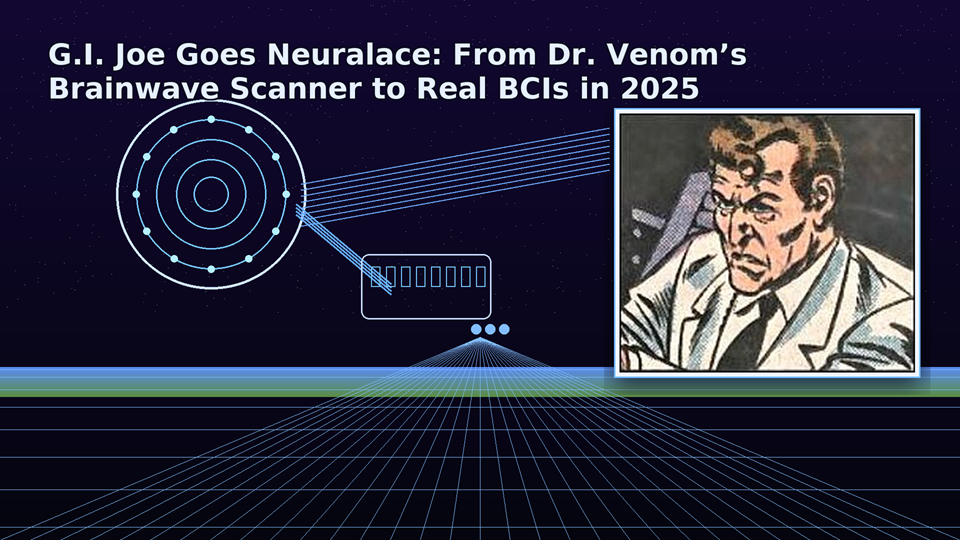
In Larry Hama’s classic G.I. Joe run, Dr. Venom’s Brainwave Scanner could map a captive’s mind by flashing images, then “read” (or even rewrite) what was inside. It debuts in 1983’s issue #10 under a Springfield arcade—Snake Eyes strapped to a chair, Venom boasting about extracting the Pit’s location—setting the tone for Cobra’s uniquely creepy brand of science. Later, Dr. Mindbender even uses the Scanner while creating Serpentor, pushing it from interrogation prop to personality programming engine.
Flash forward to 2025, and the real world has something intriguingly adjacent: high-channel, flexible brain-computer interfaces (BCIs). Blackrock Neurotech (not to be confused with the asset manager BlackRock) revealed Neuralace—a next-gen neural interface with 10,000+ channels on an ultra-thin, flexible substrate—aimed at recording from and stimulating the brain with far greater fidelity than older arrays. It’s not a comic-book mind reader, but as a sensing platform it’s a big leap.
So, what’s actually possible now? For one, precision motor intent decoding. In January 2025, researchers using Blackrock Neurotech arrays demonstrated high-performance interfaces that let users control individual finger movements—refining from cursor control into nuanced, multi-degree dexterity. That’s worlds away from the 1980s, and it mirrors the Scanner’s “map the patterns, then interpret them” workflow (minus the coercion).
Another frontier is speech restoration. In 2024, Blackrock Neurotech-based systems helped restore synthesized speech for an ALS patient, showing how channel-dense implants plus machine-learning decoders can turn neural activity into words. Researchers still need careful calibration sessions, but the trajectory is clear: higher channel counts + better algorithms = richer, faster communication for people who’ve lost it.
f you’re thinking “Is Dr. Venom’s full mind-reading real yet?”—no. Today’s BCIs decode specific signals, not autobiographical memories. They learn correlations between neural firing patterns and attempted movements, imagined phonemes, or sensory responses. That makes them incredible assistive tools—not psychic windows. Even the boldest demos are about translating intent, not pulling secrets from memory palaces. The tech is empowering, not sorcery.
What makes Neuralace noteworthy is that platform promise: a biocompatible, flexible, high-density interface that can collect cleaner signals (and potentially deliver targeted stimulation) across larger cortical areas. That unlocks research into closed-loop therapies, richer prosthetic control, and hybrid systems combining implants with wearables and AR. It’s the realistic version of the Scanner’s “calibration phase”—build an individualized neural dictionary, then use it to interpret (or modulate) activity.
And the ecosystem is heating up. In 2024, Tether invested $200 million for a majority stake in Blackrock Neurotech, explicitly to accelerate commercialization—signaling that BCIs are moving from lab tours to product roadmaps. For patients with paralysis or locked-in syndrome, that means faster paths to trials, insurance codes, and real-world availability. For society, it means the privacy, security, and ethics conversations can’t lag the hardware.
If Hama’s Brainwave Scanner gave us the dramatic metaphor—map → interpret → influence—2025’s reality is the first two steps, carefully bounded and consent-driven. Neuralace doesn’t turn us into Serpentor; it helps researchers and clinicians listen better to the brain’s language and, in controlled therapy, speak back in helpful whispers. In other words: the coolest parts of the fiction are becoming usable science—minus the villainy, plus IRB paperwork.
Bottom line: G.I. Joe’s most infamous machine imagined a world where brains were readable like books. Neuralace and modern BCIs don’t read books; they learn a few fluent chapters—movement, speech, sensation—and turn them into tools that restore autonomy. That’s a far better story than Cobra ever told.