October Monster Mash: “The Colossal Turtle from the Fire of Hell!” – Gamera, the Giant Monster (1965)
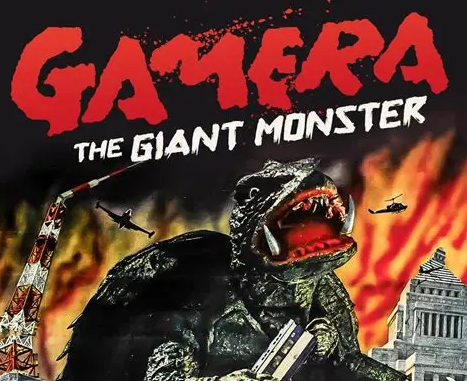
Japan’s Other Giant Awakens
By 1965, Godzilla had already conquered Japanese screens, inspiring a tidal wave of monster films that thrilled audiences with destruction and spectacle. But Daiei Studios — eager to compete with Toho’s kaiju empire — unleashed a new behemoth: Gamera, the giant flying turtle who breathed fire and fed on flames.
Directed by Noriaki Yuasa and produced by Masaichi Nagata, Gamera, the Giant Monster (Daikaijū Gamera) began as a straightforward creature feature but evolved into one of Japan’s most beloved monster franchises. Though later sequels would portray Gamera as a protector of humanity — especially children — his 1965 debut presents him as a terrifying force of nature, unleashed by nuclear folly.
The Story: Fire in the Sky
The film opens in the icy Arctic, where a group of scientists and military personnel intercept a mysterious unidentified flying object. In a moment that feels ripped from Cold War headlines, U.S. and Soviet forces clash over control — and amid the chaos, a nuclear missile explodes.
From the flames and ice emerges Gamera, a massive prehistoric turtle awakened by atomic energy.
Towering over cities and impervious to conventional weapons, Gamera begins his rampage across Japan, feeding on flames and leaving destruction in his wake. He devours fire, breathes jets of it from his mouth, and — in one of cinema’s most bizarre and unforgettable images — flies through the air like a spinning saucer, jets of flame blasting from his shell.
The Monster with the Ancient Eyes
Unlike Godzilla, who carried a sense of tragic nobility, early Gamera was more primal — a prehistoric survivor, awakened and confused. His enormous eyes conveyed both rage and sadness, a sense that he was not truly evil but displaced, thrust into a modern world he didn’t understand.
The film’s most poignant subplot follows Toshio, a young boy who loves turtles and sees Gamera not as a monster but as something wonderful and misunderstood. This connection between child and creature would later become central to the Gamera mythos, transforming him from destroyer to savior in subsequent films.
But here, in his debut, Gamera’s compassion is fleeting — his appetite for energy and destruction too great to control.
Cold War Fire and Atomic Anxiety
Like many kaiju films of its era, Gamera was born from atomic-age fears. The creature’s awakening by a nuclear blast mirrored Japan’s lingering trauma from Hiroshima and Nagasaki. The film’s opening sequence, depicting American and Soviet forces at odds in Arctic skies, also tapped into the real-world tension of the Cold War.
Beneath the spectacle of burning cities and military battles, Gamera symbolized humanity’s reckless use of science — the idea that mankind’s power to destroy could awaken something unstoppable.
Practical Effects and Daiei’s Vision
Though produced on a smaller budget than Toho’s Godzilla films, Gamera, the Giant Monster impressed audiences with its atmospheric cinematography and creative effects. Shot in striking black and white, the film emphasized smoke, shadow, and scale to convey the creature’s size and menace.
Suit actor Haruo Nakajima (who had also portrayed Godzilla) inspired Gamera’s movement style, but Daiei’s own effects crew created a unique look. Gamera’s design — tusks, wrinkled hide, and glowing eyes — gave him a distinct presence among the pantheon of kaiju.
And when he took flight, spinning through the air like a blazing discus, it was pure 1960s fantasy brought to life.
From Monster to Hero
Though Gamera was born as a destroyer, audience reaction — especially among children — was overwhelmingly positive. By the time Gamera vs. Barugon (1966) arrived, Daiei leaned into the hero angle, transforming him into a protector of Earth and children everywhere.
Yet the original film remains powerful for its darker tone. Gamera isn’t yet the gentle giant — he’s a creature of fire and instinct, tragic and terrifying in equal measure.
Conclusion
As part of our October Monster Mash, Gamera, the Giant Monster stands as a cornerstone of Japanese sci-fi — a film that blended Cold War fear with mythic spectacle, giving birth to one of cinema’s most enduring monsters.
In the decades since, Gamera has evolved from atomic terror to heroic guardian, but the 1965 original remains haunting — a stark reminder of humanity’s dangerous flirtation with forces beyond control.
So when you see flames flickering this October night, beware — somewhere in the depths of time, Gamera still hungers for fire.
“He is a prehistoric monster — reborn of the atom, unleashed upon the world!”