You’ll Shoot Your Eye Out—and Love Every Minute of It
A Perfectly Messy, Endlessly Quotable Look Back at A Christmas Story (1983)
Some Christmas movies are seasonal treats. Others are full-blown holiday rituals. A Christmas Story belongs firmly in the second category. This isn’t just a movie you watch—it’s one you live with every December, popping in and out of your day like background music that somehow becomes the main event. You don’t even have to sit down for the whole thing. You just need to catch a scene, and suddenly you’re all in again.
Set in 1940s Indiana and told through the dry, perfectly timed narration of adult Ralphie Parker, the movie unfolds like a memory—slightly exaggerated, deeply specific, and painfully honest. Ralphie’s singular obsession is simple: he wants a Red Ryder BB gun for Christmas. That’s it. That’s the plot. And somehow, from that small desire, the movie builds one of the richest, funniest portraits of childhood ever put on film.
What makes A Christmas Story work so well is how true it feels. Not idealized. Not sanitized. Just real. The kids are rude, dramatic, impulsive, and completely convinced the world revolves around their wants. The adults are tired, distracted, loving in strange ways, and prone to sudden outbursts. This isn’t a story about perfect families—it’s about recognizable ones.
And then there’s The Old Man. Ralphie’s father is one of the great Christmas movie characters of all time. He’s loud, sarcastic, obsessed with his car, and weirdly emotional about objects that matter to him—especially that infamous leg lamp. He yells constantly, but you never doubt that he loves his family in his own chaotic way. In fact, his quiet acts of kindness—like secretly getting Ralphie the BB gun anyway—hit harder because they aren’t announced with speeches or hugs.
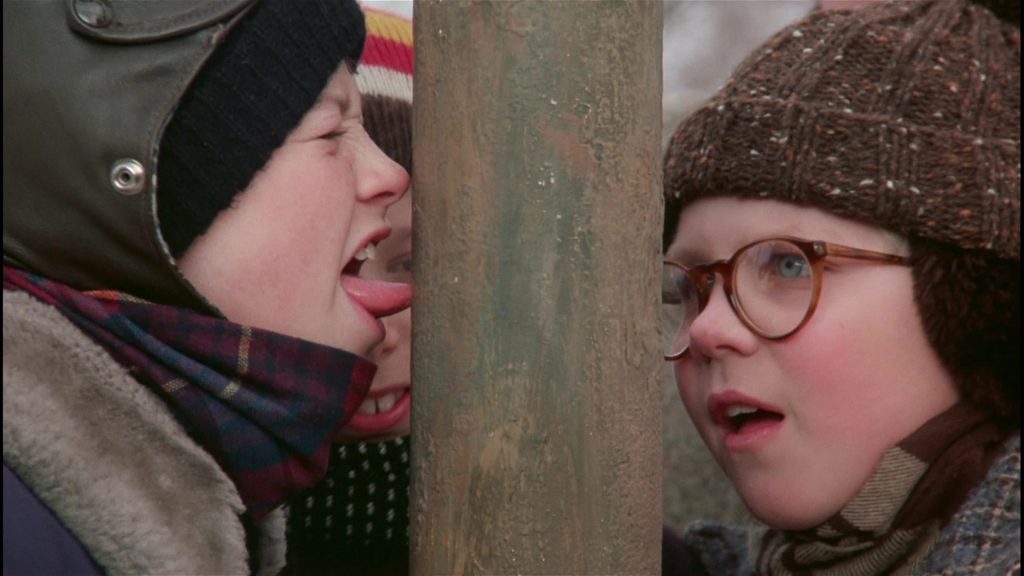
The movie is packed with scenes that feel burned into collective memory. The triple-dog-dare tongue-on-the-flagpole moment. The school fantasy sequences. The Christmas dinner disaster involving the neighbor’s dogs. The bunny suit. The soap poisoning panic. Each moment stands on its own, but together they form this perfect mosaic of what childhood felt like—when small humiliations were catastrophic and small victories felt heroic.
One of the movie’s secret weapons is its tone. It’s not sweet in a traditional way. It’s wry. Observational. Sometimes even a little mean. And that honesty is what makes it so comforting. The film doesn’t try to convince you that Christmas is perfect. It shows you that Christmas is awkward, loud, disappointing, funny, and occasionally magical—and that’s why it matters.
Visually, the movie is steeped in winter atmosphere. Snowy streets. Dimly lit department stores. Flickering Christmas lights. Everything feels slightly cold, slightly cramped, and completely right. You can almost smell the wool coats and hear boots crunching through snow. It looks like a memory that hasn’t faded—just softened around the edges.
And then there’s the ending. Ralphie finally gets the BB gun. He shoots it. He nearly shoots his eye out. And somehow, even with all the warnings coming true, it’s still the happiest moment of his Christmas. Because that’s how childhood works. You don’t want the lesson—you want the thing. And sometimes, getting the thing is the lesson.
Rewatching A Christmas Story now, it’s amazing how it changes depending on your age. As a kid, you’re Ralphie. As a teen, you’re laughing at the adults. As an adult, you suddenly realize you are the adults—and that realization hits harder than the jokes. You understand the exhaustion. The budgeting stress. The quiet satisfaction of pulling off something special without taking credit for it.
That’s why this movie endures. It doesn’t age out. It just shifts perspective with you. It grows as you do.
So yes—A Christmas Story is the movie that warned us we’d shoot our eye out. And we ignored it. Happily. Because every December, we come back for the same jokes, the same moments, the same memories—and love every single minute of it.