Before Mario Kart Rage, There Was Marble Mayhem: The Wild 80s Legacy of Run Yourself Ragged
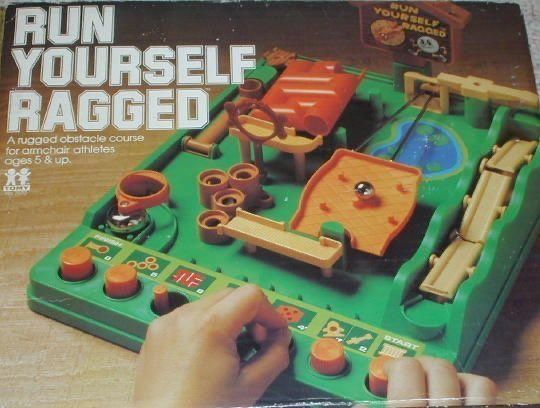
If you grew up in the late 1970s or 1980s, there is a very good chance Run Yourself Ragged looked less like a “board game” and more like a tiny plastic obstacle course designed by a cheerful mad scientist. Released by Tomy in 1979, the game challenged players to guide a steel ball through a sequence of moving hazards using knobs, levers, and buttons. It was mechanical, frantic, and just difficult enough to make kids mutter things their parents probably did not approve of. Outside the U.S., the toy became better known as Screwball Scramble, a name that eventually stuck in many markets.
What made Run Yourself Ragged stand out was its perfect mix of toy, puzzle, and dexterity challenge. This was not a game of trivia, luck, or rolling dice and hoping for mercy. It demanded timing, coordination, and nerves of steel. You had to rock the ball across a tilting bridge, maneuver it with a crane, bounce it over obstacles, and finally launch it toward the finish. It felt a bit like an arcade game that had somehow escaped the television and landed on the living room floor. In an era packed with electronic toys, its all-mechanical design gave it a special kind of magic. No batteries, no loading screens, just pure panic and plastic.
The game’s history is also a neat reminder of Tomy’s creativity during its golden years. In Japan, the concept was introduced as Athletic Land Game, and Tomy later exported it under several names, including Run Yourself Ragged, Snafu, and eventually Screwball Scramble. That ability to rebrand the same core toy for different markets helped it travel well and stay relevant for decades. Remarkably, it never really disappeared. Tomy still sells modern versions of Screwball Scramble, proving that a good idea can outlive fads, consoles, and countless toy trends.
As for the creator, the design is commonly credited to Tomy designer Masaaki Yoshimura, with engineering work by Takao Matsumoto. While detailed contemporary documentation is surprisingly scarce, later historical writeups on the toy consistently identify those two names as the key figures behind its creation. That feels fitting, because Run Yourself Ragged has always seemed like the product of both imagination and mechanical problem-solving: part toy inventor’s dream, part engineer’s headache.
The reason the game still sparks nostalgia today is simple: it was hard, loud, tactile, and unforgettable. It turned frustration into fun, which is basically the secret formula of many great 80s toys. Kids did not just play it once; they battled it, bragged about beating it, and handed it to the next person with the confidence of someone saying, “Go ahead, you try.” Run Yourself Ragged was never just a board game. It was a test of patience disguised as family entertainment, and that is exactly why people still remember it so fondly.