Pixelated Adventures: Growing Up with the Atari 2600 in the 80s
Growing up in the 1980s, the Atari 2600 video game system was a cornerstone of my childhood. The clunky joystick, the satisfying click of the button, and the vibrant, pixelated graphics all contributed to an immersive experience that has stayed with me through the years. My favorite game cartridges were Pitfall, Pac-Man, and Asteroids—each offering a unique adventure that kept me glued to the screen for hours on end.
The Atari 2600 was a marvel of its time. Released in 1977, it brought the arcade into our living rooms, transforming the way we played and interacted with video games. The excitement of slotting in a new cartridge and waiting for the game to load was unparalleled. Each game was a gateway to a new world, a new challenge, and a new story. Among the vast library of games, three stood out for me: Pitfall, Pac-Man, and Asteroids.
Pitfall
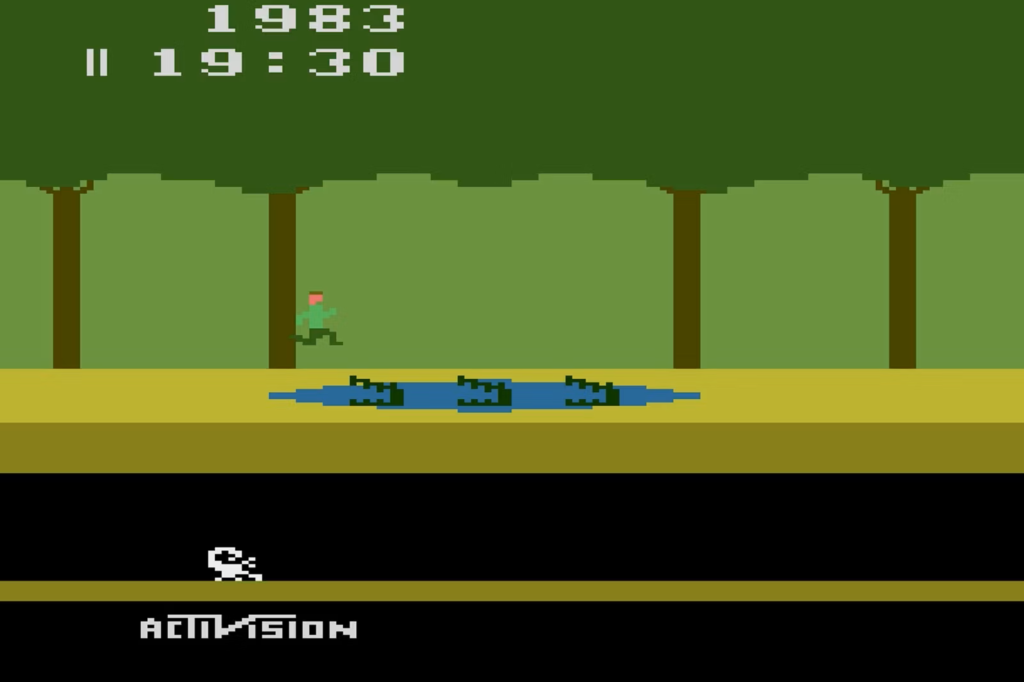
Pitfall was an adventure game that took me deep into the jungle, guiding the protagonist, Pitfall Harry, through a maze of treacherous terrain. The game’s objective was to collect treasures within a 20-minute time limit while avoiding various hazards like pits, quicksand, crocodiles, and rolling logs. The side-scrolling action was mesmerizing, and the sense of exploration was intoxicating.
The graphics of Pitfall, though rudimentary by today’s standards, were groundbreaking at the time. The vines, the underground tunnels, and the swinging ropes all contributed to a rich, immersive environment. I remember the sheer joy of timing a perfect swing over a pit or narrowly escaping the jaws of a crocodile. Each successful maneuver felt like a victory, and each treasure collected brought me closer to mastering the game.
Pitfall wasn’t just a game; it was an experience. It taught me patience, strategy, and perseverance. Every failed attempt was a lesson, and every success was a testament to my growing skills. The game’s design encouraged exploration and rewarded curiosity, making every playthrough unique and exciting.
Pac-Man
Pac-Man was another favorite, a game that transcended the boundaries of the screen and became a cultural icon. The simple yet addictive gameplay, where you navigated the titular character through a maze, eating pellets while avoiding ghosts, was a staple of my gaming sessions. The sound of chomping pellets and the distinctive “wakka wakka” noise are etched in my memory.
The appeal of Pac-Man lay in its simplicity and its challenge. Each level became progressively harder, with the ghosts becoming faster and more cunning. The thrill of clearing a level, the frustration of getting cornered by the ghosts, and the satisfaction of gobbling up a power pellet to turn the tables on your pursuers were all part of the game’s charm.
Pac-Man taught me the value of quick reflexes and strategic planning. It was a game that demanded concentration and rewarded skill. The maze might have seemed simple, but mastering it required practice and perseverance. I spent countless hours perfecting my moves, learning the patterns of the ghosts, and striving to beat my high score.
Asteroids
Asteroids, with its vector graphics and space-themed gameplay, transported me to the outer reaches of the galaxy. The objective was straightforward: destroy the floating asteroids and avoid colliding with them. The game’s physics, which allowed the ship to float freely in space, added a layer of complexity and realism that was captivating.
The appeal of Asteroids lay in its open-ended gameplay. There were no levels to complete, just a continuous struggle for survival against an ever-increasing onslaught of asteroids and enemy ships. The simplicity of the concept was balanced by the difficulty of the execution. Maneuvering the ship, aiming the shots, and managing the limited thrust and hyperspace jumps required skill and precision.
Asteroids was a test of hand-eye coordination and spatial awareness. Each session was a battle to outlast the asteroids and rack up a high score. The sense of accomplishment that came with a new high score was immense, and the desire to improve kept me coming back for more.
Reflecting on the Experience
The Atari 2600, with its blocky graphics and simple sounds, might seem primitive compared to today’s high-definition, multi-million dollar productions. But for those of us who grew up with it, it was a portal to new worlds and endless adventures. Pitfall, Pac-Man, and Asteroids were more than just games; they were formative experiences that shaped our understanding of play, challenge, and achievement.
Looking back, I realize that these games taught me valuable lessons. They taught me to embrace challenges, to be persistent in the face of failure, and to find joy in small victories. They fostered my imagination, encouraged my curiosity, and honed my reflexes. The memories of those days, spent hunched over the joystick, lost in the pixelated worlds of the Atari 2600, remain some of the fondest of my childhood.
In a world that is constantly changing, these memories remind me of the simple joys of play and the enduring appeal of a well-crafted game. The Atari 2600 may be a relic of the past, but its legacy lives on in the hearts of those who grew up with it, exploring jungles, dodging ghosts, and blasting asteroids in a quest for fun and adventure.