G.I. Joe’s Untold 1990s Secrets: Former Hasbro Brand Manager Vinnie D’Alleva Reveals What Really Happened
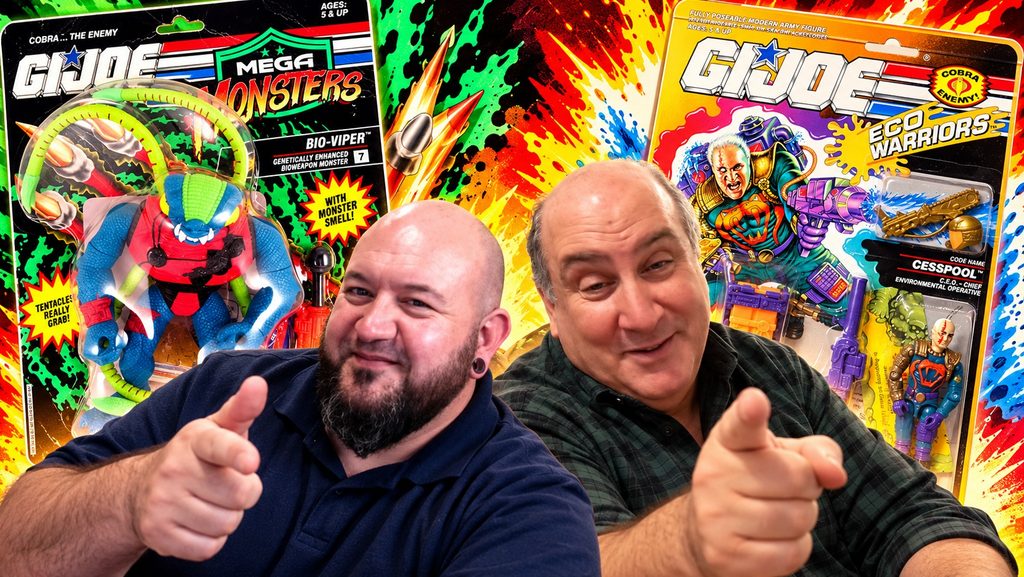
SERPENTOR’S LAIR | SPECIAL INTERVIEW FEATURE
G.I. Joe’s Untold 1990s Secrets: Vinnie D’Alleva Reveals What Really Happened at Hasbro
From the near-death of G.I. Joe to the unbelievable success of Hall of Fame, the creation of Cobra’s Cesspool, and the accidental birth of one of collecting’s most famous variants, a former Hasbro insider opens up.
By Adam Jared | SerpentorsLair.com
Presented by Action Media Toys in cooperation with SerpentorsLair.com
For G.I. Joe collectors, the 1990s remain one of the most fascinating, misunderstood, and frequently debated periods in the franchise’s history. It was an era of fluorescent uniforms, spring-loaded weapons, environmental warfare, ninja combat, experimental vehicles, and ambitious attempts to keep America’s legendary action figure brand alive.
But what was actually happening behind closed doors at Hasbro? Why did the company change its formula so dramatically? Who made those decisions? And how close did some of the brand’s most beloved products come to never existing at all?
In a revealing conversation hosted by Terry of Action Media Toys, former Hasbro G.I. Joe Brand Manager Vinnie D’Alleva shares extraordinary firsthand memories of his years working on the franchise. The interview, presented in cooperation with Serpentor’s Lair, also addresses questions submitted by Adam Jared.
D’Alleva, who served as G.I. Joe Brand Manager from 1990 through 1994, spent approximately ten and a half years at Hasbro. His work included Transformers, WWF, G.I. Joe, and later collectible and retailer-exclusive products.
What follows is more than a nostalgic conversation. It is a rare opportunity to understand the difficult choices that helped shape an entire generation of childhood memories.
WATCH THE COMPLETE INTERVIEW
Action Media Toys Presents: Vinnie D’Alleva — Hasbro G.I. Joe Brand Manager, 1990–1994
Interview courtesy of Action Media Toys, in cooperation with SerpentorsLair.com.
The Duke Figure That Almost Never Happened
Perhaps the interview’s most remarkable revelation concerns Hasbro’s decision to reintroduce the classic 12-inch G.I. Joe format through what eventually became the Hall of Fame line.
According to D’Alleva, the concept had been repeatedly rejected by company leadership. Executives viewed the return of the larger action figures as an unnecessary distraction while the traditional G.I. Joe business was declining.
But D’Alleva saw something management was missing: the emotional connection between fathers who grew up with the original 12-inch figures and their children who collected the smaller 3¾-inch characters.
After repeated presentations failed to win approval, an unexpected opportunity arrived during a meeting with Target. A retail executive independently asked whether Hasbro had considered bringing back 12-inch G.I. Joe figures.
Suddenly, the proposal had something it previously lacked: a major retailer actively requesting the product.
The project moved forward with a single desert-camouflage Duke figure, designed for a Father’s Day launch.
20,000 Figures. Three Hours.
D’Alleva’s recollection of the original Target-exclusive Duke launch
D’Alleva recounts initially being told that the release was a failure. Only later did he discover that the initial inventory had actually sold out in approximately three hours.
He says Target subsequently placed additional orders and that approximately 120,000 Duke figures were sold through the retailer during a six-month period. He also credits the Hall of Fame initiative with adding more than $30 million to G.I. Joe during a challenging year.
For D’Alleva, the success validated a simple belief: parents and children could rediscover G.I. Joe together.
Watch the Hall of Fame story beginning at 11:33
Why G.I. Joe Became So Different in the 1990s
For decades, collectors have debated the dramatic changes to G.I. Joe during the 1990s. Why the brighter colors? Why the oversized weapons? Why the increasingly unusual specialty teams?
D’Alleva offers a straightforward explanation: competition.
As new toy properties entered the market, G.I. Joe faced pressure from franchises including Teenage Mutant Ninja Turtles, Batman, Aliens, and numerous other action-oriented brands.
Competitors offered television exposure, elaborate action features, launching projectiles, and distinctive visual designs. Hasbro’s established formula, however successful during the 1980s, could no longer dominate an increasingly crowded market.
D’Alleva explains how initiatives such as Ninja Force, Mega Marines, Eco-Warriors, and Sonic Fighters were developed in part to address those competitive pressures.
He recalls how Ninja Force incorporated mechanisms that allowed figures to perform kicking and chopping actions, while Eco-Warriors introduced water-activated color-changing features in response to growing interest in environmental themes.
He also provides a revealing financial perspective: during the period he describes, the traditional 3¾-inch G.I. Joe business was overwhelmingly driven by vehicles rather than individual figures.
According to his recollection, figures accounted for less than ten percent of sales in a business that depended heavily on substantial vehicles and playsets.
The changes that sometimes frustrated longtime collectors were, from his perspective, attempts to keep G.I. Joe competitive and commercially viable.
The Television Decision He Believes Hurt the Brand
One particularly revealing moment concerns the decision to discontinue funding new G.I. Joe cartoon episodes.
D’Alleva recalls management facing significant pressure to improve profitability. The television program represented an expense of approximately $2 million annually, according to his account.
He argues that removing the animated storytelling was a serious strategic error.
“That really was the kiss of death.”
His reasoning was simple: boys’ action figure brands needed compelling stories, television programs, or movies to keep audiences invested in the characters.
Without new entertainment supporting the brand, he believed G.I. Joe faced a tremendous disadvantage against competitors with strong television and theatrical exposure.
It is an especially interesting perspective for fans who have long debated how much the absence of fresh animated storytelling contributed to the franchise’s decline.
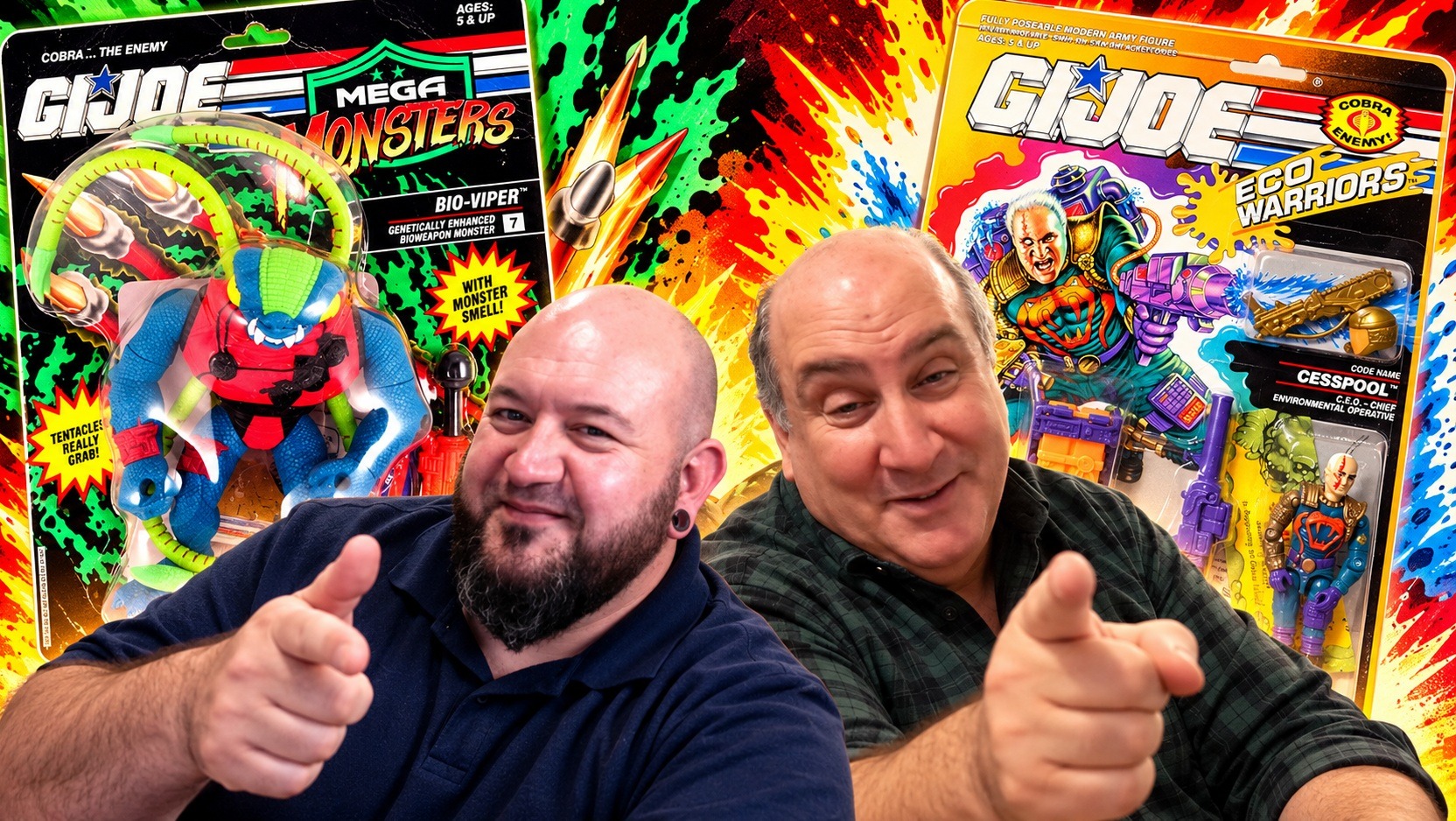
How Vinnie D’Alleva Became Cobra’s Cesspool
One of the interview’s most entertaining moments comes when the discussion turns to the Eco-Warriors lineup and its unforgettable Cobra villain, Cesspool.
D’Alleva explains that Hasbro’s designers decided to use his likeness for the character.
He also reveals that a costume was constructed for him during production of an Eco-Warriors television commercial. Dressed as Cesspool, he was positioned high above the set, only for his appearance to be removed from the finished advertisement.
The entire experience remains a humorous memory for D’Alleva, who jokes about the unique honor of being selected as one of Cobra’s villains.
His connection to the character went beyond facial resemblance. Cesspool’s original file card identified the character as Vincent A. D’Alleva.
For collectors who own the original figure, that makes Cesspool a particularly unusual piece of Hasbro history.
Watch the Cesspool discussion at 33:08
The Accidental Birth of “Pimp Daddy” Destro
Another extraordinary revelation involves the infamous colorful Destro variation collectors know as “Pimp Daddy” Destro.
According to D’Alleva, the unusual design was never intended to become an official retail product.
He recounts that the design began as a joke within Hasbro’s team. However, it was mistakenly included with production materials sent overseas, and by the time the error was discovered, figures had already been manufactured.
Rather than discard the entire production, the company made a running change.
What began as an internal joke ultimately became one of the most recognizable oddities in G.I. Joe collecting.
D’Alleva expresses amusement and some bewilderment that the design’s popularity continued to grow, eventually inspiring additional products.
The story illustrates how something never intended to reach consumers can become an enduring piece of collector culture.
Hear the Destro story at 46:14
The G.I. Joe Future That Never Arrived
The conversation also explores Hasbro’s plans for the proposed 1995 Battle Rangers assortment, including efforts to move away from numerous specialty segments and return to a more traditional military approach.
D’Alleva discusses production tooling, unused concepts, and the development compromises that occurred while the company struggled to maintain schedules and competitive pricing.
He also recalls the origins of Sgt. Savage, including the involvement of legendary comic book artist Joe Kubert, changes in figure scale, and his affection for the line’s P-40 Warhawk aircraft.
Together, these stories provide a fascinating look at an industry where creative ambition, manufacturing challenges, and corporate financial realities constantly intersected.
More Than Toys: The People Behind G.I. Joe
Despite the commercial challenges, disagreements, and sometimes exhausting production schedules, D’Alleva speaks warmly about the people he worked alongside.
He describes reuniting with former colleagues at G.I. Joe conventions after decades apart and realizing how important those professional relationships had become.
The conversation also turns toward collectors, childhood memories, and the emotional significance of preserving toys that helped define an entire generation.
For D’Alleva, the success of Hall of Fame remains a defining professional achievement. But the friendships, creative collaboration, and opportunity to build something meaningful for children continue to hold a special place in his memories.
And perhaps that is what makes this interview so valuable.
Behind every G.I. Joe figure, every unusual accessory, every unexpected paint scheme, and every childhood favorite was a team of real people trying to create something extraordinary under enormous commercial pressure.
Some ideas succeeded. Others never made it beyond the drawing board. A few became collectible legends entirely by accident.
But together, they helped shape the history of G.I. Joe.
Watch the Complete Conversation
The full interview goes considerably deeper into Hall of Fame, Ninja Force, Eco-Warriors, Sonic Fighters, Battle Corps, Star Brigade, Sgt. Savage, the unproduced Battle Rangers, and D’Alleva’s personal collection.
We encourage every G.I. Joe fan, particularly those who grew up with the 1990s assortment, to experience the entire discussion.
Special thanks to Vinnie D’Alleva for sharing his experiences and to Terry of Action Media Toys for conducting this conversation in cooperation with SerpentorsLair.com.
EDITORIAL NOTE: Business figures, internal decisions, and production anecdotes discussed in this article are attributed to D’Alleva’s firsthand recollections in the interview. Some transcript wording has been condensed or paraphrased for clarity.
Additional Background Sources
3DJoes — Vinnie D’Alleva Profile
3DJoes — Hall of Fame Duke
Action Figure Insider — Hasbro Interview with Vinnie D’Alleva