The 1986 Sears Wish Book: The Christmas Catalog That Made Every Kid Dream
SERPENTORSLAIR.COM • 1980s NOSTALGIA
THE 1986 SEARS WISH BOOK
The Christmas Catalog That Made Every Kid Dream
40 YEARS OF CHRISTMAS MAGIC • 1986–2026
By Adam Jared

There was a time when Christmas didn’t begin with an online shopping cart. It began with a thick catalog arriving in the mail.
If you grew up in the 1980s, you know exactly what we’re talking about.
Long before Amazon, online wish lists, smartphones, and social media, there was one publication that could bring an entire household to a standstill.
The Sears Christmas Wish Book.
It was enormous. It was colorful. It smelled like freshly printed paper. And somewhere within those hundreds of pages was nearly everything a kid could possibly dream of finding beneath the Christmas tree.
In 1986, that meant G.I. Joe, Transformers, M.A.S.K., Masters of the Universe, ThunderCats, Nintendo, Teddy Ruxpin, and an almost unbelievable assortment of other toys.
For millions of American children, the arrival of the Wish Book wasn’t simply another piece of mail.
It was practically a holiday in itself.
And now, forty years later, we’re opening those magical pages again.
The Day the Sears Wish Book Arrived
Picture a November afternoon in 1986.
You’ve just arrived home from school. Your backpack is lying on the floor, cartoons are playing on the television, and there’s probably a half-finished glass of Kool-Aid sitting somewhere nearby.
Then you notice something sitting on the coffee table.
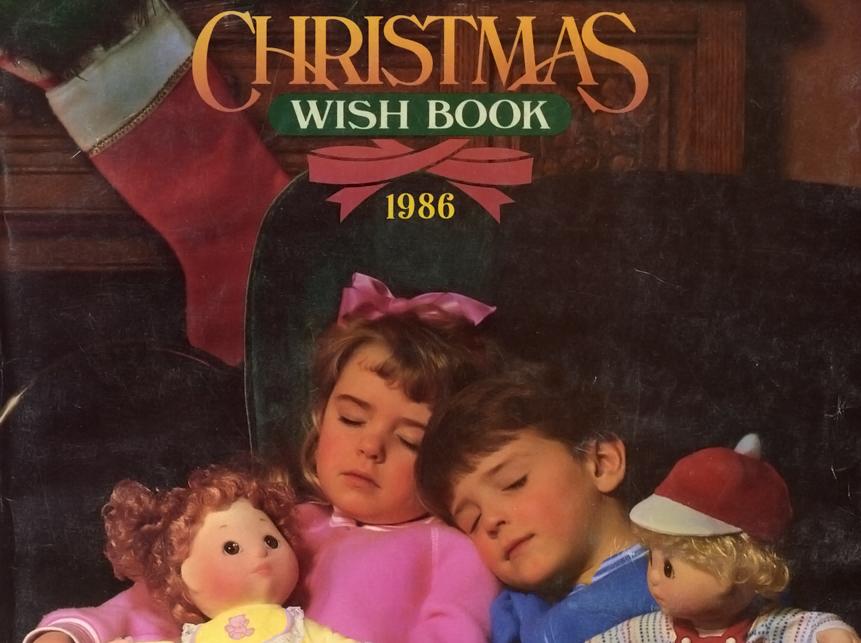
It’s thick. It’s colorful. And across the front are four wonderful words.
CHRISTMAS WISH BOOK 1986
Suddenly, everything else becomes unimportant.
You pick up that enormous catalog, settle onto the carpet, and begin flipping through the pages.
Women’s clothing? Keep going.
Kitchen appliances? Not interested.
Furniture? Maybe when we’re older.
But then, after what feels like an eternity, you reach the section you’ve been searching for.
The toys.
Page after magnificent page of action figures, enormous playsets, electronic games, stuffed animals, bicycles, robots, and vehicles.
You study every photograph as if you’re examining the blueprints for a top-secret military operation.
You check the prices, even though you aren’t the one paying for them.
You compare vehicles and action figures, trying to decide which ones deserve a spot on your Christmas list.
And if your parents allow it, you begin circling your favorites with a pen.
Some children circled a handful of items.
Others practically decorated entire pages.
For the next several weeks, that catalog would become one of the most important books in the house.
G.I. Joe: The Ultimate Christmas Battlefield
For G.I. Joe fans, 1986 was an extraordinary year.
Hasbro’s Real American Hero toy line was riding an incredible wave of popularity, and the Sears Wish Book offered one of the most spectacular displays of G.I. Joe merchandise imaginable.
Rather than simply arranging toys against a plain background, Sears presented an elaborate miniature battlefield.
In the main advertisement, the G.I. Joe Tomahawk helicopter approached a gigantic Cobra Terror Drome positioned among the mountains.
The scene looked like an actual moment from the animated series.
And underneath the battlefield were rows of vehicles, figures, and exclusive sets begging to be added to a Christmas list.
ORIGINAL 1986 G.I. JOE ADVERTISEMENT
See the Actual Sears Catalog Page
The original 1986 advertisement featuring the Cobra Terror Drome, G.I. Joe Tomahawk, and both Sears-exclusive Dreadnok vehicle sets is preserved by 3DJoes.
VIEW THE ORIGINAL 1986 G.I. JOE CATALOG SCAN
Historical catalog documentation courtesy of 3DJoes.com. Scroll to the 1986 section.
The Cobra Terror Drome: Every Kid’s Dream Headquarters
Let’s start with the big one.
The Cobra Terror Drome wasn’t simply another playset.
It was a colossal enemy fortress.
The circular headquarters featured multiple levels, opening compartments, weapons stations, removable components, and an extraordinary central launch system.
Inside was the Cobra Firebat aircraft, complete with the A.V.A.C. pilot.
Imagine owning that magnificent fortress at ten years old.
Cobra Commander could oversee his operations from the command center. Destro could supervise the construction of new weapons. The Baroness could coordinate attacks while Cobra troops prepared to repel an incoming G.I. Joe assault.
Suddenly, every other toy in your collection had an important new purpose.
There was just one problem.
Convincing your parents to buy it.
ORIGINAL 1986 SEARS ADVERTISED PRICE
$56.99
Cobra Terror Drome with Firebat and A.V.A.C. pilot.
Fifty-six dollars and ninety-nine cents was a significant Christmas purchase in 1986.
For many families, that kind of gift was something parents had to plan for.
But the child staring at that advertisement wasn’t thinking about household budgets.
He was wondering if Santa could possibly squeeze the Terror Drome down the chimney.
The Tomahawk: G.I. Joe’s Magnificent Flying Fortress
Directly above the Terror Drome in the advertisement was the G.I. Joe Tomahawk.
And what an amazing toy it was.
This massive twin-rotor helicopter wasn’t just a vehicle designed to hold a single figure.
It was a troop transport packed with features.
There were opening compartments, removable seating, missiles, rotating rotors, a functional rescue winch, and plenty of room for an entire G.I. Joe mission.
Lift-Ticket was included as the pilot.
The Tomahawk made it possible to imagine rescue operations, troop deployments, dangerous jungle insertions, and full-scale assaults on Cobra installations.
The original Sears price?
$16.99
Think about that for a moment.
One of the most memorable vehicles in G.I. Joe history, advertised for less than seventeen dollars.
Naturally, that price meant something very different to a family’s budget forty years ago.
But seeing it today is enough to make practically any collector shake his head.
The Sears-Exclusive Dreadnoks: Something Truly Special
Perhaps the most interesting part of the original advertisement was the inclusion of two special Dreadnok vehicle sets.
These weren’t ordinary releases that Sears simply pulled from the toy aisle.
They were exclusive repaints of existing G.I. Joe and Cobra vehicles, redesigned in eye-catching Dreadnok color schemes.
First came the Dreadnok Air Assault set.

This set combined specially decorated versions of the Cobra F.A.N.G. helicopter and G.I. Joe Sky Hawk.
Instead of their familiar military colors, the vehicles appeared in unusual Dreadnok-inspired shades.
The Sears catalog identified the pairing as the Dreadnok Fang and Skyhawk, and advertised it for $9.99.
Then came the Dreadnok Ground Assault set.

That set paired a modified Cobra Stinger vehicle with a repainted G.I. Joe R.A.M. motorcycle.
The original Sears price was $12.99.
Both sets had a distinctive feature that makes them especially interesting today: their colors could change when exposed to sunlight.
There was something wonderfully appealing about toy companies offering exclusive vehicles that couldn’t be found everywhere.
If you wanted those particular Dreadnok sets, you had to know where to look.
And forty years later, they remain prized pieces of G.I. Joe collecting history.
Transformers: 1986 Was a Year of Giants
While G.I. Joe fans dreamed about the Terror Drome, Transformers collectors faced an equally difficult decision.
What do you ask for when the catalog is filled with gigantic transforming robots?

The 1986 Transformers lineup was extraordinary.
The animated movie had introduced a new generation of characters, and Hasbro’s toy assortment was expanding into some spectacular territory.
There was Metroplex, the gigantic Autobot who could transform into an enormous city.
There was Trypticon, the menacing Decepticon dinosaur who could become a fortress and battle station.
And surrounding them were additional characters, combiners, and transforming vehicles.
For the kid who loved Transformers, these weren’t merely toys.
They were entire worlds waiting to be assembled on the bedroom floor.
A single catalog photograph could lead to days of imagining enormous battles between the Autobots and Decepticons.
Of course, if you were a fan of both G.I. Joe and Transformers, your Christmas wish list was already getting dangerously expensive.
Masters of the Universe: The Impossible Dream Called Eternia
If the Terror Drome was G.I. Joe’s ultimate headquarters, Eternia represented one of the greatest ambitions in the Masters of the Universe toy line.
Its enormous structure included multiple towers, a central rail system, and locations for staging adventures with He-Man, Skeletor, and their allies.
It was the kind of playset that could dominate an entire bedroom.
The 1986 Sears Wish Book advertised Eternia for $99.99.
For a child, that gigantic playset looked like the ultimate Christmas present.
For many parents, however, it probably looked like the entire Christmas budget rolled into one box.
Still, that didn’t stop children from circling it.
A hundred-dollar price tag wasn’t going to prevent a kid from dreaming.
M.A.S.K.: When Every Car Hid a Secret
One of the most visually spectacular toy advertisements in the 1986 Wish Book belonged to M.A.S.K.
The toy line combined the military adventures of G.I. Joe with the transforming vehicles that made Transformers so popular.
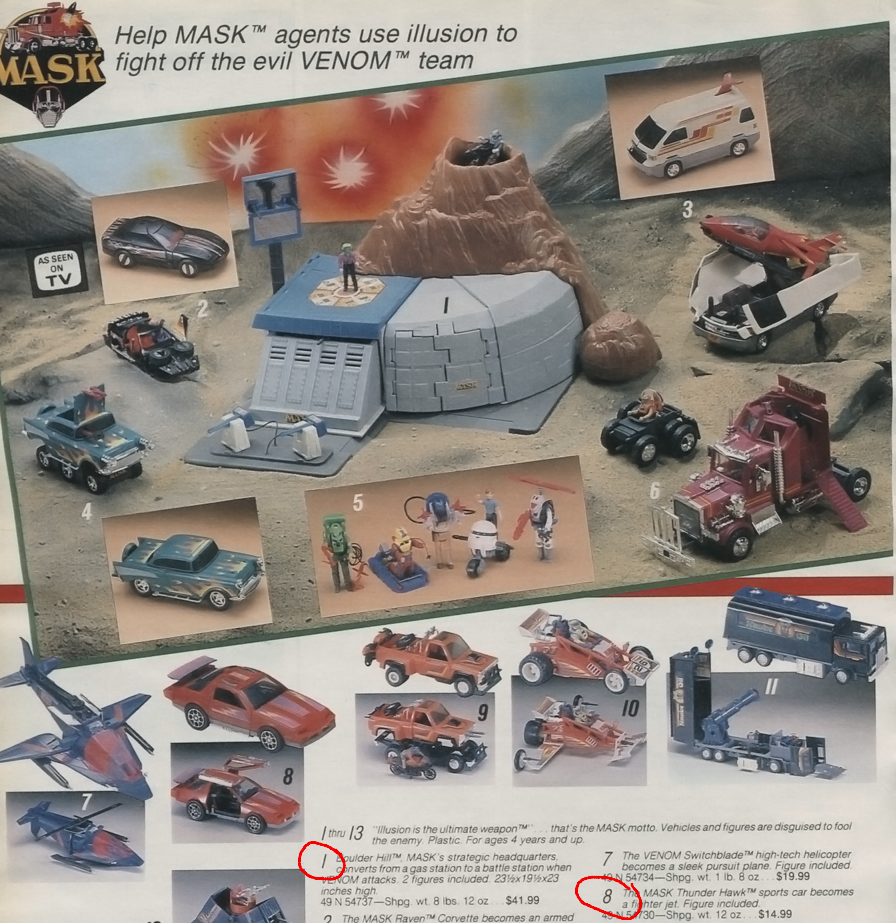
At the center of the page was Boulder Hill, the magnificent M.A.S.K. headquarters disguised as a gas station.
Around it were vehicles that could reveal secret weapons and transform into entirely different machines.
Thunder Hawk looked like a sleek sports car until its gull-wing doors transformed it into a flying attack vehicle.
Switchblade could convert between helicopter and jet configurations.
Rhino, the enormous semi-truck, was practically a playset in its own right.
The M.A.S.K. vehicles were a perfect example of what made 1980s toys so special.
They encouraged children to invent their own stories long after the television episode ended.
And the Sears catalog presented them together in a way that made owning the entire collection seem like the greatest idea in the world.
Nintendo: A New Kind of Christmas Magic
While action figures dominated much of the toy section, another technological revolution was taking place.
The Nintendo Entertainment System was establishing itself in American homes.

The catalog prominently featured the familiar gray console, its controllers, the Zapper Light Gun, and the peculiar Robotic Operating Buddy known as R.O.B.
Imagine being a child in 1986 and seeing this technology for the first time.
Instead of spending quarters at the local arcade, you could play video games on the television in your own living room.
The idea was extraordinary.
Duck Hunt, Gyromite, and other early Nintendo titles suddenly seemed like the future of entertainment.
For many families, Christmas 1986 marked the beginning of a new holiday tradition: gathering around the television to play video games together.
And although plenty of kids still wanted their action figures and vehicles, the Nintendo Entertainment System was beginning to change what Christmas morning could look like.
Teddy Ruxpin, My Pet Monster, and Everything in Between
One of the wonderful things about the Sears Wish Book was its variety.
Not every child wanted a Cobra fortress or a transforming robot.
For some, the most exciting Christmas gift was a talking bear.

Teddy Ruxpin seemed almost magical.
Insert a cassette tape, and the bear could move his mouth and eyes while telling stories and singing songs.
Today, talking toys are commonplace.
But in 1986, Teddy Ruxpin was an astonishing demonstration of how electronics could bring a stuffed animal to life.
And then there was his much stranger contemporary.
My Pet Monster: The Lovable Beast of Christmas 1986

With his enormous teeth, brightly colored fur, and breakaway orange handcuffs, My Pet Monster was one of the most wonderfully bizarre stuffed toys of the decade.
The original Sears advertisement listed him for $31.99.
He wasn’t traditionally cute.
That was precisely what made him appealing.
For kids who loved monsters, Saturday morning cartoons, and slightly strange toys, My Pet Monster seemed like the perfect companion.
And the contrast between Teddy Ruxpin and My Pet Monster illustrates why the Wish Book was so memorable.
There really was something for everybody.
The Toys We Never Got
Here’s something that becomes clearer as we get older.
Some of our strongest childhood Christmas memories aren’t about the toys we received.
They’re about the toys we desperately wanted but never found beneath the tree.
Maybe you circled the Terror Drome every time you opened the catalog.
Maybe you dreamed about the gigantic U.S.S. Flagg aircraft carrier.
Maybe it was Metroplex, Eternia, Boulder Hill, or the Nintendo Entertainment System.
And then Christmas morning arrived.
You tore through the wrapping paper, searched behind the tree, and opened every box.
But that one enormous toy wasn’t there.
At ten years old, it could be a disappointment.
At fifty years old, the memory feels different.
Because now we understand something that most children didn’t fully appreciate in 1986.
Those toys cost real money.
A family had groceries to buy, utility bills to pay, car repairs to manage, and sometimes several children hoping for something special.
The fact that our parents and grandparents managed to put presents beneath the tree at all was sometimes a much greater accomplishment than we understood.
Maybe you didn’t get the Terror Drome.
But you got a Cobra Viper.
Maybe the giant Transformer was out of reach.
But you received a smaller Autobot that became one of your favorite toys.
And maybe those modest gifts turned out to be the things you remember most fondly.
Because somewhere along the way, we discovered that Christmas wasn’t really about how much the toys cost.
It was about the people who made the morning special.
When Waiting Was Half the Fun
There is something we lost when Christmas shopping moved almost entirely into the digital world.
Anticipation.
In 1986, children didn’t usually have the opportunity to watch dozens of high-definition unboxing videos before a toy even reached the stores.
There were no online galleries showing every accessory from twenty different angles.
Sometimes, the catalog photograph was the first time you ever saw a particular toy.
And that made every image feel important.
You studied the pictures.
You wondered how the play features worked.
You tried to determine whether the toy was actually as big as it looked.
Then you waited.
Thanksgiving came and went.
Christmas decorations appeared in the department stores.
Holiday commercials began filling television screens.
And that Sears catalog remained on the coffee table, beside the couch, or under your bed.
Its pages became worn.
Its corners folded.
Its toy section became practically memorized.
But no matter how many times you opened it, the magic never completely disappeared.
Because every time you studied those pages, you were imagining Christmas morning.
Forty Years Later, the Magic Is Still There
It’s November 2026.
Forty years have passed since the 1986 Sears Christmas Wish Book made its way into homes across America.
The children who once sat cross-legged on the carpet studying its pages are now adults.
Many have families of their own.
Some have become collectors, rebuilding the G.I. Joe, Transformers, Masters of the Universe, and other collections they loved as children.
Others still own a few treasured toys, perhaps tucked away in an attic or proudly displayed on a shelf.
Some have nothing left from those Christmas mornings except their memories.
But show them the right photograph from that old Sears catalog, and something remarkable happens.
They remember.
The toys.
The cartoons.
The commercials.
The excitement of running into the living room on Christmas morning.
The familiar sound of wrapping paper tearing.
The smell of the Christmas tree.
And, perhaps most importantly, the faces of the people who made those holidays special.
The Sears Wish Book didn’t just show us the toys we wanted. It gave us an entire Christmas season to dream about them.
Maybe that’s why these old catalogs mean so much today.
Because when we open the 1986 Sears Wish Book, we’re not simply looking at vintage merchandise.
For a few wonderful moments, we’re children again.
We’re sitting on the living room floor.
There’s a pen in our hand.
Christmas is still weeks away.
And anything seems possible.
Those really were magical times.
NOW IT’S YOUR TURN!
It’s Christmas 1986. You’re a kid again.
The Sears Wish Book is open in front of you, and you can circle ONE toy.
WHAT WAS THE ONE TOY YOU DESPERATELY WANTED FOR CHRISTMAS 1986?
Was it the Terror Drome? The Tomahawk? Metroplex? Boulder Hill? Nintendo? Eternia? Or something else entirely?
Tell us in the comments. And if you still own that childhood toy, we want to hear the story!
SHARE THIS STORY WITH SOMEONE WHO GREW UP IN THE 1980s!
Vintage Catalog Archives and Historical References
Readers interested in exploring these historical advertisements can visit the archives below.
- 3DJoes — Original Sears G.I. Joe Wish Book Advertisements
- Rediscover the ’80s — 1986 Sears Wish Book
- Dinosaur Dracula — Highlights from the 1986 Sears Wish Book
- 80s Baby — Sears Christmas Wish Book 1986
- Historical Christmas Catalog and Wish Book Archive
Historical catalog scans and collector reference images are credited to their respective archives and publishers. All vintage trademarks and character properties belong to their respective owners.
ABOUT THE AUTHOR
Adam Jared is the founder of SerpentorsLair.com, an entertainment and pop-culture website dedicated to G.I. Joe, vintage toys, classic television, movies, animation, and the nostalgia of the 1980s and beyond. He is also the creative force behind Destro Designs – Viper Den Studios. Adam holds a Master of Science in Social Media Management and is currently pursuing a Ph.D. in Strategic Communication. Through original articles, collector features, interviews, and community projects, Adam works to preserve the stories, memories, and cultural legacy of the entertainment and collectibles that shaped a generation.