The Toy Whistle That Let Anyone Hack AT&T
SERPENTORSLAIR.COM
The Retro Tech Files
VINTAGE TECHNOLOGY • THE ORIGINAL HACKERS
THE TOY WHISTLE
THAT LET ANYONE
HACK AT&T
A cereal-box prize, a mysterious telephone tone, and the underground pioneers who changed hacking history.
STORY BY @GIJOEREPAIRSHOP
SerpentorsLair Contributor

01 / BEFORE THE INTERNET
WHEN THE TELEPHONE NETWORK HAD A SECRET
Last week, this author wrote about hacking satellite television systems in the 1980s. Going back to the 1960’s, “phone phreaks” were already trying to hack their way into the AT&T telephone network. At the time, it was the only large-scale telephone network in the United States. In 1960s and 1970s, control commands traveled right through the human range of hearing. A 2,600 Hz tone told the switching equipment that a call had ended and the trunk line was free.

2,600 Hz
THE FREQUENCY THAT BECAME A LEGEND
02 / THE CEREAL-BOX DISCOVERY
THE CAP’N CRUNCH CONNECTION
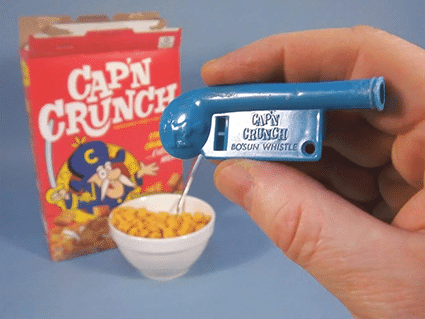
Also starting in the 1960’s were various brands of children’s cereal, each giving away a particular low-cost toy or stickers with each box. From 1963 to 1969, Cap’n Crunch cereal gave away the Cap’n Crush Bo’sun whistle with every box. In 1969, a blind phone phreaker named Joe Engressia (a.k.a., Joybubbles) and pirate radio operator Denny Teresi realized that by covering one hole on the toy and blowing the whistle into a telephone receiver, it tricked the system into dropping the billing connection while keeping the line open, therefore allowing access to operator/switching modes for free long-distance calling!

03 / THE BLUE BOX REVOLUTION
CAPTAIN CRUNCH, STEVE JOBS & THE UNDERGROUND
Teresi introduced this trick to John Draper (a.k.a. Captain Crunch), who began building and selling tone generators nicknamed “Blue Boxes” that would allow anyone with the press of a button to generate a precise 2.6KHz tone and obtain free calling. Draper earned that nickname after a 1971 article in Esquire magazine profiled him and the entire phone phreaking scene, titled “Secrets of the Little Blue Box.” Draper was also a friend of Apple co-founder Steve Wozniack. It’s said that the first product produced by Steve Jobs and Steve Wozniack was not the Apple I. Rather, for a short time, the pair built and sold Blue Boxes while working for Atari and Hewlett-Packard.

04 / THE PRICE OF PHREAKING
WHEN THE TELEPHONE COMPANY FOUGHT BACK
For his part, Draper spent most of the 1970’s in and out of jail, as his obsession with the phone network led him to become a repeat offender. In 1972, he was convicted in federal court of wire fraud for using a Blue Box to make unauthorized long-distance calls. He received five years probation and a $1,000 fine. In 1976, he was arrested again and sentenced to four months in a federal prison and five years probation after violating his 1972 probation. In 1977, he was again arrested, this time in Pennsylvania and New Jersey, for using illegal telecommunications devices. He served thirty days in Pennsylvania and had to serve an additional one year in California in a work furlough program in 1979. However, he remains a legend in the hacking community and continues to work today as a security consultant.
05 / THE END OF AN ERA
WHY A TOY WHISTLE CAN’T HACK YOUR PHONE TODAY
Eventually, AT&T phased out the vulnerable in-band signaling in favor of digital and out-of-band signaling systems that are in use today. Modern telephone networks use Signaling System No. 7 (SS7) or digital equivalents. Voice travels on one channel, while routing, billing, and hang-up commands travel on a completely separate data channel. Additionally, analog electromechanical switches that listened for specific audio frequencies were phased out decades ago in favor of fully digital switches and, more recently, Voice-over-Internet-Protocol (VoIP) networks. Finally, modern voice codecs (like those used in cell phones and VoIP) compress audio specifically for human speech. They often distort or strip out pure, sustained single-frequency tones before they even reach the core network. So, the era of Captain Crunch is officially over.
THE ORIGINAL PHONE PHREAKS
From a childhood cereal prize to the beginnings of modern hacker culture — an unforgettable chapter in technological history.
STORY BY @GIJOEREPAIRSHOP
SerpentorsLair Contributor
Read the Original Contributor Forum Post
Where nostalgia lives forever.