NINJA TURTLE NOVEMBER — #14 LEATHERHEAD: THE BEAST WITH A CONSCIENCE
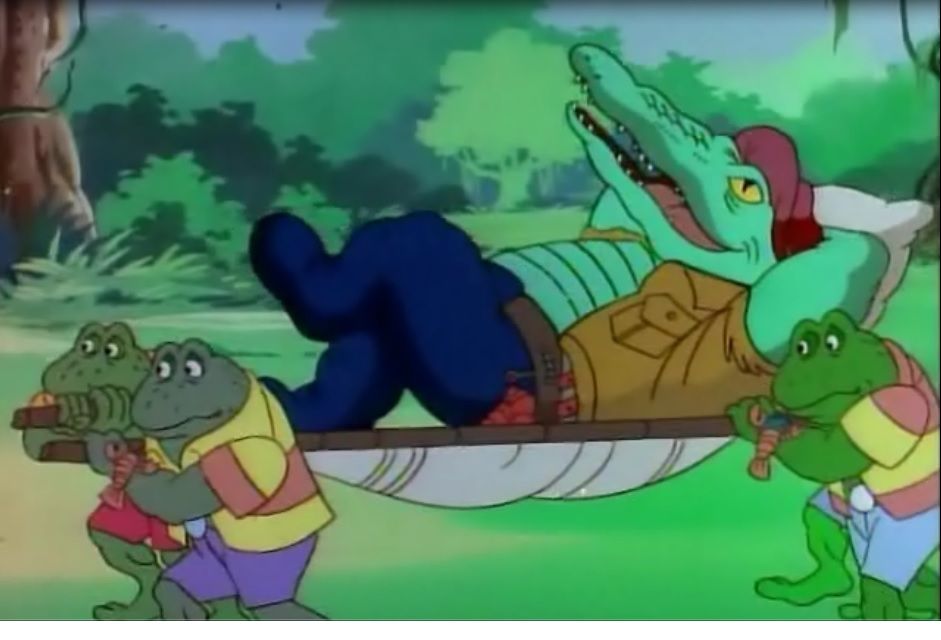
Deep in the Louisiana bayou, where cypress trees lean over black water and the air hums with the sound of life and decay, a legend stirs. He isn’t a myth or a monster—he’s Leatherhead, a creature caught between man and beast, intellect and instinct, friend and foe. To the outside world, he’s just a hulking mutant alligator, a walking nightmare with scales thick enough to shrug off bullets. But to the Turtles, he’s something much more complicated—a mirror of what they might have become had compassion not found them first.
Leatherhead’s story begins far from New York City. Once, he was an ordinary alligator, living among the reeds and shadows of the swamp. Some tales say he was a scientist named Jess Harley, caught in his own experiment. Others insist he was simply a gator who wandered too close to mutagen runoff and emerged walking upright, confused and furious. Whatever the origin, the result was the same: a creature too human for the swamp, too savage for the city. He sought refuge underground, where the lonely and the lost tend to gather—and there, the Turtles found him. At first, they fought. They always fight. But beneath Leatherhead’s roar was a wounded soul, one that didn’t want to conquer—just to be left alone.
Leatherhead is a contradiction. He’s an apex predator who reads books, a philosopher with claws, a genius trapped inside a monster’s body. In some versions, he’s one of Donatello’s greatest intellectual equals, a brilliant mind trying to maintain sanity in a body that won’t let him rest. In others, he’s more primal, a raging force manipulated by the likes of Shredder, Krang, or the Rat King—always the weapon, never the master. But even at his angriest, there’s tragedy beneath his rage. He doesn’t destroy for pleasure; he lashes out because he remembers what it felt like to be human—and he knows he can’t go back. It’s not hate that drives him. It’s heartbreak.
The beauty of Leatherhead lies in his unpredictability. He can be a loyal ally one day, smashing Foot Soldiers with a grin, and a snarling adversary the next, lost in his own animal fury. You never know which version you’re getting—and neither does he. The Turtles understand this better than anyone. They know that Leatherhead’s worst enemy isn’t them—it’s himself. When he’s in control, he’s articulate, compassionate, and fiercely protective of the innocent. But when his temper snaps, the human mind disappears, and the monster takes over. That tension—that constant war between reason and rage—makes him one of TMNT’s most layered characters. Leatherhead doesn’t choose good or evil. He chooses survival. And sometimes, that’s all any mutant can do.

When the Leatherhead action figure hit stores in 1989, he looked every bit the southern swamp beast he was meant to be—a crocodilian powerhouse with a red vest, a shotgun bandolier, and a snarl frozen mid-growl. His sculpt was magnificent: jagged teeth, scaled arms, and a tail that looked capable of clearing a whole shelf. He wasn’t elegant or sleek. He was raw power, molded into plastic. For many kids, Leatherhead became the figure that completed their sewer battles—the unstoppable wild card that could smash through both sides of a fight. His Cajun accent and unpredictable nature made him stand out even among the neon chaos of the TMNT line. He was the wild—untamed, unpolished, and unforgettable.
One of the most haunting things about Leatherhead is how intelligent he can be. In the Mirage and Archie comics, he isn’t just muscle; he’s a thinker—building machines, quoting philosophy, trying to find order in a life that’s been reduced to instinct. He hates being seen as a brute, yet he knows that’s all most will ever see. He craves peace, yet violence follows him wherever he goes. It’s a tragic paradox—to be too human for the beasts and too beastly for the humans. Leatherhead doesn’t fit anywhere, and maybe that’s why he resonates so deeply. He’s a monster trying to remember who he was.
Leatherhead earns his spot not through villainy or heroism, but through complexity. He’s the TMNT universe distilled into one tortured body: the collision of science, mutation, and soul. His every appearance feels unpredictable, emotional, and dangerous. He’s as capable of saving the Turtles as he is of tearing them apart—and that makes him real. He’s not the loudest or the funniest, but he’s unforgettable—a creature that feels ancient and alive in every medium he inhabits. Leatherhead is a reminder that mutation doesn’t just change the body—it changes the spirit. And sometimes, what’s left behind is something wild, brilliant, and tragically beautiful.
In the end, Leatherhead walks his own path—half philosopher, half predator, forever torn between two worlds. He’ll help you one day and hunt you the next. And when he vanishes back into the shadows of the sewer or the murky waters of the swamp, you can’t help but wonder which version you’ll meet if he ever returns. He’s not evil. He’s not good. He’s Leatherhead—the beast who remembers what it means to be human.