October Monster Mash: “Even a Man Who Is Pure in Heart…” – The Wolf Man (1941)
The Beast Within
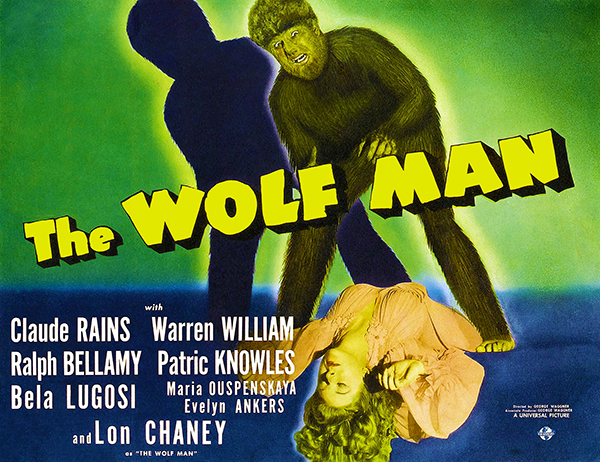
If Dracula gave horror its aristocrat and Frankenstein its tragic creator, The Wolf Man gave it its soul. Released in 1941 and directed by George Waggner, The Wolf Man stands as one of Universal’s most enduring monster tales — a film that turned the werewolf myth into a cinematic archetype.
It’s not just about silver bullets and full moons; it’s about guilt, destiny, and the curse of being human.
The Story: The Curse of Larry Talbot
The film begins with Larry Talbot (Lon Chaney Jr.) returning to his ancestral home in Wales after years abroad. He’s a kind, awkward man trying to reconnect with his father, Sir John Talbot (played with stoic grace by Claude Rains).
But Larry’s peaceful homecoming turns into a nightmare when he’s bitten by a wolf while trying to save a young woman from an attack. The villagers later reveal that the animal was actually a man — Bela, a gypsy (played by Bela Lugosi), cursed to become a wolf under the full moon.
Soon, Larry begins to feel the curse himself. When the moonlight shines through his window, his body contorts, hair sprouts, and claws replace his hands — in one of cinema’s most famous transformation sequences.
The kind-hearted Larry becomes the Wolf Man, doomed to roam the moors and kill against his will. His struggle is not just against the monster, but against the inevitability of fate.
“Even a man who is pure in heart, and says his prayers by night,
May become a wolf when the wolfsbane blooms, and the autumn moon is bright.”
Lon Chaney Jr.: The Tragic Monster
Lon Chaney Jr. brought a heartbreaking humanity to Larry Talbot. Unlike the monsters of earlier Universal films, the Wolf Man isn’t evil — he’s a victim. Every kill tears at his conscience, every transformation deepens his torment.
Chaney’s performance radiates vulnerability — his wide eyes and trembling voice making him the most sympathetic of all Universal’s creatures.
It’s no coincidence that audiences pitied the Wolf Man as much as they feared him. In many ways, he was the first horror character truly defined by inner conflict — a man crushed by his own duality.
Makeup and Transformation Magic
The Wolf Man’s legendary look was crafted by Universal’s makeup wizard Jack Pierce, who had already created Frankenstein’s monster and the Mummy. Pierce’s process was painstaking — applying yak hair and spirit gum layer by layer, then photographing Chaney frame by frame to create the illusion of transformation.
The result was revolutionary for its time. Watching Larry’s face slowly sprout fur and morph under moonlight remains one of the defining moments in horror history.
The image of the Wolf Man — fanged, furry, and tragic — became instantly iconic, influencing every werewolf design that followed, from An American Werewolf in London to The Howling.
Gothic Mood and Myth
The Wolf Man is drenched in atmosphere. Cinematographer Joseph Valentine bathes the Welsh moors in fog and shadow, turning them into a dreamlike purgatory. The sets — winding forest paths, misty graveyards, and torch-lit villages — evoke a timeless gothic world, where superstition and science collide.
The script, written by Curt Siodmak, cleverly blends folklore with psychology. The werewolf curse is both literal and metaphorical — a symbol of repressed desire, guilt, and the beast inside every man.
Larry Talbot’s tragedy is universal: no matter how hard he tries to do good, he’s fated to destroy what he loves.
Legacy of the Lycanthrope
The Wolf Man became one of Universal’s most beloved horror films, spawning multiple sequels — Frankenstein Meets the Wolf Man (1943) among them — and solidifying the character as part of the Monster canon.
Lon Chaney Jr. would reprise his role in five films, making Larry Talbot the only Universal Monster portrayed by the same actor across every appearance.
More than eight decades later, the Wolf Man remains a cornerstone of horror. Every modern werewolf movie — from The Wolfman (2010) to Underworld — howls in his shadow.
Conclusion
As part of our October Monster Mash, The Wolf Man stands as the most human of all monster stories. It’s not about power or revenge — it’s about pain, fate, and the monstrous side of every heart.
Larry Talbot’s curse isn’t just to turn into a beast — it’s to remember what he’s done when he wakes.
“There’s a curse upon me. I can’t escape it.”
And that’s why The Wolf Man still endures — not as a monster of the night, but as a mirror of the soul.