
Privateer: Another View on the Wing Commander Universe
Story by @Kingmakeress
“Who are you to fly so good? Are you insane?”. Although the designers of Privateer in Origin Systems had a very sane idea, namely utilizing the Wing Commander I engine to show a different side of the vast game universe, the world created in September 1993 was certainly insanely spectacular and not only for that time: Privateer blends space combat and galactic trade with an exciting plot culminating in an epic space battle.
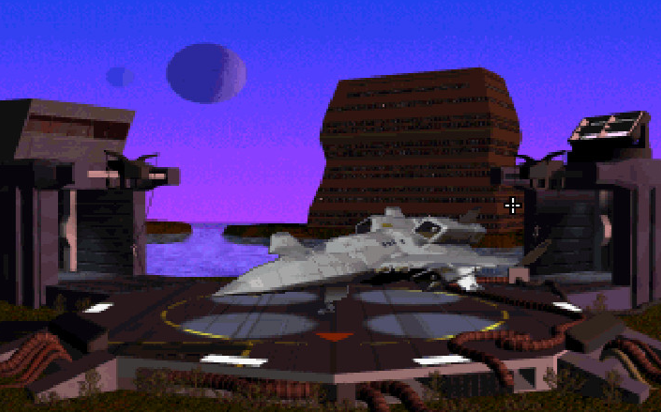
The Privateer universe is open for exploring. (Image: WC CIC)
Historically, in the pirate era privateers were officially employed by the nations with steaks in the Caribbean to conduct raids on ships and cities. This official status was certified by the letter of marque, which was grating its holder and their crew certain rights in case of being captured by an opposing nation. This was an important aspect of pirate life which actually found its way to another legendary game, Sid Meier’s Pirates! Along this line of reasoning, the premise of Privateer is deceptively simple: With the ongoing Terran-Kilrathi war still raging on with unabated intensity in the background, a streetwise (spacewise?) and resourceful privateer is looking out for any sort of financial opportunities while working for various Gemini factions. Canonically this lonely wolf is named Grayson Burrows, but he is unofficially and more widely known as Brownhair, similarly to Wing Commander’s Bluehair. Brownhair is roaming the tens of systems spanning the Gemini sector in 2669 trying to make a fortune, a significant deviation from the military objectives of the main Wing Commander games. That is not to say, though, that the game is devoid of action, quite on the contrary –more on that later.
Wealth can be accumulated by collecting bounties placed on members of the Gemini factions, carrying commodities between bases, or accepting special missions from fixers sitting at the bar of certain bases. Thus, you want to explore every single star base you come across, as they are the mainstays of the space economy. The latter is not an easy task since there are over sixty bases of various types including agricultural and mining ones as well as special bases including the system government seat, the sector Confed headquarters, a Ivy League-like space university, and a massive commercial and industrial hub which is a great place to conduct business.
In its core the game is a space trade and combat simulator. Unlike the mainline Wing Commander titles, which focus on military campaigns, Privateer emphasizes open-ended, sandbox-style gameplay, allowing players to choose their path as a merchant, pirate, mercenary, smuggler, or bounty hunter. All these career paths are perfectly valid in the Privateer universe, which in fact encourages different play styles. To this end, there are four available spaceships in total, each with its own unique strengths and weaknesses, as shown below.
Tarsus: A scout ship with limited capabilities. Its speed is low, but its mobility is fair so Tarsus can avoid some incoming fire. Additionally, the armament options are satisfying for a ship of its class. On the down side, the shields are weak, the armor thin, and a few shots at the aft can severely damage or even destroy critical systems quickly. Still, players can and actually have won the game flying Tarsus, which is considered a major feat and an attestment to incredible flying skills.
Galaxy: The ship every merchant really, truly wants. Its ample cargo bays can make the player rich quickly over the right trade routes, but its lack of mobility and its large size make Galaxy a prime target for pirates, who can be a real hassle in swarms. Thus, a novice pilot in a Galaxy should better choose established trade lanes at the core of the Confederation space where lucrative opportunities are not rare, while the chance of encountering pirate ships is low due to the increased number of Confed and militia patrols.
Orion: A rough ship with thick armor and powerful engines which can support high end shields. In fact, the most powerful engine and shiled generator levels are unique to Orion, which is quite frequently taken advantage of. Thus, the sight of an Orion carrying very heavy guns is a common sight in Gemini. The ship is ideal for mercenaries and scouts who are really likely to run into some heavy opposition. However, carrying lots of cargo is clearly not within the design specifications for Orion.
Centurion: This fast fighter with its impressive armament array is ideal for demanding missions like running past blockade forces, safe delivery of low volume but critical cargo, and taking out waves of enemy fighters, especially light ones. Still, I give you the same defensive tip as with Tarsus: Watch your six. Really. Also, be very careful with slower targets, as you may end up ramming them accidentally. A Centurion normally can withstand a collision with a Talon, but what about an Orion or even a Kamekh?
The player begins with Tarsus, the modest scout ship which can be fairly upgraded, and must earn credits through missions or trade to upgrade their vessel with better weapons, radars, shields, and engines. Although the vast array of choices may initially sound confusing, the hard constraints imposed by each fighter, mostly in terms of available hard points and gun racks as well as energy requirements. The latter is often overlooked, but it is especially important as no one wants a depleted gun capacitor at the midst of a wave of enemy fighters. Therefore, a player should choose a fighter according to their flying style and their strategy to win the game. This requires a combination of thinking and experience, which guarantees lots of fun!
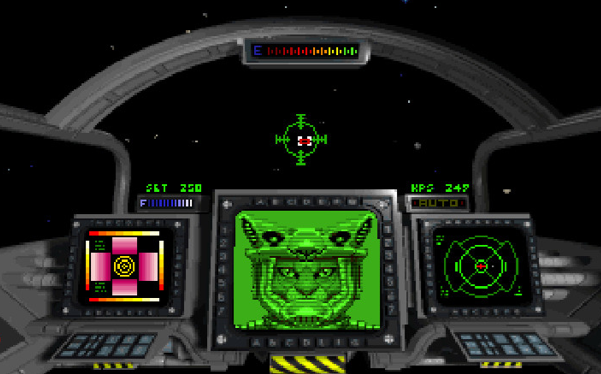
Kilrathis and Centurions do not mix! (Image: WC CIC)
The Privateer ship dealers offer an impressive array of guns and missiles which should be installed and used strategically, especially as missiles in a true Wing Commander fashion are eventually used up. Therefore, pilots often find themselves relying solely on their ship’s guns. As guns have their own characteristics, they should be carefully selected depending on the player’s flight style, the number of guns a given ship can support, and of course on the budget. Among the parameters involved in gun selection are energy consumption, projectile speed and damage, effective range, and abuse strength. The latter determines how well a gun can continue to function at certain acceptable damage levels. As a general rule, the more complex a gun is the lower its abuse strength is. Good aim, assisted by high end radars, can help the player destroy enemies quickly, increasing the chances of survival especially when dogfighting multiple enemies. Because of the stability in Gemini trade routes, every weapon and missile is available even in the most remote bases at the edge of the Gemini sector. This standardized range can be quite useful to pilots frequently operating away from the Gemini core. Finally, as with any ship component, aim for maximizing value for money and keep in mind that in space what you pay is not always what you may get.
As stated earlier, space economy is an integral part of the game as it essentially determines among others how much money the player can make and how fast. In turn, this opens up more possibilities such as more powerful ships as well as more specialized components. Since purchasing the right ship and customizing it often can be quite expensive, any pilot should plan ahead their budget. Taking and completing missions is one of the two main ways to earn credits, trading goods being the other. Gemini abounds with established and latent trade routes, both waiting to be exploited. As the laws of supply and demand apply in the game, the more you trade along a single route, the less the margin of profit is. Therefore, the player sooner or later is led to seek more routes, effectively exploring the vast game universe. Therein bases serve as hubs for cargo to and from remote planets, providing safe marketplaces where payment is immediate.
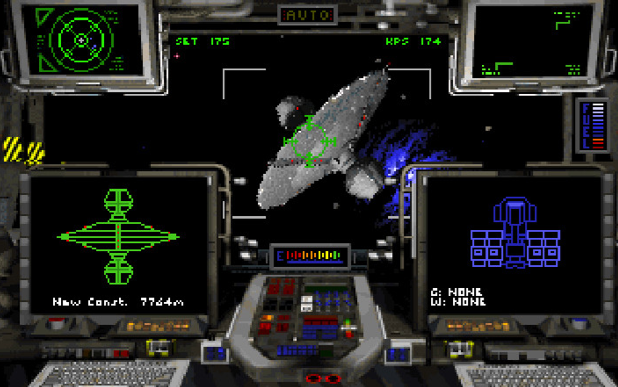
New Constantinople is the seat of the Gemini sector government. (Image: WC CIC)
In the game, typically the longer the number of jumps, the higher the reward. However, the probability of encountering ships flown by one of the several Gemini factions. These include the pirates, the mercenaries, the merchants, the retros, and even the Kilrathi. Retros are unique in Privateer and they are a group of religious fanatics aiming to destroy virtually all technology and to establish an agrarian society. Of course, as the player flies in Confed space, there will be plenty of Confed and militia fighters, especially around the major plants. The interaction with these factions is dynamic and it depends on the actions of the player during the game. Literally everyone can become your friend or your enemy, with the sole exception of retros, who are always your foes.
To summarize, Privateer is a very fun game with a smooth learning curve and many innovative immersion elements. The latter include a gradual and realistic degradation of the ship’s components as it takes damage, color coded damage display in the ship’s systems, and a fantastic music by Nenad Vugrinec. Moreover, there are many hidden Easter eggs and references: Base and system names like Kronecker, Pyrenees, and Rilke come out of science, art, and real world places. Moreover, weapon names like the proton torpedo should sound somehow familiar. Recently, an early alpha build has resurfaced as announced by the Wing Commander CIC. It is very different from the final release and shows the work put in the final release of the game, which is an iconic landmark of the 1990s DOS gaming as documented by recent articles.
Hint: There is no secret Confed munitions dump, but something much bigger …



Great article! Gemini here I come!