After-Dark Detective Work: Moonlighting Made Flirting a Full-Time Job
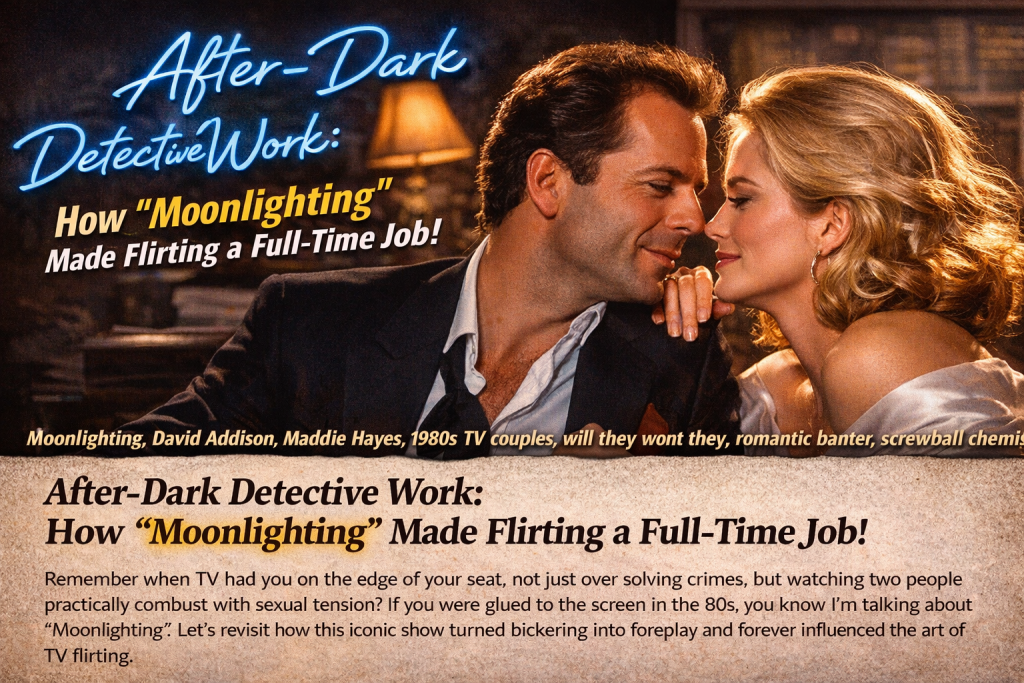
Some shows give you a mystery. Some shows give you a romance. And then there are the rare, dangerous ones that give you both—then lean in close, smirk, and dare you to pretend you’re not watching for the chemistry.
That’s Moonlighting in a nutshell: a slick little cocktail of detective hijinks and slow-burn desire, shaken with snappy dialogue and served with a look across a room that could practically fog your TV screen. You didn’t just watch David and Maddie—you felt like you were eavesdropping on two people who were one sarcastic comment away from either kissing or committing a minor felony.
The setup is pure 80s wish-fulfillment with a bite: Maddie Hayes is the former model whose life gets flipped when she discovers she’s been cleaned out financially. One of the leftover “assets” is a detective agency she didn’t even know she owned. Enter David Addison, the fast-talking, rule-bending, charming disaster who’s been running the place like a con man with a conscience.
Their “how they became a couple” isn’t a simple meet-cute. It’s a slow, stubborn collision. Maddie wants order, dignity, and control. David is allergic to all three. He needles her. She shuts him down. He pushes again. She pushes back harder. And somewhere in the middle of all that—between case files, late nights, and that constant I’m annoyed by you / I’m fascinated by you energy—they build trust.
Not the soft-focus, violins-in-the-background kind. The 80s kind: forged in chaos, sharpened by sarcasm, and fueled by the fact that neither one can stop watching the other walk out of a room.
Let’s be honest: the “will they/won’t they” trope didn’t start in the 80s, but Moonlighting helped turn it into a national pastime. The show wasn’t shy about weaponizing tension. It understood that desire isn’t always about grand declarations—it’s about timing, proximity, ego, and the delicious frustration of two people trying to stay professional while failing spectacularly.
And the dialogue? It wasn’t just flirting. It was sport. The banter crackled like a live wire. It felt adult without being syrupy. Sexy without being crude. Even when they were arguing, you could tell the argument was just a disguise for the real conversation happening underneath: “I’m into you, and that’s inconvenient.”
Part of why it still hits is the show’s playful awareness of itself. Moonlighting loved to wink at the audience, bend the rules, and treat romance like something clever people could be in on—not something they had to be embarrassed by. It made the flirting feel nimble, like a private joke shared between the characters and the viewers.
That matters, because the 80s could be wildly cheesy when it wanted to be. But this show made attraction feel like a chess match. Every look and comeback was a move. Every near-miss felt intentional. It wasn’t sappy—it was sharp.
The legacy is everywhere. If you’ve ever watched a modern show where the leads spend seasons circling each other with snarky chemistry, congratulations: you’ve seen the blueprint. Maddie Hayes and David Addison made romantic tension feel like the main event, not a side dish.