Bob Ross: The Man Who Taught a Generation of Gen X Kids That Everything Would Be Okay
There was a time when television didn’t have to be loud to capture our attention. Sometimes, all it took was a man with a paintbrush, a gentle voice, and a few happy little trees.
For those of us who grew up during the 1970s, 1980s, and early 1990s, childhood television was an extraordinary place. We had G.I. Joe battling Cobra, Optimus Prime fighting Megatron, Saturday morning cartoons, cereal commercials, and the unmistakable sound of our favorite television theme songs.
But somewhere between the explosions, superheroes, and animated adventures, there was another television personality who became part of our childhoods.
His name was Bob Ross.
And somehow, without special effects, action figures, or a cartoon series of his own, he captured something just as important as our imaginations.
He made us feel that everything was going to be okay.

When the World Slowed Down for Thirty Minutes
If you grew up watching PBS during the 1980s, chances are you remember stumbling across The Joy of Painting.
There was no dramatic introduction. No screaming audience. No flashing graphics demanding your attention.
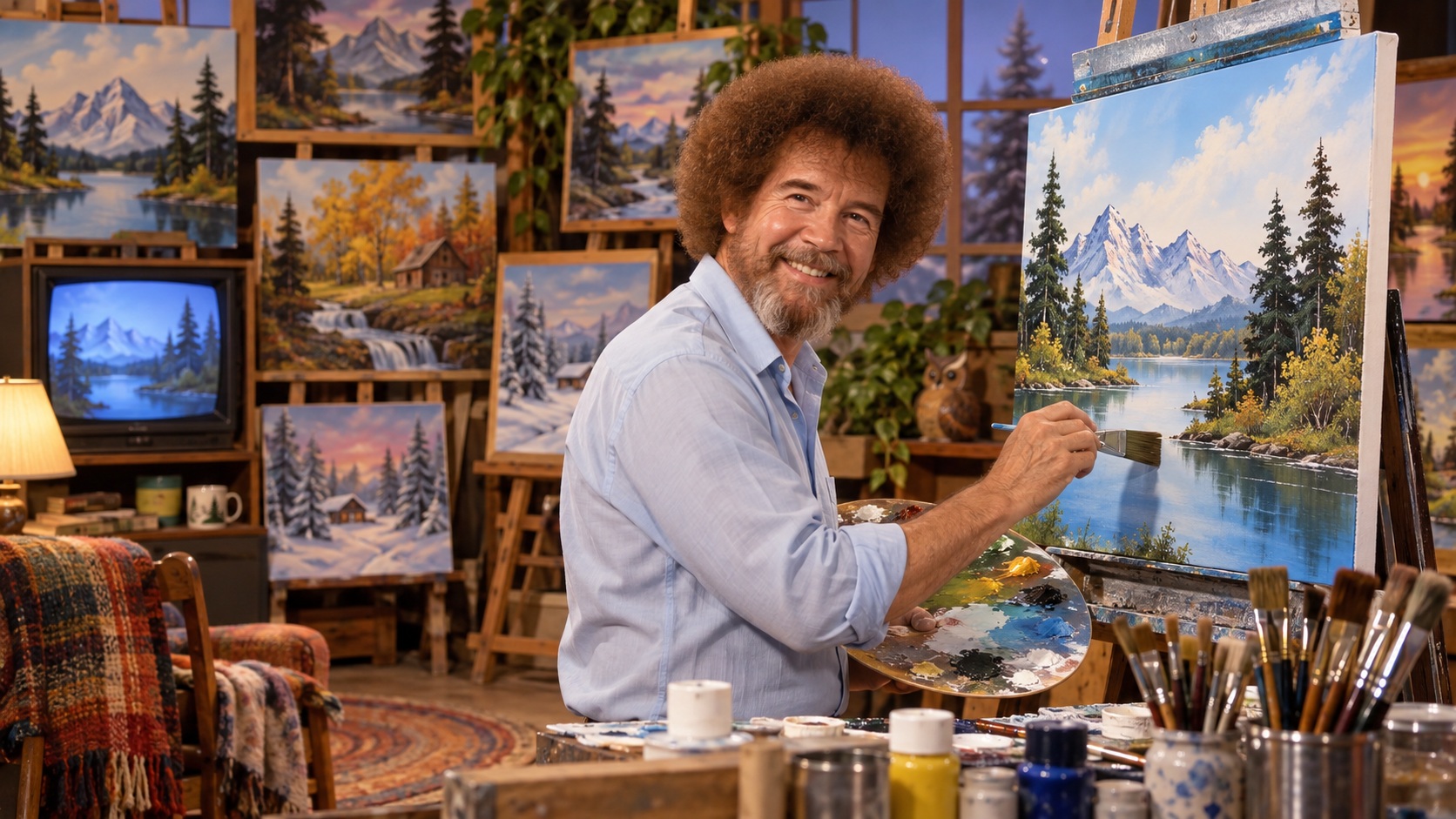
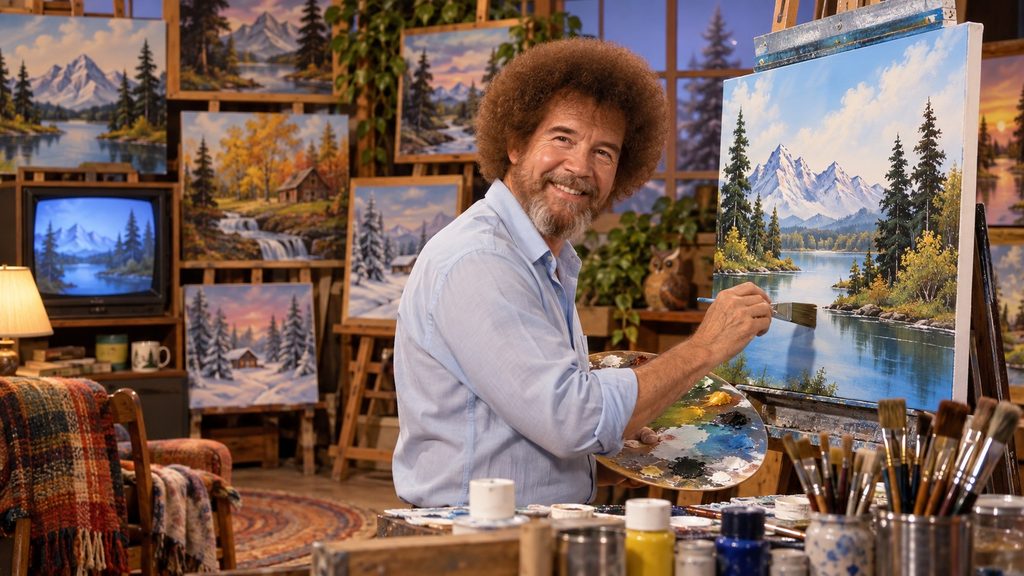
Just Bob, his easel, a palette of oil paints, and a blank canvas that somehow never stayed blank for very long.
We watched him create mountains that seemed to rise from nowhere, rivers that wound through peaceful forests, and cabins that looked like the perfect places to escape the troubles of the world.
And then there were those trees.
Those wonderful, happy little trees.
Sometimes we watched because we wanted to learn to paint. Sometimes we watched because there was nothing else on television. And sometimes, although we might not have understood it as children, we watched because Bob Ross had a remarkable way of making the world feel a little less frightening.
He never made us feel foolish for not knowing how to do something. He never demanded perfection.
He simply invited us to try.
For a generation growing up amid Cold War anxieties, changing families, school pressures, and the everyday uncertainties of childhood, that was a surprisingly powerful gift.
Before the Happy Little Trees, There Was a Man in Uniform
One of the most surprising facts about Bob Ross is that before he became America’s beloved television painter, he spent approximately twenty years serving in the United States Air Force.
Born Robert Norman Ross on October 29, 1942, in Daytona Beach, Florida, he enlisted in the Air Force in 1960 and eventually attained the rank of master sergeant.
His military assignments took him to Alaska, where the scenery would change the course of his life.
Those magnificent snow-covered mountains, towering evergreens, and northern landscapes became the inspiration for the paintings millions of Americans would later recognize immediately.

While stationed in Alaska, Ross took a painting lesson at a USO club in Anchorage. He also began selling landscape paintings on gold-mining pans to tourists.
Imagine that for a moment.
Before millions of people knew his name, Bob Ross was painting little Alaskan landscapes on souvenir pans.
It is a wonderful reminder that extraordinary things often begin in remarkably ordinary ways.
The Teacher Who Helped Shape Bob Ross
Another name worth remembering in the Bob Ross story is William Alexander, a painter and television instructor whose wet-on-wet oil painting method helped influence Ross’s artistic career.
This technique, sometimes called alla prima, allows an artist to apply fresh paint over paint that is still wet. Rather than waiting for each layer to dry, a landscape can be developed in one sitting.
Ross adapted the method into his own accessible approach, using large brushes, palette knives, and reassuring instructions to help beginners create landscapes they might never have imagined themselves capable of painting.

In 1983, The Joy of Painting began introducing viewers to Ross’s unforgettable style.
Over its original 31 seasons, the show produced 403 episodes between 1983 and 1994.
And although television had plenty of larger-than-life personalities, Bob Ross became beloved by simply making people believe they could create something beautiful.
The Surprising Truth About His Famous Hair
We cannot talk about Bob Ross without mentioning that extraordinary head of curly hair.
But here is something many fans never knew.
Bob Ross did not naturally have that famous hairstyle.
According to his longtime business partner Annette Kowalski, Ross originally got a perm because he was trying to save money on haircuts while establishing his painting career.
As his popularity grew, the hairstyle became an essential part of his public image and eventually appeared in the company’s branding.
Ironically, Kowalski later recalled that Ross grew tired of the curly hair.
By then, however, the world had fallen in love with the familiar face and hairstyle of its favorite painting instructor.
Sometimes a simple decision made to save a few dollars becomes part of television history.
Four Beautiful Bob Ross Paintings We Still Love
Ross painted countless landscapes during his career, but certain televised works remain especially memorable for their color, atmosphere, and sense of quiet wonder.
1. Northern Lights (1986)
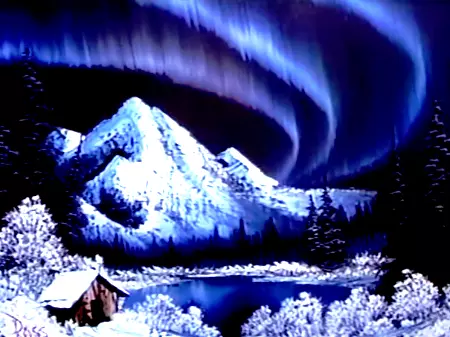
Few Bob Ross paintings capture the wonder of the natural world quite like Northern Lights.
Against a nearly black sky, luminous waves of blue light sweep over snow-covered mountains, their brilliance reflected in the icy world below.
The painting feels like a love letter to the Alaskan wilderness that helped inspire his artistic journey.
2. Purple Splendor (1984)
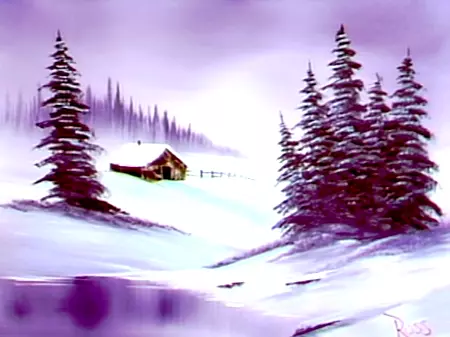
With just four paint colors, Ross demonstrated how a winter landscape could become an extraordinary world of lavender shadows, snow-covered trees, and gentle reflections.
It was an example of something he taught throughout his career: creating something beautiful does not always require expensive supplies or complicated techniques.
3. The Old Mill (1984)
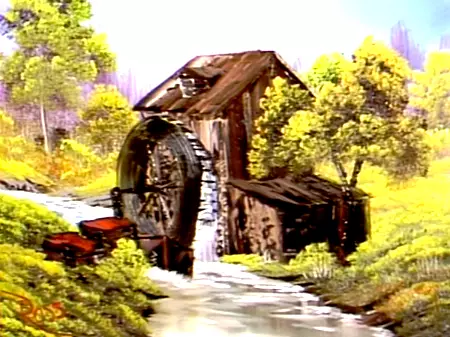
A weathered wooden mill stands beside a stream, surrounded by warm sunlight and trees that seem to have been growing there for generations.
Unlike his vast mountain landscapes, The Old Mill feels intimate, like a place you might discover at the end of a quiet country road.
That was part of Ross’s magic. He could turn an imaginary location into somewhere you almost remembered visiting.
4. Golden Sunset (1986)
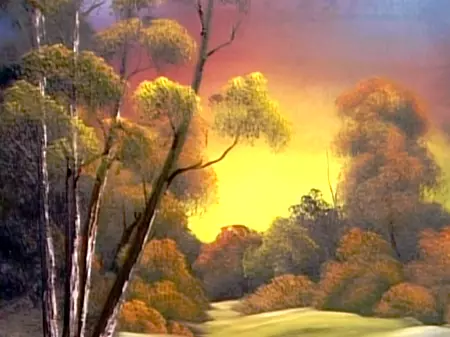
Warm golden light pours through the trees, transforming an ordinary woodland scene into a place of incredible beauty.
There is something deeply nostalgic about this painting. It recalls the feeling of a late afternoon when the sun was beginning to set, your bicycle was waiting outside, and childhood still seemed like it might last forever.
Bob Ross Had a Special Place in His Heart for Animals
Longtime viewers remember that not every episode of The Joy of Painting was exclusively about painting.
Occasionally, Bob introduced the audience to little animals he had helped care for, including squirrels and birds.
He and his friends rescued and raised young wildlife, sometimes caring for the animals until they could return to the outdoors.
One of those memorable companions was a squirrel named Peapod.
In a television era where animal personalities often existed simply to get a laugh, Bob treated these little creatures with obvious tenderness.
His fondness for animals was not something invented for television. According to his official biography, his love and respect for wildlife began during childhood and was nurtured by his mother.
That affection was another reason Bob felt so genuine. Whether he was teaching us to paint a tree or introducing a squirrel, he seemed to sincerely care about the smallest things.
He Usually Painted the Same Scene Three Times
Here is another fascinating fact.
The finished masterpiece viewers saw him paint on television was often not the only version of that scene.
For many episodes, Ross created three different versions of the same painting.
The first was a reference painting prepared before the program. The second was created during the television recording. The third was a more detailed version prepared afterward for instructional materials.
It sounds like an enormous amount of work, but it demonstrates something important about his television persona.
Bob Ross made painting look effortless because he had already devoted countless hours to mastering his craft.
His easygoing delivery did not mean his work was careless. Behind the gentle voice was a remarkably dedicated artist and teacher.
Even His Son Shared the Joy of Painting
Some viewers may also remember seeing Bob’s son, Steve Ross, appear on the program.
Steve was himself a talented painter and demonstrated landscapes during several episodes of the series.
Bob’s pride in his son’s artistic abilities was unmistakable. In one introduction, he warmly welcomed Steve to the easel and spoke about the appreciation viewers had shown for his work.
It was a wonderful glimpse of the father behind the television personality.
And for children watching at home, perhaps with their own parents or grandparents nearby, moments like those helped make the program feel like an extended family gathering.
The Smithsonian Finally Welcomed Bob Ross
Despite his enormous popularity, Ross was not always embraced by the traditional art establishment.
His paintings were sometimes dismissed as sentimental or overly commercial. But Bob seemed far more interested in encouraging ordinary people to paint than in convincing critics to admire him.
In a beautiful turn of events, several of his original paintings and personal artifacts eventually entered the Smithsonian’s National Museum of American History.
Among those works are versions of On a Clear Day and Blue Ridge Falls.
It is difficult not to smile at the thought.
The man who spent so much of his career telling everyday people they could make art had become an important part of America’s cultural history.
The Lesson Generation X Didn’t Know We Were Learning
Bob Ross passed away on July 4, 1995, at just 52 years old.
For those of us who grew up with his program quietly playing in our living rooms, his passing marked the loss of another familiar piece of our childhood.
But something remarkable happened.
His television appearances never really disappeared.
New generations discovered his painting lessons through reruns, streaming services, and the internet. Children who had once watched him alongside their parents became adults who introduced him to their own families.
And suddenly, the same reassuring voice that filled our living rooms in 1985 was bringing comfort to people decades later.
Looking back, perhaps the greatest thing Bob Ross gave Generation X was never really about painting at all.
It was the idea that we did not have to be perfect.
That we could make a mistake and still create something wonderful.
That patience mattered.
That the world still had beautiful places worth imagining.
And that sometimes, when life became overwhelming, it was perfectly acceptable to spend a little time doing something peaceful simply because it made us happy.
We grew older. We graduated. We found jobs. We raised families. We watched our own childhood heroes grow old and sometimes disappear.
But somewhere, on an old television recording or a modern computer screen, Bob Ross is still standing in front of his easel.
Still painting mountains.
Still making those happy little trees.
Still reminding us that a mistake doesn’t have to be the end of the picture.
And maybe that is why so many of us still love him.
Because for thirty quiet minutes, Bob Ross made the world feel like a kinder place.
And for a generation of kids who are now grown adults, that is a childhood memory worth holding onto.
Thank you, Bob, for all the happy little memories.
Watch Bob Ross Paint Northern Lights
Relive one of his most memorable episodes below, courtesy of the official Bob Ross YouTube channel.
Want to revisit even more episodes? Visit PBS: The Best of The Joy of Painting.
Now we want to hear from you!
Did you grow up watching Bob Ross on PBS? Did you ever try painting along with him, or were you simply happy to sit back and enjoy the peaceful scenery?
Share your favorite Bob Ross memories in the comments below, and follow Serpentor’s Lair for more nostalgic trips through the television shows, artists, and unforgettable personalities that shaped our childhoods.
Research and Historical Sources
- Bob Ross Inc. — Official Biography
- PBS — The Bob Ross Experience
- Smithsonian Magazine — What Happened to Bob Ross’s Paintings?
- NPR — The Real Bob Ross
- TwoInchBrush — Bob Ross Painting Reference Database
Image credits: Historical photographs via Wikimedia Commons, identified as public domain in the United States on their respective file pages. Bob Ross artwork © Bob Ross Inc.; painting reference images via TwoInchBrush. Artwork is reproduced here for editorial discussion and appreciation. All rights to the original paintings remain with their respective rights holders.