Saturday Morning Cartoon Wars of 1986: ABC vs. CBS vs. NBC
SERPENTORSLAIR.COM PRESENTS
THE 1986 TELEVISION TIME MACHINE
Saturday Morning Cartoon Wars of 1986
ABC vs. CBS vs. NBC: The Hidden Battle That Defined Childhood
Forty years later, the lost network strategies, ratings secrets, and cartoons that changed television can finally be revisited.
By Adam Jared | SerpentorsLair.com | November 2026
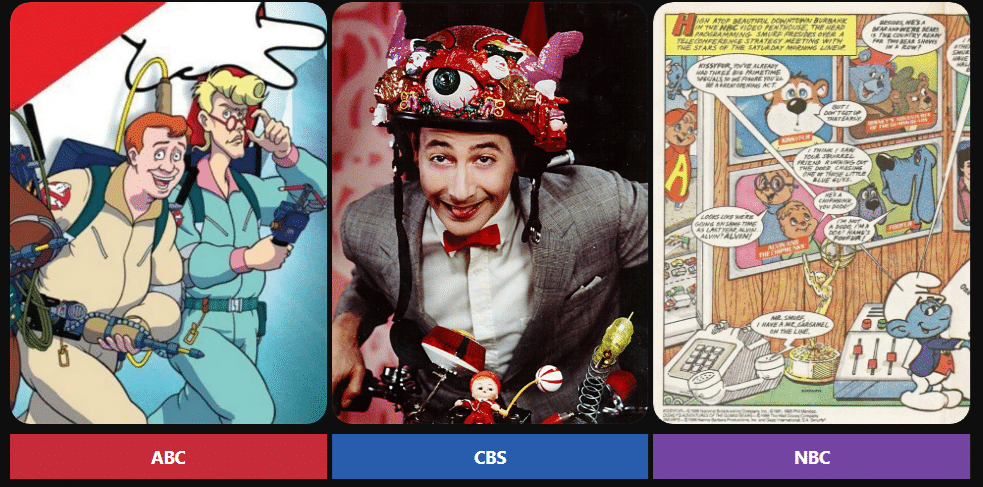
THE ULTIMATE 1986 SHOWDOWN
 ABC |
 CBS |
 NBC |
Authentic archival animation, television publicity and 1986 promotional artwork. Rights retained by their respective owners.
Picture it: Saturday morning, autumn 1986.
Your parents are still asleep. You’re in your pajamas, sitting inches from a television that probably weighs more than you do. A giant bowl of cereal is balanced on your knees, and the only serious decision you have to make is which network deserves your attention.
On ABC, the Ghostbusters are preparing to battle the supernatural. CBS has Kermit, Miss Piggy, and an eccentric man in a gray suit with a red bow tie. Over on NBC, a village full of little blue characters is helping anchor one of television’s most formidable children’s schedules.
Welcome to the Saturday Morning Cartoon Wars of 1986.
Forty years later, those memories still feel magical. But behind the animation was a remarkably calculated struggle involving network executives, toy manufacturers, audience research, advertising dollars, and hundreds of thousands of dollars spent producing individual cartoon episodes.
And thanks to surviving television-industry documents from 1986, we can tell a story that goes far beyond remembering which cartoons came on before lunch.
“The battle wasn’t simply about which cartoons kids loved. It was about which network could understand them, attract them, and keep them watching.”
SERPENTOR’S LAIR EDITORIAL PERSPECTIVE
THE BATTLEFIELD: WHAT WAS REALLY ON TV?
On September 13, 1986, the three major commercial networks launched their new fall Saturday morning seasons. In many television markets, the following programs formed the core of the national schedules.
These listings are based primarily on an original Television/Radio Age industry report dated August 4, 1986. They represent the networks’ announced fall schedules; local affiliates, time zones, and later midseason changes could alter what individual viewers actually saw.
| Eastern | ABC | CBS | NBC |
|---|---|---|---|
| 8:00 | The Wuzzles | The Berenstain Bears | Kissyfur |
| 8:30 | The Care Bears Family | Wildfire | Adventures of the Gummi Bears |
| 9:00 | The Flintstone Kids | Jim Henson’s Muppet Babies | The Smurfs |
| 10:00 | The Real Ghostbusters | Galaxy High | The Smurfs (continued) |
| 10:30 | Pound Puppies | Teen Wolf | Punky Brewster |
| 11:00 | The Bugs Bunny and Tweety Show | Pee-wee’s Playhouse | Alvin and the Chipmunks |
| 11:30 | The All-New Ewoks | The Puppy’s Great Adventures | Foofur |
| 12:00 | ABC Weekend Special | Hulk Hogan’s Rock ‘n’ Wrestling | Lazer Tag Academy |
Source: Television/Radio Age, August 4, 1986, pp. 61, 116–117. Some shows continued across multiple half-hour slots; the published industry timetable and local listings could differ.
ABC: THE GHOSTBUSTERS OFFENSIVE
NETWORK STRATEGY: NEW FRANCHISES, FAMILIAR CHARACTERS, AND A YOUNGER AUDIENCE
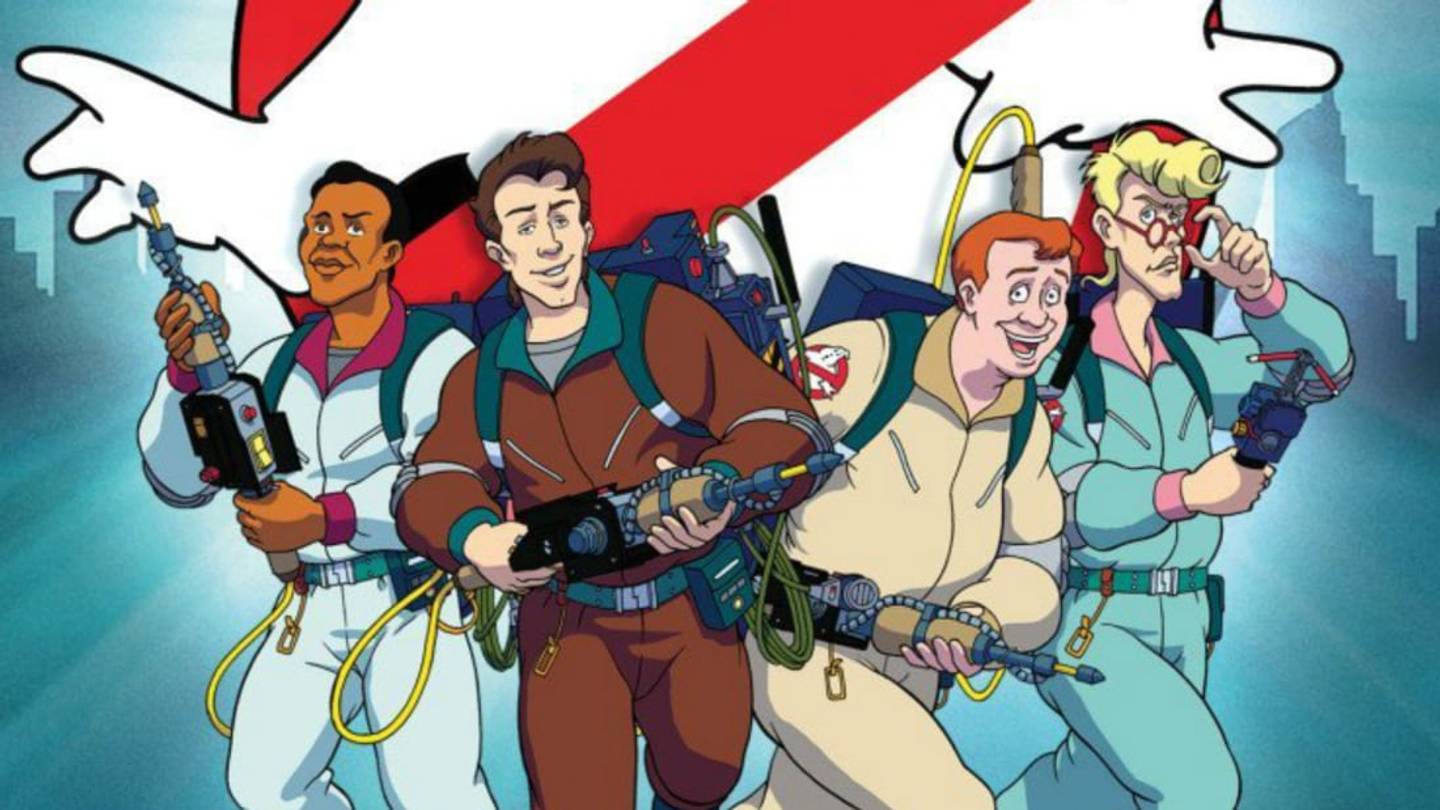
The Real Ghostbusters brought the characters from the hit film to ABC in September 1986. Image: animation artwork, via Mental Floss.
ABC entered the 1986 season desperate to rebuild its children’s audience.
The network had been trailing NBC and CBS, and executives believed that launching a largely refreshed schedule might help reverse the decline. Familiar properties gave the new shows a chance to attract viewers quickly.
At the center was The Real Ghostbusters, which premiered on September 13, 1986.
Based on the smash-hit 1984 movie, the series brought Peter Venkman, Ray Stantz, Egon Spengler, Winston Zeddemore, and Slimer into living rooms across America.
It delivered paranormal adventures, memorable character voices, outrageous monsters, and an animated version of a movie phenomenon that children already loved.
The secret behind the word “Real”
One of the strangest facts about the cartoon is that its name was partly a product of a competing entertainment property.
Filmation already had a connection to the Ghost Busters name through an earlier live-action television show. When animated versions of two different Ghostbusters concepts appeared in 1986, Columbia’s cartoon was called The Real Ghostbusters to distinguish it from Filmation’s series.
That’s right: while ABC carried the movie-inspired Ghostbusters, another cartoon called Ghostbusters was competing in syndication. The name confusion was real, and contemporary reporting covered the unusual rivalry.
According to an original September 1986 Los Angeles Times article, the two productions were separated by more than branding: they represented different character lineages and competed for children’s attention during the same television season.
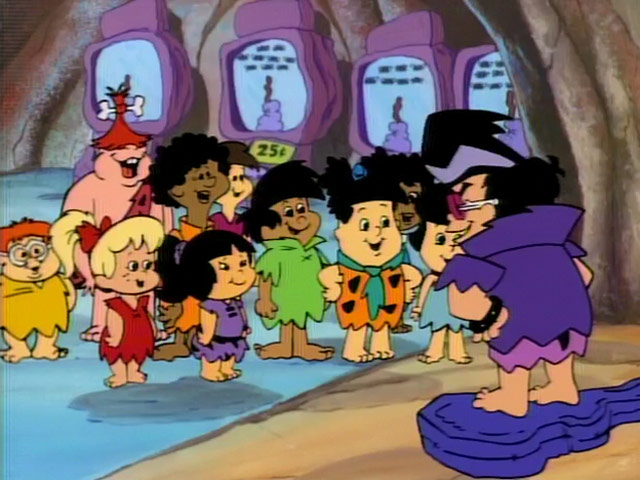
Fred, Wilma, Barney and friends as youngsters in The Flintstone Kids. Original-series imagery via Mantronix Retro TV.
But ABC’s ambitions extended beyond Ghostbusters.
The Flintstone Kids introduced younger versions of the famous Bedrock characters. The Care Bears Family expanded a hugely familiar entertainment and merchandise franchise. Pound Puppies brought another toy-store favorite to television.
Even more surprisingly, ABC had obtained The Wuzzles, a Disney animated series that had aired on CBS the previous season. It was a literal network switch in the middle of the Saturday morning battle.
The hidden story: In 1986, ABC’s children’s programming executives were intentionally trying to attract younger viewers. A contemporary report quoted the network’s executive Squire Rushnell describing a shift toward the six-year-old audience, including greater attention to girls.
Those assumptions reflect the marketing attitudes of the era, but they reveal how deliberately ABC was rebuilding its programming identity.
ABC replaced the long-running Super Friends and Scooby-Doo network staples while reworking its lineup. Two of Saturday morning’s most recognizable franchises were no longer the network’s central strategy.
CBS: THE NETWORK THAT EMBRACED THE WEIRD
NETWORK STRATEGY: MUPPETS, ALIENS, WEREWOLVES AND PEE-WEE HERMAN
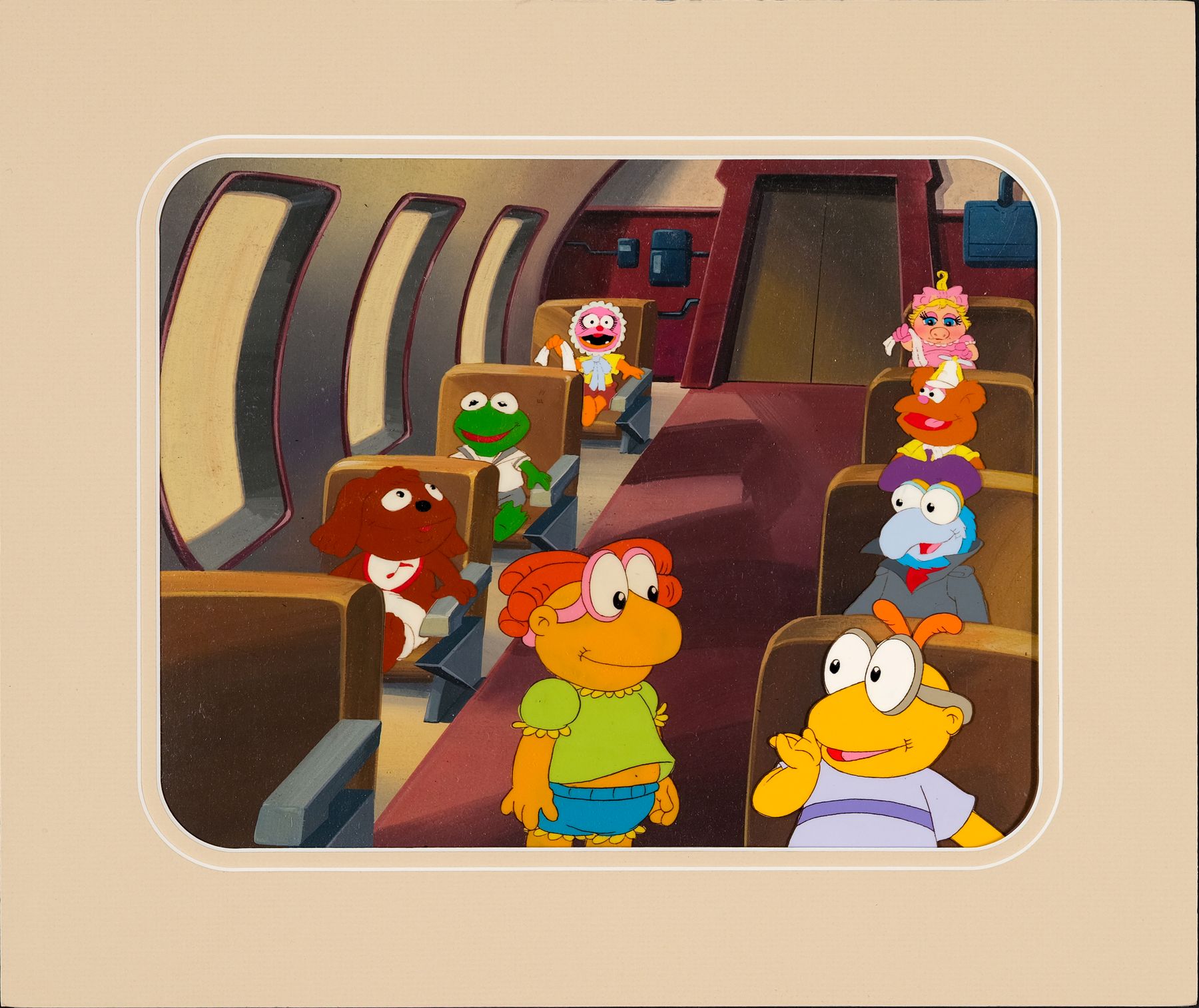
Original Muppet Babies production cel on painted background. Archival photograph: Propstore.
CBS’s 1986 lineup might have been the most delightfully unpredictable of the three networks.
Jim Henson’s Muppet Babies had already established itself as a Saturday morning powerhouse. Baby Kermit, Miss Piggy, Fozzie, Gonzo and company transformed their nursery into a place where any imaginary adventure was possible.
In fact, the series was already successful enough to challenge one of NBC’s greatest weapons: The Smurfs.
According to the August 1986 industry report, CBS programming executive Judy Price specifically wanted Muppet Babies to hold its own against NBC’s competing 9 a.m. block.
CBS made an extraordinary research decision
Here’s a detail many fans have never heard: CBS reportedly developed its 1986 Saturday lineup without the formal program research it had used previously.
Price said the network had found children’s focus-group and preference research difficult to interpret. Instead, her approach emphasized editorial instinct and ideas drawn from pop culture, movies, television and books.
It’s an extraordinary window into how a major network chose its shows: sometimes gut instinct had more influence than a stack of audience surveys.
And CBS’s biggest new gamble was unlike anything else on Saturday morning television.
Pee-wee Herman, played by Paul Reubens, brought a surreal live-action world to the 1986 CBS lineup. Series imagery via IMDb.
Pee-wee’s Playhouse debuted on September 13, 1986, and television would never have quite the same Saturday morning atmosphere.
It was loud, colorful, absurd, visually experimental, and packed with bizarre characters. But beneath all that chaos was a surprisingly sophisticated production.
In the contemporary trade report, CBS’s programming executive described the new show as approximately 70 percent live action and 30 percent animation and clay animation.
The gamble paid off creatively. The program went on to win six technical and creative-arts Daytime Emmy Awards in 1987.
Meanwhile, the network also experimented with Teen Wolf, Galaxy High, Wildfire and the animated antics of Hulk Hogan’s Rock ‘n’ Wrestling.

Galaxy High took the high-school comedy formula into outer space. Original-series imagery: The Cartoon Databank.
The Hollywood talent behind Galaxy High
Many viewers never knew that Galaxy High was developed by Chris Columbus, the screenwriter associated with Gremlins and The Goonies, who would later become a major Hollywood film director.
And Wildfire, the fantasy adventure featuring a magical horse and a young princess, was developed in association with fantasy author Peter S. Beagle, whose work includes The Last Unicorn.
Those details help explain why CBS’s experimental lineup still inspires cult affection, even among viewers who can barely remember the shows’ names.
Before Pee-wee’s Playhouse, CBS had tried multiple live-action or mixed-format children’s shows with disappointing results. The 1986 program represented an unusually bold effort to prove that such entertainment could succeed on Saturday mornings.
NBC: THE SATURDAY MORNING EMPIRE
NETWORK STRATEGY: PROTECT THE THRONE WITH THE SMURFS, DISNEY AND FAMILY FAVORITES
An extraordinary original NBC 1986–87 promotional comic featuring the network’s Saturday morning characters. View historical source.
If ABC was attempting a comeback and CBS was taking creative risks, NBC was defending an empire.
Its 1985–86 ratings had placed it comfortably ahead of the competition, and it entered the next season with a lineup built around familiar, reliable successes.
The biggest of all was The Smurfs.
Those little blue characters weren’t simply another cartoon. They were one of the foundations of NBC’s children’s programming identity, occupying a substantial stretch of the network’s morning.
Alongside them were Alvin and the Chipmunks, Disney’s Adventures of the Gummi Bears, and new additions including Kissyfur, Foofur and Lazer Tag Academy.

Disney’s Adventures of the Gummi Bears was one of the company’s pioneering modern television animation series. Original animation image via Filmtoast.
Disney’s surprising importance
Many fans associate Disney’s television-animation boom with DuckTales and the later Disney Afternoon.
But Gummi Bears was already part of a crucial earlier wave. The series had premiered on NBC in September 1985.
Disney’s own historical archive recounts how Michael Eisner pushed the company to produce television animation after arriving in 1984, with a series ready for the following fall season.
Along with The Wuzzles, Gummi Bears helped establish a new foundation for Disney animation on television.
NBC tested cartoon ideas on real children
One of the most unexpected details in the 1986 trade report concerns NBC’s approach to deciding which shows deserved airtime.
The network tested concepts for programs such as Kissyfur and Foofur with audiences reached through cable systems in different parts of the country.
Executives could learn from viewers’ reactions to character artwork and story ideas before finalizing a program.
Remarkably, Lazer Tag Academy arrived too late to undergo that same testing process, according to the contemporary report.

The Smurfs remained a powerful NBC staple in 1986. Original 1986 episode imagery via IMDb.
NBC did not need to reinvent Saturday mornings. It had an established audience, beloved characters, and a successful ratings foundation. Its mission was to keep children tuned in while ABC and CBS attempted to lure them away.
THE 1986 SECRET FILES: FACTS THAT CHANGED THE STORY
These are not simply fun trivia questions. They come from industry reports, contemporary news coverage and historical production records.
1. NBC was the ratings king entering the season
For the preceding 1985–86 season, Television/Radio Age reported Saturday-morning household ratings of 6.0 for NBC, 4.7 for CBS, and 4.1 for ABC across the measured morning period. These figures describe the season leading into fall 1986, not the final outcome of the new fall lineup.
2. CBS abandoned its usual research process
Its programming executive said that traditional children’s research did not reliably predict success. For the 1986 lineup, instinct and pop-cultural judgment played the leading role.
3. ABC deliberately targeted younger children
After struggling against NBC, ABC concentrated on a younger audience and discussed stronger appeal to girls. It was a calculated response to changing audience demographics and advertiser priorities.
4. Saturday morning cartoons were extremely expensive
A CBS executive estimated animation costs of roughly $200,000–$300,000 per half-hour episode, averaging around $250,000. ABC’s planning figures were higher still, at about $275,000 per half-hour. Those are contemporary dollar estimates, not inflation-adjusted figures.
5. Two different Ghostbusters cartoons were competing
ABC had the movie-based The Real Ghostbusters, while Filmation introduced a different Ghostbusters series through syndication. The overlapping names were connected to the complicated history of the original Ghost Busters property.
6. Disney’s Wuzzles changed networks
After appearing on CBS, Disney’s The Wuzzles moved to ABC for the 1986 fall season. Meanwhile, Disney’s Gummi Bears remained on NBC. Disney animation was represented on two competing network schedules.
7. CBS deliberately put Muppet Babies against The Smurfs
The network hoped its popular Muppet characters could contain NBC’s dominance in the crucial 9 a.m. hour. This was strategic counterprogramming, not an accidental time-slot collision.
8. Pee-wee was a hybrid production
CBS’s programming leadership described Pee-wee’s Playhouse as approximately 70 percent live action and 30 percent animation or clay animation. The show would later win six 1987 Daytime Emmy Awards for technical and creative work.
9. Galaxy High had a future Hollywood director behind it
Chris Columbus, already known for his screenwriting, helped develop the science-fiction school comedy. This connection is documented in the original 1986 trade report.
10. Wildfire had a fantasy-literature connection
The magical-horse adventure was developed in association with Peter S. Beagle, author of The Last Unicorn.
11. NBC used cable systems for concept testing
Character artwork and program descriptions were evaluated with selected audiences. The late-arriving Lazer Tag Academy missed the process.
12. The networks were fighting the toy-driven syndicators, too
G.I. Joe, Transformers, He-Man and other action-oriented programs were prominent in syndicated television. They were important competitors for children’s attention, even though they were not the principal shows in the three-network fall 1986 Saturday schedule.
THE MONEY BEHIND THE MAGIC
$250,000
Approximate average cost of a CBS animated half-hour reported in 1986.
Historical industry estimate, not a universal cost for every cartoon.
THE COMMERCIALS WERE PART OF THE BATTLE
The programs themselves were only half the experience.
Between cartoon adventures came cereal mascots, toy demonstrations, fast-food promotions, and advertisements that made every new action figure look absolutely essential.
One of the most revealing parts of the contemporary industry report was its discussion of the growing financial pressure from syndicated children’s television and toy-related merchandising.
The networks were contending with expensive animation, competition for advertising dollars, and questions about how closely programming should be connected to products sold in stores.
For kids, of course, none of those business decisions mattered.
All they knew was that somewhere between the Ghostbusters, the Smurfs and Pee-wee Herman, a commercial might introduce the next toy they would beg their parents to buy.
WATCH REAL 1986 SATURDAY-MORNING COMMERCIAL BREAKS
ABC — September 13, 1986
CBS — September 13, 1986
NBC — Commercials from 1986
Videos are independently uploaded historical recordings. Availability and embedding permissions are controlled by their respective YouTube owners.
SO WHO ACTUALLY WON THE CARTOON WARS?
It’s tempting to crown a single winner.
If we’re talking about the ratings race entering fall 1986, NBC clearly had the advantage.
If we’re talking about artistic experimentation, CBS made one of the most memorable gambles with Pee-wee’s Playhouse, while holding onto the enormously popular Muppet Babies.
And if we’re talking about creating a phenomenon that would continue to inspire generations of fans, ABC had a powerful new contender in The Real Ghostbusters.
But these are three different ways of judging success, not evidence that one network necessarily won the entire fall 1986 season. A definitive 1986–87 ratings championship would require the completed season’s comparable ratings.
THE SERPENTOR’S LAIR VERDICT
NBC entered the war as the heavyweight champion.
ABC unleashed the Ghostbusters.
CBS delivered the wildest creative surprise.
Forty years later, none of us remembers the exact rating of a cartoon we watched in our pajamas.
We remember the cereal. The theme songs. The commercials. The sound of the television before the rest of the family woke up.
We remember rushing through the week so Saturday could finally arrive.
And whether your heart belonged to ABC, CBS or NBC, the most extraordinary thing about the Cartoon Wars of 1986 is how much of that childhood magic is still with us today.
The networks battled for the audience.
The kids got the memories.
And those memories lasted a lifetime.
NOW IT’S YOUR TURN!
You wake up on a Saturday morning in 1986. Which network gets your television?
ABC — THE REAL GHOSTBUSTERS?
CBS — MUPPET BABIES & PEE-WEE?
NBC — THE SMURFS & GUMMI BEARS?
Tell us your choice in the comments—and name the one show that made your Saturday mornings unforgettable!
Historical Sources & Further Reading
- Television/Radio Age, August 4, 1986 — contemporary network schedules, executive interviews, ratings and program development costs.
- Evening Herald, August 22, 1986 — contemporary coverage of the fall Saturday morning premieres.
- Los Angeles Times, September 18, 1986 — coverage of the competing Ghostbusters animated series.
- Television Academy: Pee-wee’s Playhouse — series history and Emmy recognition.
- Disney D23: History of Disney Television Animation — the origins of Disney’s 1985 television cartoon initiative.
- Disney D23: Adventures of the Gummi Bears — broadcast history.
- UPI, October 11, 1986 — surviving contemporary weekend television listings.
Archival visuals are reproduced or linked for historical illustration, with source attribution. Copyright and trademark rights remain with the respective owners and licensors. Source credit does not replace any required reproduction permission.
ABOUT THE AUTHOR
Adam Jared is the founder of SerpentorsLair.com, a pop-culture entertainment community dedicated to classic action figures, television, cartoons, film, and the creative personalities behind them. He holds a Master of Science in Social Media Management and is pursuing a PhD in Strategic Communication. His writing explores the entertainment, culture, and lasting memories that continue to connect generations of fans.
SERPENTORSLAIR.COM — KEEPING THE MEMORIES ALIVE