Halloween Candy in the 1980s Was Better — And We’re Ready to Prove It!
Halloween Candy in the 1980s Was Better — And We’re Ready to Prove It!
From full-size chocolate bars and homemade popcorn balls to the Halloween candy nobody wanted, we’re going back to the sweetest nights of our childhood.
BY ADAM JARED | OCTOBER 30, 2026
Before Halloween became an Instagram event, it was a neighborhood adventure — and the candy was everything.
There was a moment every Halloween night in the 1980s when the entire world seemed to stop.
It happened when you finally got home.
Your cheap plastic mask was pushed up onto your forehead. Your costume was probably torn somewhere. Your feet hurt from walking three neighborhoods farther than your parents had originally approved.
And there, clutched tightly in your hands, was the greatest treasure a kid could imagine.
A pillowcase full of candy.
Not an expensive gift basket. Not some carefully curated selection of artisan chocolates. Just a glorious mountain of candy bars, chewy taffy, bubble gum, lollipops, mystery wrappers, and things that barely qualified as food.
And it was magnificent.
The Great Living Room Candy Dump
If you grew up during the 1980s, you remember the ceremony.
You arrived home and immediately turned your Halloween bag upside down.
Hundreds of pieces of candy — or at least what felt like hundreds — came crashing onto the living room carpet.
Wrappers crackled. Chocolate bars scattered. Loose Smarties rolled beneath the furniture.
And somewhere in the pile was an apple you had absolutely no intention of eating.
Then the sorting began.
Chocolate went into one pile. Hard candy into another. Gum and novelty candy off to the side.
The questionable candy went into a separate pile that usually became your younger sibling’s problem.
Halloween candy was practically its own childhood economy.
Two little rolls of Smarties might get you a Tootsie Pop. A handful of miscellaneous candy might buy you something truly valuable.
But nobody with any sense was trading away a full-size Snickers.
Full-Size Candy Bars: The Holy Grail
Every neighborhood had legends.
There was the creepy house with the flickering porch light. The house where somebody jumped out of the bushes wearing a monster mask. The house that gave out pennies.
And then there was the house that handed out full-size candy bars.
That house was sacred ground.
Word traveled from kid to kid faster than any modern social media notification.
“THEY’RE GIVING OUT FULL-SIZE BARS!”
Suddenly, every ghost, vampire, ninja, and G.I. Joe in the neighborhood was sprinting toward the same front porch.
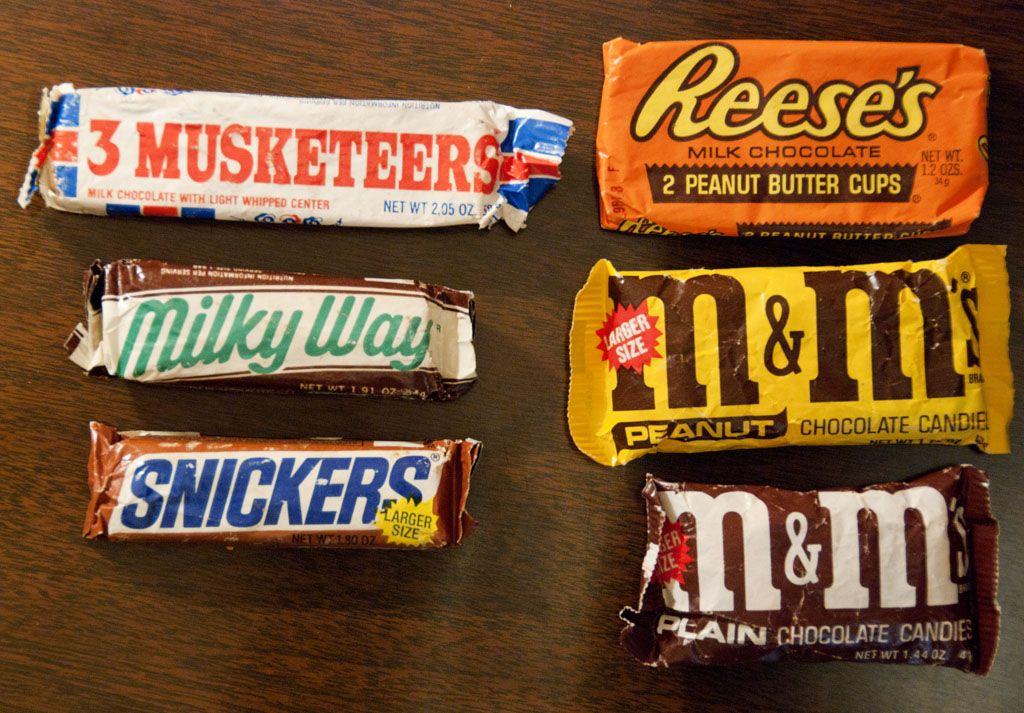
Snickers. Milky Way. 3 Musketeers. Hershey’s. Reese’s Peanut Butter Cups. Butterfinger.
These weren’t merely candy bars. They were Halloween trophies.
And although those brands still exist, receiving one unexpectedly after walking through a chilly October neighborhood felt like winning the lottery.
The Homemade Popcorn Ball: Halloween’s Forgotten Treasure

Long before every Halloween treat came sealed in a shiny factory wrapper, there was the popcorn ball.
A glorious, sticky sphere of popcorn held together with syrup, caramel, or marshmallow.
Some were small enough to fit in your palm. Others looked like somebody had attempted to construct a baseball out of breakfast cereal.
They were homemade. They were messy. And depending on who made them, they could be absolutely delicious or so hard you feared for your dental work.
In some neighborhoods, everybody knew the house that made popcorn balls.
Maybe it was the elderly woman down the street. Maybe it was a family friend whose kitchen always smelled like caramel in October.
For children who received them from people their families knew, these treats were more than candy.
They represented something that has become increasingly rare: a neighborhood tradition passed from one generation to another.
As concerns about unwrapped Halloween treats grew, factory-sealed candy became the safer and more common expectation.
But for those who remember homemade popcorn balls, the memory is inseparable from the Halloween nights of long ago.
Candy Cigarettes: Only in the 1980s!

Now here’s a candy that perfectly illustrates how different childhood culture used to be.
Candy cigarettes.
Yes, children could buy little cardboard packages containing white candy sticks designed to resemble cigarettes.
Some were chalky and brittle. Others were made from bubble gum, and certain versions even produced a little puff of powdered sugar when blown through.
For many kids, the attraction was the novelty of pretending to be grown-ups, detectives, or cowboys from television.
Looking back, of course, the imitation-smoking concept was deeply questionable, especially considering the known dangers of tobacco.
But these candies were an unmistakable part of the novelty-candy landscape that many 1980s children remember.
And the taste?
Let’s just say nobody was buying them because they were better than Reese’s Peanut Butter Cups.
The Halloween Candy Nobody Wanted!
Now we arrive at the controversial part of this article.
Because for every glorious Snickers bar or Reese’s Peanut Butter Cup, there were certain candies that seemed to exist for one purpose:
To disappoint children on Halloween night.
And if you grew up in the 1980s, there’s a good chance you remember all three of these notorious offenders.
1. The Orange-and-Black Peanut Butter Kisses

There they are.
Those things.
The mysterious orange-and-black wrapped peanut butter candies that seemed to appear in every Halloween bag in America.
Technically known as peanut butter kisses, these chewy taffy-like candies had a peanut butter center and a distinctive seasonal wrapper.
But to generations of trick-or-treaters, they were simply “those orange and black things.”
You knew what they were before you even unwrapped one.
And somehow, every Halloween, you ended up with at least twelve.
They were sticky. They were chewy. Sometimes they seemed determined to become permanently attached to your molars.
Of course, some people genuinely loved them. In fact, these candies have survived for generations precisely because they have devoted fans.
But for many 1980s kids, they occupied the very bottom of the Halloween candy trading market.
One Reese’s Peanut Butter Cup for twenty peanut butter kisses?
Not a chance.
2. Circus Peanuts: Why Were They Orange?

And then there were Circus Peanuts.
Let’s examine the evidence.
They were shaped like peanuts.
They were bright orange.
They had the texture of marshmallows that had experienced some sort of unfortunate scientific experiment.
And somehow, they tasted like bananas.
BANANAS!
Who looked at a peanut-shaped candy and decided banana flavor was the obvious choice?
To this day, Circus Peanuts remain one of the great mysteries of the American candy aisle.
They weren’t specifically a Halloween invention, but their orange color and old-fashioned reputation made them memorable members of many childhood candy collections.
For some people, they were a beloved treat.
For others, they were what happened when a marshmallow forgot what it was supposed to be.
And that’s the beauty of nostalgia. Even the candy we disliked can bring back wonderful memories.
3. Bit-O-Honey: The Candy That Refused to Be Chewed

And finally, we have Bit-O-Honey.
First introduced in 1924, this honey-and-almond taffy was already an old-fashioned candy by the time children of the 1980s encountered it.
Its familiar wrapper promised a sweet, nutty treat.
What it delivered was a full-scale jaw workout.
You could put one in your mouth at the beginning of a Halloween television special and still be chewing when the credits rolled.
There were times when it felt less like eating candy and more like attempting to remove industrial adhesive from your teeth.
And yet, Bit-O-Honey had — and still has — a fiercely loyal following.
Some people love its distinctive honey flavor and long-lasting chew.
Others remember it as the candy that made them appreciate the structural integrity of their fillings.
Whether you loved it or hated it, you certainly remembered it.
THE GREAT HALLOWEEN CANDY DEBATE!
Which candy was the WORST?
Orange-and-black peanut butter kisses?
Circus Peanuts?
Bit-O-Honey?
Tell us in the comments!
Wax Lips and the Candy That Made Absolutely No Sense
And while we’re discussing bizarre childhood candy, we cannot forget wax lips.
Who decided children should put enormous pieces of flavored wax in their mouths and pretend they were delicious?
Whoever it was deserves a special place in the Museum of Bizarre Childhood Inventions.
Wax lips were spectacular for approximately four minutes.
You wore them. You made ridiculous faces. You tried to talk. Then you attempted to chew something with the consistency of a birthday candle.
Then there were Nik-L-Nip wax bottles.
Little containers of colored syrup that required you to bite off the top, drink the tiny amount of liquid inside, and figure out what to do with the remaining wax.
These novelty candies weren’t invented in the 1980s, but they remained wonderfully strange survivors of an earlier candy culture.
And somehow, they were part of the magic.
Candy Corn: The Candy That Divided America
Few Halloween candies inspire stronger opinions than candy corn.
For some people, those little yellow, orange, and white triangles are the very taste of autumn.
For others, they resemble sweetened candle wax shaped into tiny traffic cones.
There seems to be no middle ground.
Candy corn was already an old-fashioned confection when the 1980s arrived, with roots reaching back to the nineteenth century.
But its distinctive colors made it inseparable from Halloween.
Love it or hate it, candy corn could make an ordinary kitchen table feel like October.
The Razor-Blade Scare That Haunted Halloween
Of course, no conversation about Halloween candy in the 1980s is complete without remembering the warnings.
Parents inspected candy. Schools issued reminders. Television news reports warned about suspicious treats.
And nearly every child heard some version of the terrifying razor-blade-in-the-apple story.
The actual history is more complicated than the rumors.
Researchers studying Halloween candy-tampering reports found that widespread fears of strangers randomly poisoning children were dramatically exaggerated.
Isolated incidents and genuine crimes did occur, but the popular image of neighborhoods filled with malicious strangers secretly tampering with candy was not supported by the evidence.
Nevertheless, the warnings became part of Halloween’s cultural soundtrack.
For many of us, having Mom or Dad examine our candy before we could eat it was simply another step in the evening’s ritual.
Was Halloween Candy Really Better in the 1980s?
Here comes the difficult question.
Was Halloween candy in the 1980s genuinely better?
Some recipes, packaging, product selections, and manufacturing practices have changed over the decades. Some old favorites disappeared. Others survived and remain available today.
But declaring that every chocolate bar tasted better forty years ago would be impossible to prove.
Perhaps what changed most was us.
At eight years old, a miniature candy bar wasn’t just a snack.
It was something you had earned by dressing like a cartoon character, braving the darkness, and knocking on dozens of doors.
There was anticipation. Adventure. Friendship. Mystery.
There was the sound of dry leaves scraping across the sidewalk and the glow of plastic jack-o’-lanterns on neighborhood porches.
And somewhere in the distance, you could hear another group of kids shouting that somebody was giving out the good candy.
Maybe that was the secret ingredient.
The Sweetest Thing Was Never the Candy
Today, many of us can walk into a grocery store and purchase an entire bag of the candy we once worked so hard to collect.
We can buy Snickers whenever we want. Reese’s Peanut Butter Cups are available year-round. Candy corn returns every autumn like an old friend who refuses to take the hint.
And yet, none of it tastes quite the same.
Because we aren’t standing in our childhood living rooms anymore.
Our costumes are gone. The old neighborhoods have changed. Some of the people who waited for us at home are no longer there.
The television might still be playing a familiar Halloween special, but the voices coming from the kitchen are different now.
And the pillowcase that once seemed heavy enough to contain every treasure in the world has long since disappeared.
That’s what makes those memories so precious.
We thought we were collecting candy.
But what we were really collecting were moments.
Moments with our brothers and sisters. Moments with our best friends. Moments with our parents, who pretended not to notice when we sneaked one more chocolate bar before bedtime.
And moments from a childhood we could never have imagined would pass so quickly.
Maybe Halloween candy wasn’t better in the 1980s.
Maybe Halloween was better because we were there, together, and young enough to believe the magic would last forever.
Now It’s Your Turn!
What was the BEST Halloween candy of the 1980s?
Were you a Reese’s kid? A Snickers fanatic? A devoted fan of wax lips, candy cigarettes, or popcorn balls?
And which candy did you immediately try to trade away?
Were the orange-and-black peanut butter kisses really that bad, or have we been unfairly criticizing them for forty years?
Tell us in the comments and share this article with somebody who remembers the glorious sound of an entire pillowcase of Halloween candy hitting the living room floor.
Happy Halloween from SerpentorsLair.com!
Historical Sources and Further Reading
Smithsonian National Museum of American History — Halloween Treat Traditions
HISTORY — The Haunted History of Halloween Candy
JSTOR Daily — Trick or Treat Sadists: A Halloween Urban Legend
About the Author
Adam Jared is the founder of SerpentorsLair.com, a pop culture and entertainment destination celebrating the toys, television, movies, and unforgettable memories of generations past. He holds a Master of Science in Social Media Management and is pursuing a PhD in Strategic Communication. Through nostalgic editorials and cultural commentary, Jared explores the lasting influence of childhood entertainment and the memories that connect generations.