Happy 84th Birthday, Bob Ross: The Wonderful Stories Behind America’s Happy Painter
SERPENTORSLAIR.COM | SPECIAL BIRTHDAY TRIBUTE
OCTOBER 29, 1942 – JULY 4, 1995
Happy 84th Birthday, Bob Ross
The Wonderful Stories Behind America’s Happy Painter
A celebration of the remarkable man, the forgotten moments, and the extraordinary legacy that continues to grow.
By Adam Jared | October 29, 2026

Somewhere, you would like to think, Bob Ross is celebrating his birthday with a freshly cleaned paintbrush, a magnificent mountain, and absolutely no reason to hurry.
Today would have marked the 84th birthday of Robert Norman Ross, a man whose extraordinary ability to connect with people transformed a modest instructional television program into one of the most enduring cultural treasures of the twentieth century.
There have been famous painters, celebrated television personalities, and gifted teachers. Bob Ross occupied a rather remarkable place where all three met.
His friendly smile became internationally recognized. His paintings found their way into the imaginations of millions. His voice became so familiar that generations of people could recognize it without even looking at their television screens.
But there was much more to Bob Ross than the familiar television image.
Behind those studio lights was a hardworking teacher, an unlikely television pioneer, a man with an unmistakable sense of humor, and someone whose generosity could emerge in the most unexpected places.
On what would have been his 84th birthday, rather than simply revisit the famous moments everyone remembers, we are celebrating some of the wonderful stories that reveal the Bob Ross viewers rarely got to see.
The Rusty Camper That Changed Public Television
In 1983, a rather unremarkable Datsun camper rolled into Muncie, Indiana.
It was not exactly the sort of entrance one might expect from a future television legend. The vehicle was well-worn, its wheels reportedly showing rust, and it was loaded with art supplies rather than the possessions of a wealthy entertainer.
Behind the wheel was Bob Ross.
At the time, he was a traveling painting instructor trying to build a future in the uncertain world of art education.
According to the historical archives of Minnetrista Museum & Gardens, Ross and business partner Annette Kowalski purchased two local television advertisements to promote an upcoming painting workshop.
The advertisements worked remarkably well. So many people wanted to attend that the workshop schedule had to be reconsidered.
Ross was impressed.
He and Kowalski subsequently met with WIPB television management, discovering a small public broadcasting operation with a dedicated staff and an unusually strong connection to its community.
Ross already had an initial series of painting programs produced in Virginia. Muncie, however, offered something special: people who genuinely believed in what he was trying to accomplish.
The partnership became one of the great unlikely success stories in public television history.
Not bad for a man arriving in a rusty camper.
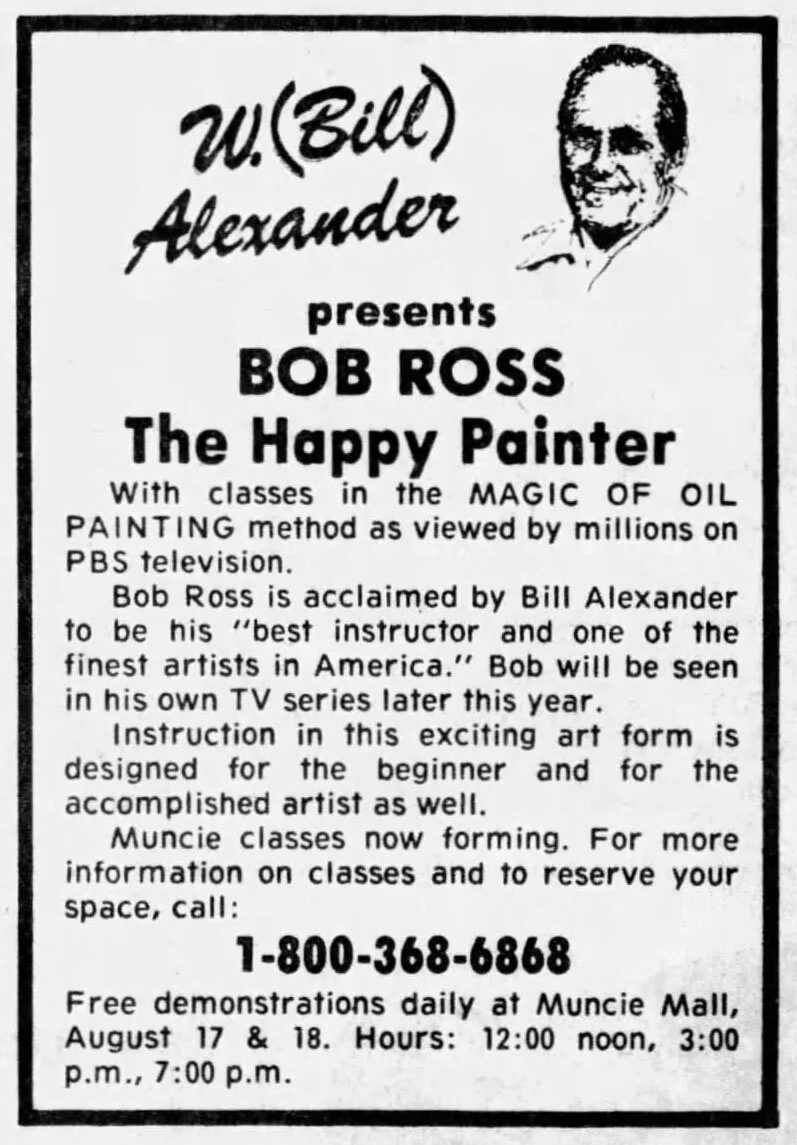
Look carefully at that advertisement.
There was no assumption that Ross would become an international celebrity. He was simply trying to convince ordinary Americans that they might enjoy learning to paint.
The advertisement even promised demonstrations inside a shopping mall.
For those of us who remember 1980s malls, imagine the experience: walking past the familiar storefronts, the food court, and the record stores, only to discover Bob Ross demonstrating the creation of an entire landscape.
That was how genuinely accessible his art was supposed to be.
It belonged wherever people happened to gather.
The Day Bob Ross Helped a Banker Become an Artist
One particularly delightful story comes from October 1983.
WIPB was preparing for its annual fundraising telesale, and organizers wanted to offer something considerably more interesting than the usual auction merchandise.
The plan was to have three local citizens create original oil paintings under the instruction of Bob Ross. Their finished canvases would then be auctioned to benefit the public television station.
Among the participants was Stefan Anderson, then president of Merchants National Bank.
Anderson was not appearing as an art-world celebrity. He was a local businessman discovering what could happen with a little encouragement and instruction.
At the Delaware County Fair Grounds, Ross guided the participants through clouds, mountain highlights, and the techniques that would eventually become familiar to millions.
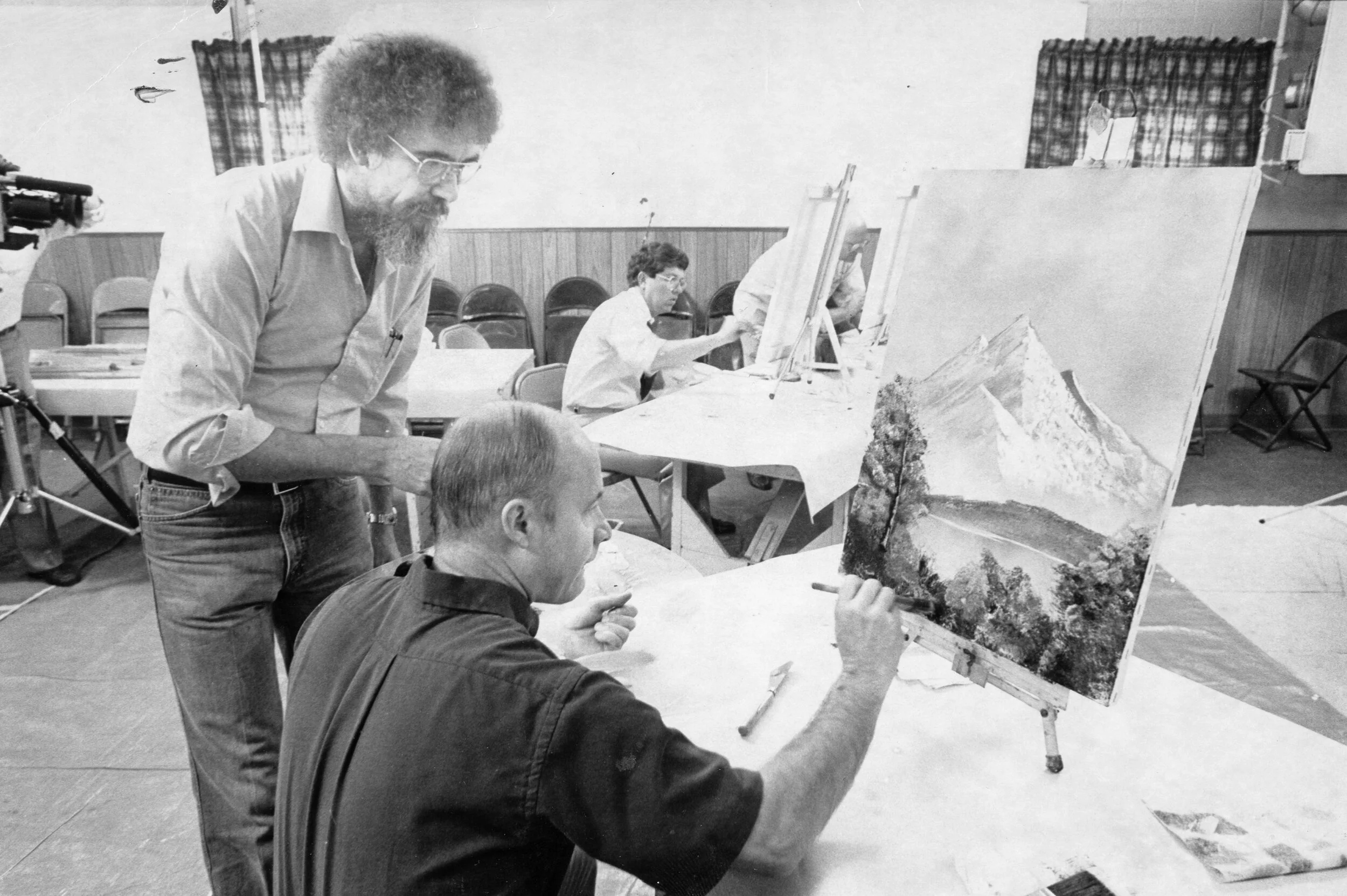
What makes this story special is not simply that Anderson completed a painting.
It is what happened afterward.
According to Minnetrista’s historical account, Anderson continued to treasure the canvas for decades, eventually displaying it in a lake cottage.
Years later, his grandson discovered the painting and was amazed that his grandfather had once painted alongside Bob Ross.
One afternoon of instruction had become a family keepsake.
That is the part of Ross’s legacy that cannot be measured by television ratings or auction prices. Somewhere in America, there are people who still possess their own canvases, created during an afternoon when an enthusiastic instructor convinced them to give painting a try.
To Ross, the person holding the paintbrush mattered just as much as the picture.
When a Colorblind Viewer Inspired an Entire Episode
One of the finest examples of Ross responding directly to his audience occurred during the early years of The Joy of Painting.
During a painting demonstration at a shopping mall, a man approached Ross and explained that he did not believe he could paint because he was colorblind.
Ross took the comment seriously.
Instead of dismissing the man’s concern, he decided to devote an entire television episode to demonstrating how much could be accomplished with a restricted palette.
The result was the memorable Season 2 episode Shades of Grey, originally broadcast in September 1983.
Using a mixture of blue and brown to produce gray tones, together with white, Ross painted an elaborate winter landscape filled with mountains, trees, reflective water, and a small cabin.
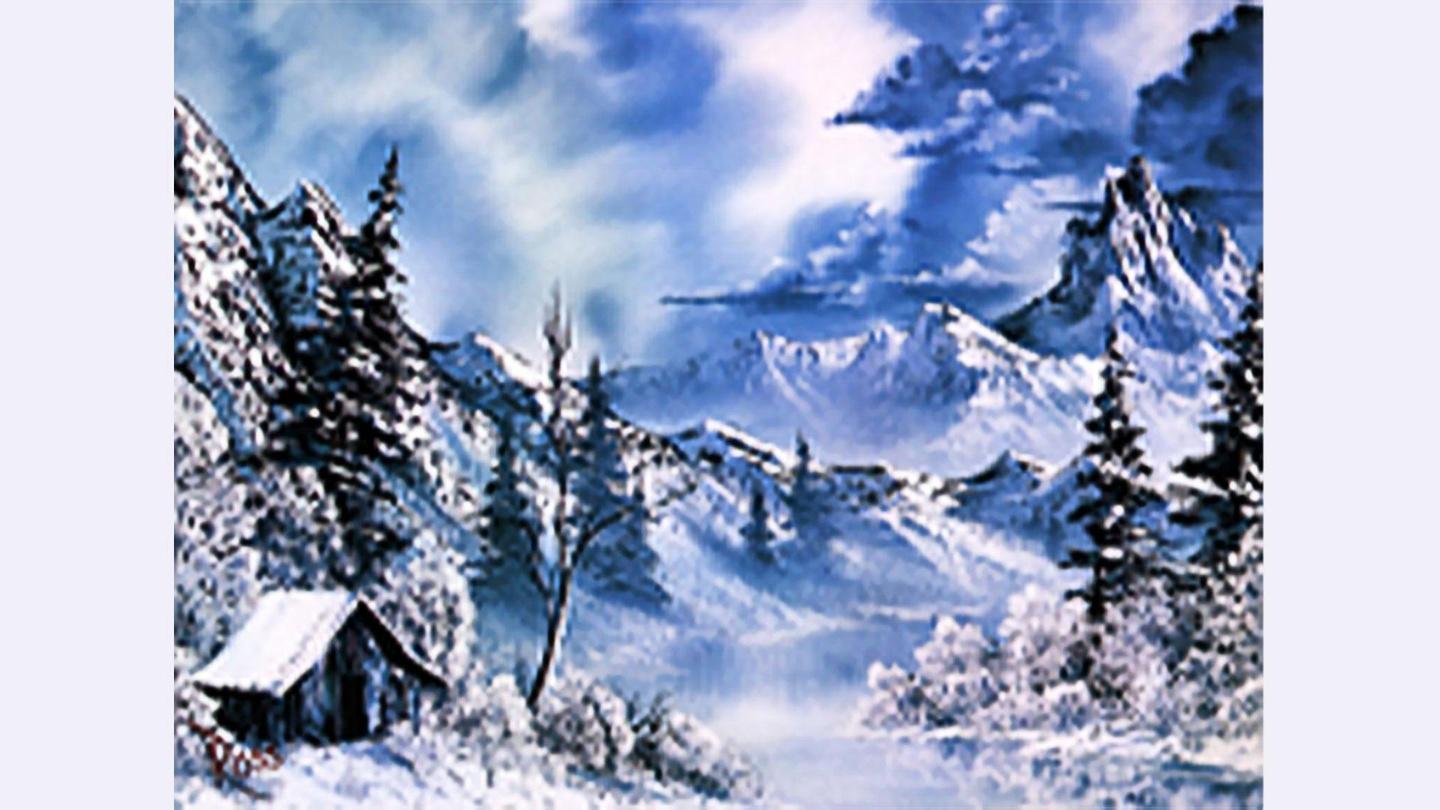
Consider what this tells us about his approach to teaching.
Ross had an internationally distributed television program, yet a single conversation with a stranger influenced the subject of an episode.
He recognized that the important obstacle was not necessarily the man’s vision. It was his belief that creating art was impossible for him.
And Ross wanted to challenge that belief.
The finished painting was an extraordinary demonstration of light, shadow, texture, and imagination, achieved without the colorful assortment of pigments ordinarily associated with his work.
He was not merely teaching someone to paint mountains.
He was demonstrating that creativity could remain available even when someone believed the usual methods were closed to them.
WATCH THE ORIGINAL 1983 EPISODE
Bob Ross — Shades of Grey (Season 2, Episode 4)
Watch the full episode on the official Bob Ross YouTube channel
The Surprising Secret of Bob Ross’s Cabins
Here is something you may never have noticed while watching The Joy of Painting.
Many of Bob Ross’s cabins were missing one very ordinary architectural feature.
A chimney.
In a fascinating statistical examination of the paintings created for his television series, journalist Walt Hickey cataloged the objects and landscapes Ross repeatedly included.
Mountains, forests, bodies of water, and rustic structures were common subjects.
Yet there was something unusual about those little buildings tucked away among the trees.
According to longtime Ross associate Annette Kowalski, the absence of chimneys was usually intentional. She explained that Ross generally preferred to avoid obvious signs of human occupation in his landscapes.
There were exceptions, and Hickey eventually located a painting that did contain a chimney, but the general pattern was revealing.
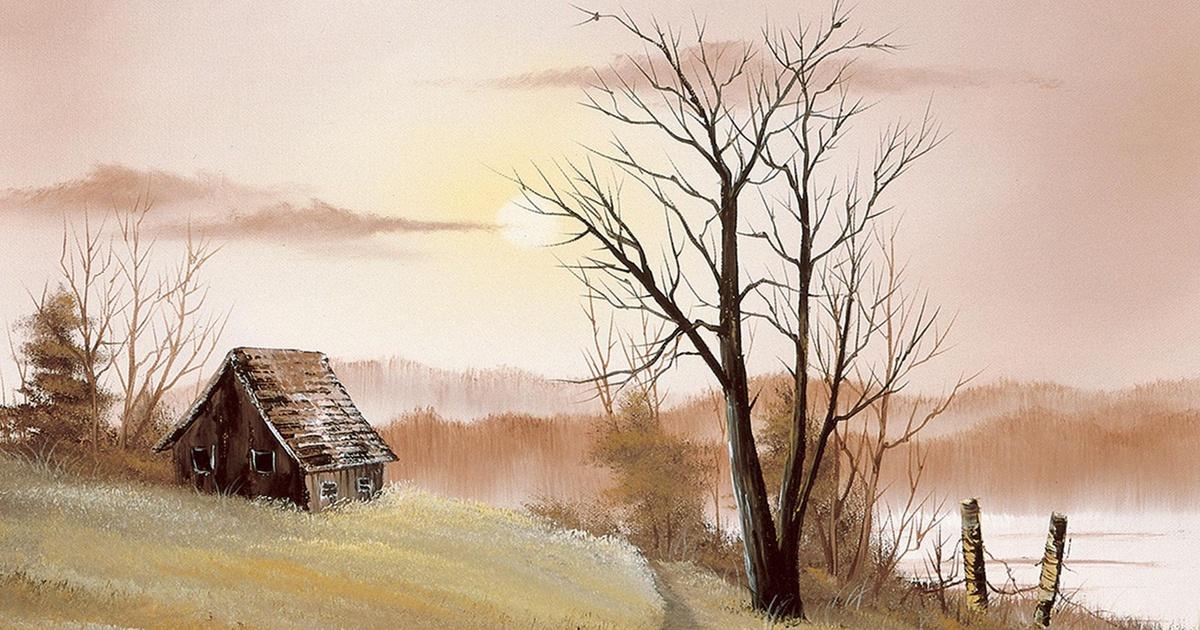
Ross was constructing places that seemed to exist just outside ordinary human activity.
The cabins might welcome an imaginary visitor, but the forests and mountains did not require a human story to make them meaningful.
Perhaps that helps explain why his paintings feel so open to interpretation.
A viewer can imagine discovering one of those rustic cabins beside a stream, sitting on the porch, or simply walking along a trail beneath enormous trees.
Ross left room for the viewer’s imagination to complete the scene.
We cannot know every personal reason behind those artistic choices. But the remarkable consistency of his landscapes suggests an artist with a much more deliberate visual philosophy than casual observers might assume.
The Television Star Who Found a Second Home in Indiana
The public knows Bob Ross as an American television personality. Residents of Muncie, Indiana, also came to know him as a neighbor and friend.
For years, Ross returned regularly to the community to record The Joy of Painting.
The program’s production was far removed from the extravagant world of Hollywood television.
Its early Indiana episodes were recorded inside the historic Lucius L. Ball house, where a former living room became an improvised television studio.
Imagine that for a moment.
One of the most recognizable programs in public television history was being created inside what had once been somebody’s family home.
And it worked.
The relationship between Ross and the station’s personnel became genuinely personal. Minnetrista’s accounts describe jokes, shared stories, and the ordinary friendships that developed among a small group of people working together over many years.
Ross even maintained a home in the Muncie area.
It was much more than a temporary workplace.
According to Minnetrista, some 390 episodes of the series were recorded in Muncie over the program’s run, including episodes after WIPB moved into newer Ball State University facilities.
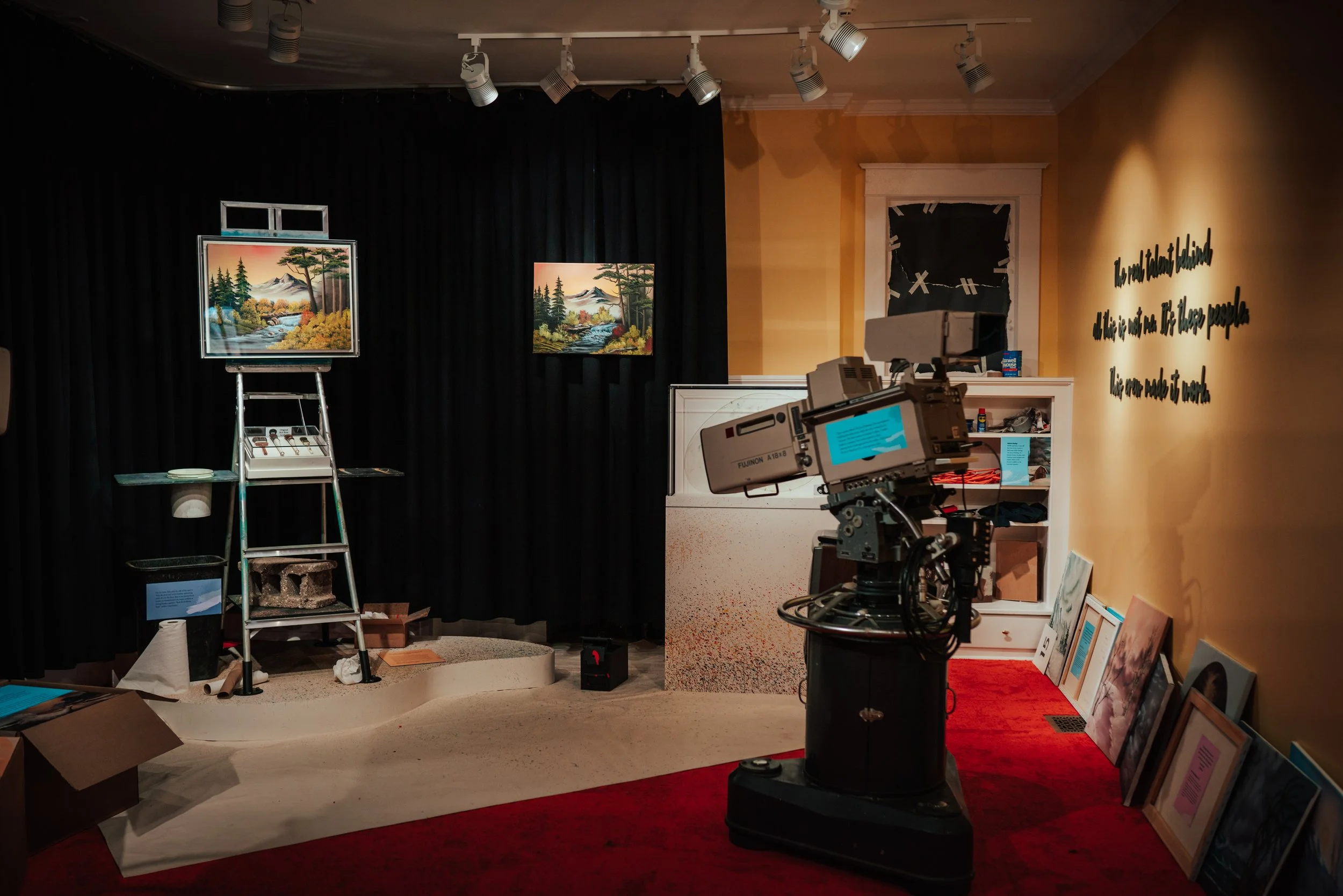
Today, that connection survives through the Bob Ross Experience at Minnetrista Museum & Gardens.
Visitors can walk into the historic house, discover original paintings and artifacts, and explore the space where so much of the program’s history unfolded.
There is something wonderfully appropriate about the preservation of that building.
Ross never required a glamorous studio to become successful.
He needed a canvas, the right tools, an audience willing to learn, and a group of people who believed in him.
Sometimes the most important cultural achievements happen in surprisingly ordinary places.
The Playful Bob Ross Behind the Cameras
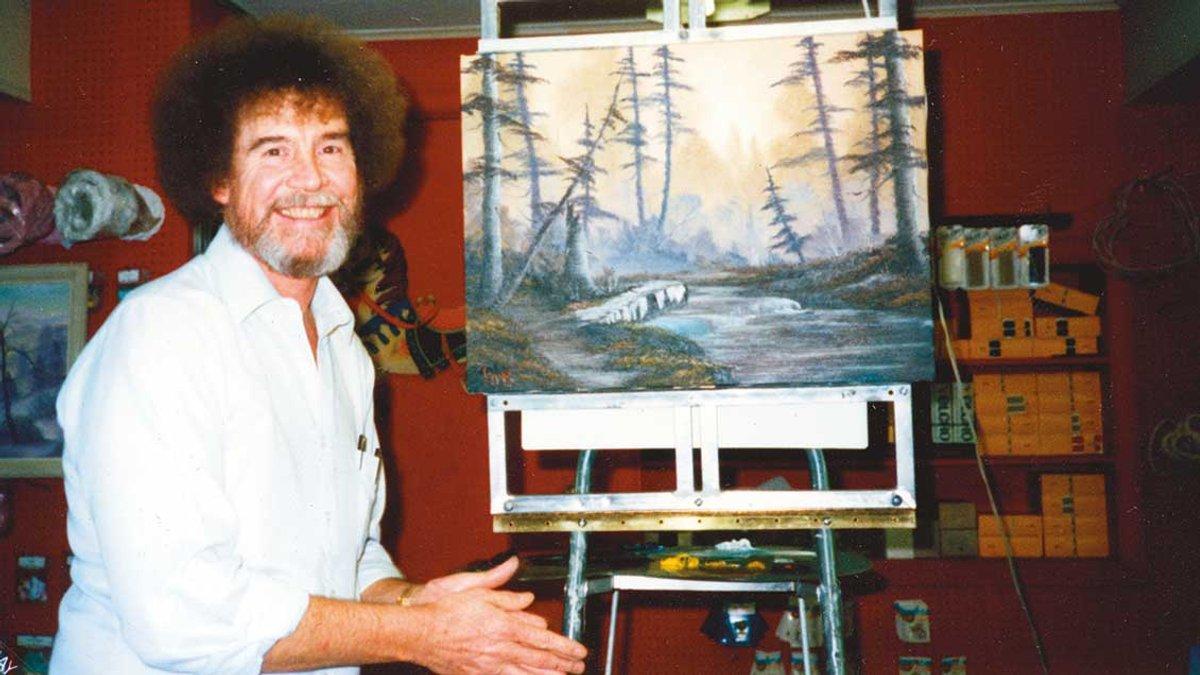
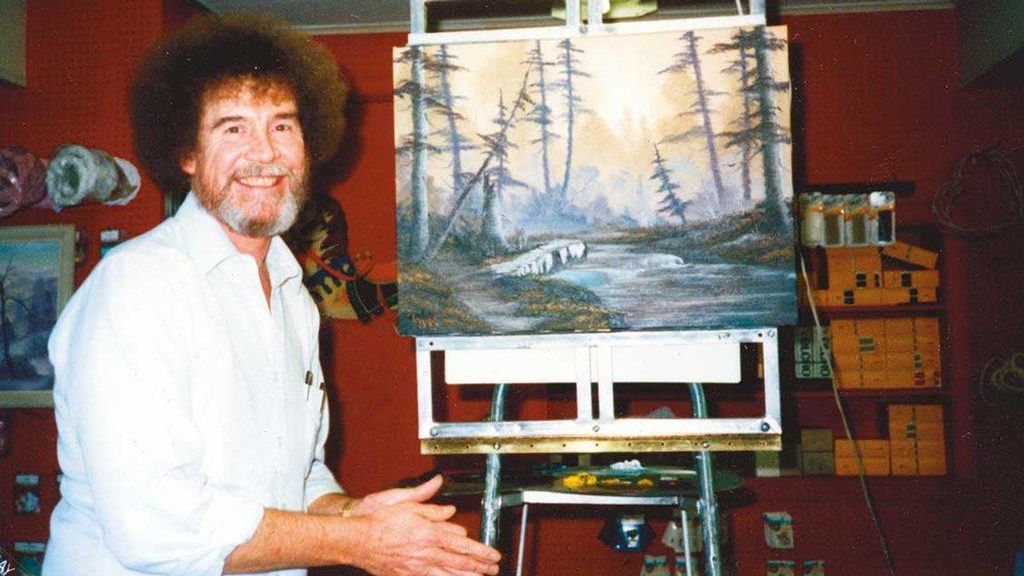
Although Ross’s television program cultivated a remarkably peaceful atmosphere, archival photographs reveal a man who clearly enjoyed being playful.
One charming photograph shows him smiling while holding a production clapperboard, apparently delighted by the opportunity to fool around with an object usually associated with the technical side of filming.
Another memorable image shows Ross enjoying himself behind a camera rather than standing in front of one.

This was a television star who did not appear particularly concerned with acting like a television star.
He was comfortable being himself.
That quality is more significant than it might initially seem.
Many beloved personalities from the 1980s became famous through larger-than-life characters, carefully scripted catchphrases, extravagant productions, or constant publicity.
Ross became famous through an almost entirely different formula.
He communicated in a conversational manner, painted with extraordinary efficiency, and made the process entertaining without treating his audience as spectators who were incapable of joining in.
Even the occasional bursts of enthusiastic brush cleaning offered a glimpse of his playful personality.
He understood that painting could be both serious craftsmanship and tremendous fun.
And he made it perfectly acceptable to enjoy both.
In 2026, Bob Ross’s Paintings Are Still Helping Public Television
Perhaps the most extraordinary birthday story of all is unfolding in our own time.
More than thirty years after his death, original Bob Ross paintings are being sold to help support the public broadcasting institutions that helped introduce him to the world.
In 2025, Bob Ross Inc. donated a group of thirty paintings for a series of auctions benefiting American public television stations facing funding challenges.
These were not inexpensive reproductions.
They were original works by Ross himself, many preserved in storage for decades after their creation.
The public response has been remarkable.
By September 2026, the first ten works offered through the principal Bonhams fundraising series had generated more than $2 million in sales.
And one particular painting returned some of that financial support directly to the community that had played such a meaningful role in Ross’s career.
On June 30, 2026, an original painting titled Mountain Summit, connected to Season 13, Episode 10 of The Joy of Painting, sold at auction for an astonishing $320,000.
The net proceeds benefited Ball State PBS.

There is something almost poetic about the arrangement.
Decades ago, a relatively unknown painting instructor discovered a supportive group of people at a public television station in Indiana.
That station helped him share his work with millions.
Today, the paintings created during that remarkable partnership are helping sustain the same kind of educational and cultural programming for another generation.
It is an extraordinary full-circle moment.
In September 2026, additional works including Wilderness Cabin, By the Sea, and Under Pastel Skies were also offered as part of the fundraising initiative.
The collection illustrates just how much variety existed in Ross’s body of work.
His seascapes, for example, sometimes offered dramatic waves, rugged cliffs, and brilliant skies quite different from the peaceful mountain scenes for which he became best known.
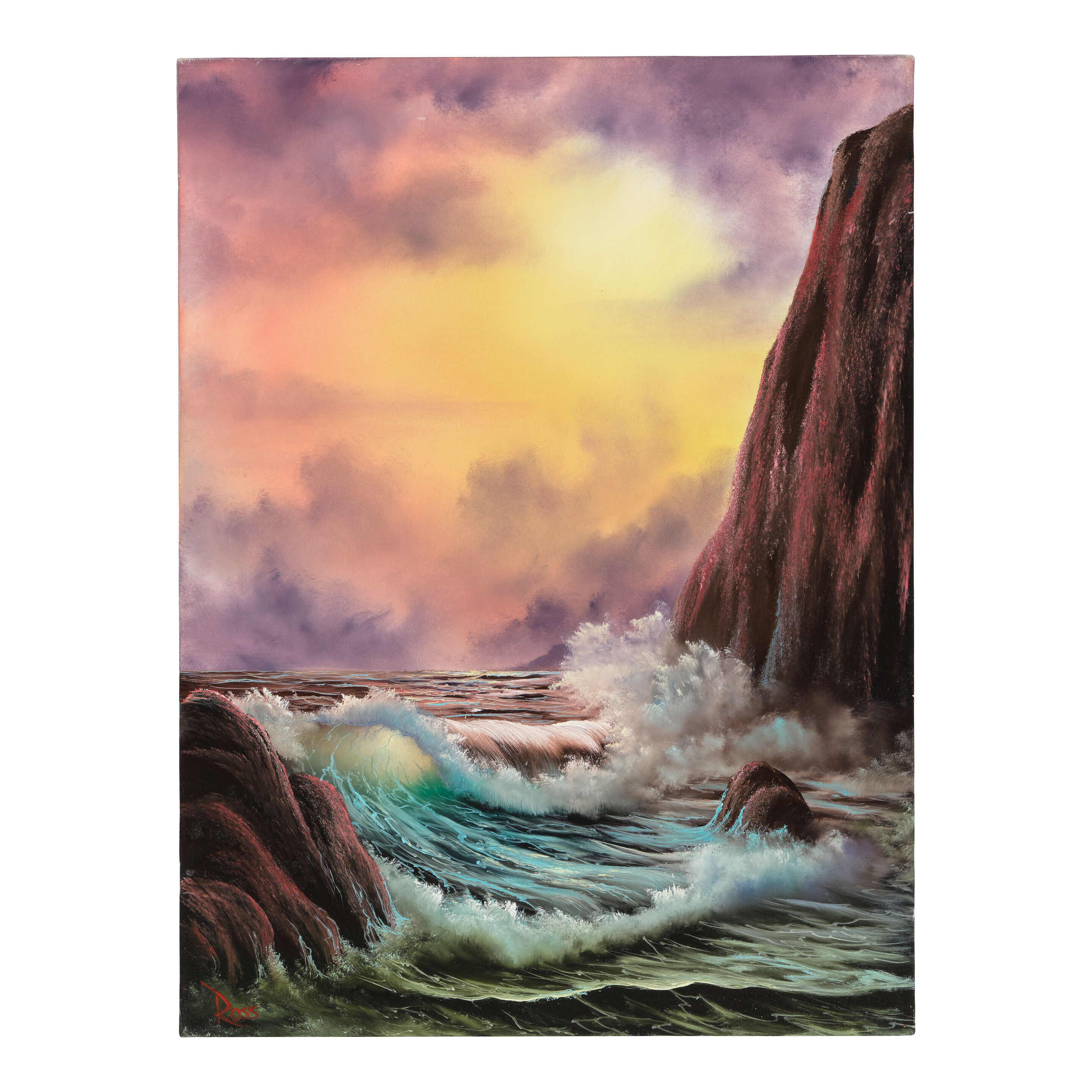
And with another public television benefit auction scheduled for November 2026, the story is not finished.
It is remarkable to consider how a painter who passed away in 1995 can still have such a tangible influence on the future of public broadcasting.
Ross’s paintings are doing what his television program always tried to do: creating opportunities for other people.
He Never Needed to Be the World’s Greatest Painter
There is a curious debate that periodically surrounds Bob Ross.
Was he a great painter?
His work generally did not pursue the intellectual experimentation or revolutionary techniques associated with the most celebrated movements in fine art.
His paintings were accessible, recognizable, and frequently built upon familiar subjects.
Some art critics have dismissed that approach as overly sentimental or repetitive.
But those criticisms miss something fundamental about the purpose of his television program.
Ross was not attempting to convince viewers that they were watching an artistic genius whose abilities they could never hope to approach.
He was showing them that a beautiful landscape did not have to remain something only a professional artist could create.
He dismantled the intimidating distance between the artist and the audience.
And whether the finished canvas became a masterpiece was not necessarily the most important outcome.
The experience of creating it mattered.
That is a contribution to American art education worth celebrating in its own right.
Happy Birthday, Bob. Your Canvas Is Still Growing.
There is something deeply moving about celebrating the birthday of someone who has been gone for more than three decades.
Bob Ross never lived to see the full reach of the internet, the enormous popularity of his videos among younger generations, or the remarkable financial value his original paintings would eventually command.
He never saw his former television studio become a museum destination welcoming visitors who had grown up watching him.
And he certainly never saw the extraordinary events of 2026, when his artwork helped bring substantial financial support to public television.
But perhaps the truest legacy of Bob Ross is not preserved inside a museum or attached to an auction record.
It lives in the people who remember an encouraging teacher standing in front of an easel.
It lives in ordinary paintings hanging on family walls.
It lives in people who discovered an unexpected creative ability because somebody finally told them to try.
And it lives in the new generations who encounter his program and discover that art can be approachable, enjoyable, and wonderfully personal.
Today, October 29, 2026, Robert Norman Ross would have been eighty-four years old.
His life ended much too early, but the influence of that life continues to expand in ways that few television personalities ever experience.
So here’s to the traveling art instructor in the rusty camper.
Here’s to the teacher who encouraged a banker to pick up a paintbrush.
Here’s to the man who created an entire painting because one viewer believed he couldn’t paint.
And here’s to the smiling television host who proved that extraordinary things could happen in the most ordinary places.
Happy 84th Birthday, Bob Ross.
Thank you for every beautiful world you helped someone imagine.
Now we’d love to hear from you:
Did you ever try painting along with Bob Ross? Did your family watch The Joy of Painting? And which of these behind-the-scenes stories surprised you the most?
Share your memories in the comments, and help us celebrate the man who brought the joy of painting into homes around the world.
For more nostalgia, television history, and pop culture memories, visit SerpentorsLair.com.
Historical Sources & Further Reading
- Bob Ross Inc. — Official Biography
- Minnetrista — Experiencing Bob Ross at Minnetrista
- Minnetrista — Teaching for Telesales
- PBS — Shades of Grey Episode and Transcript
- Minnetrista — The Bob Ross Experience
- FiveThirtyEight — A Statistical Analysis of the Work of Bob Ross
- Ball State University — Mountain Summit Auction, June 2026
- Town & Country — September 2026 Bob Ross Public Television Auctions
About the Author
Adam Jared is the founder of SerpentorsLair.com, a pop culture and entertainment publication dedicated to celebrating nostalgia, collectibles, film, television, and the creative personalities who shaped generations of fans. He holds a Master of Science in Social Media Management and is currently pursuing a PhD in Strategic Communication. His editorial work explores the relationship between popular culture, media history, childhood memories, and the communities that keep these traditions alive.