G.I. Joe Cover Artist Monte M. Moore | Exclusive Interview
SERPENTORSLAIR.COM
EXCLUSIVE ARTIST SPOTLIGHT
THE ARTIST BEHIND THE G.I. JOE COVER
Monte M. Moore on G.I. Joe, Star Wars, Lady Death, and the Stories Only He Could Tell
EXCLUSIVE INTERVIEW BY ADAM JARED
NOVEMBER 22, 2026
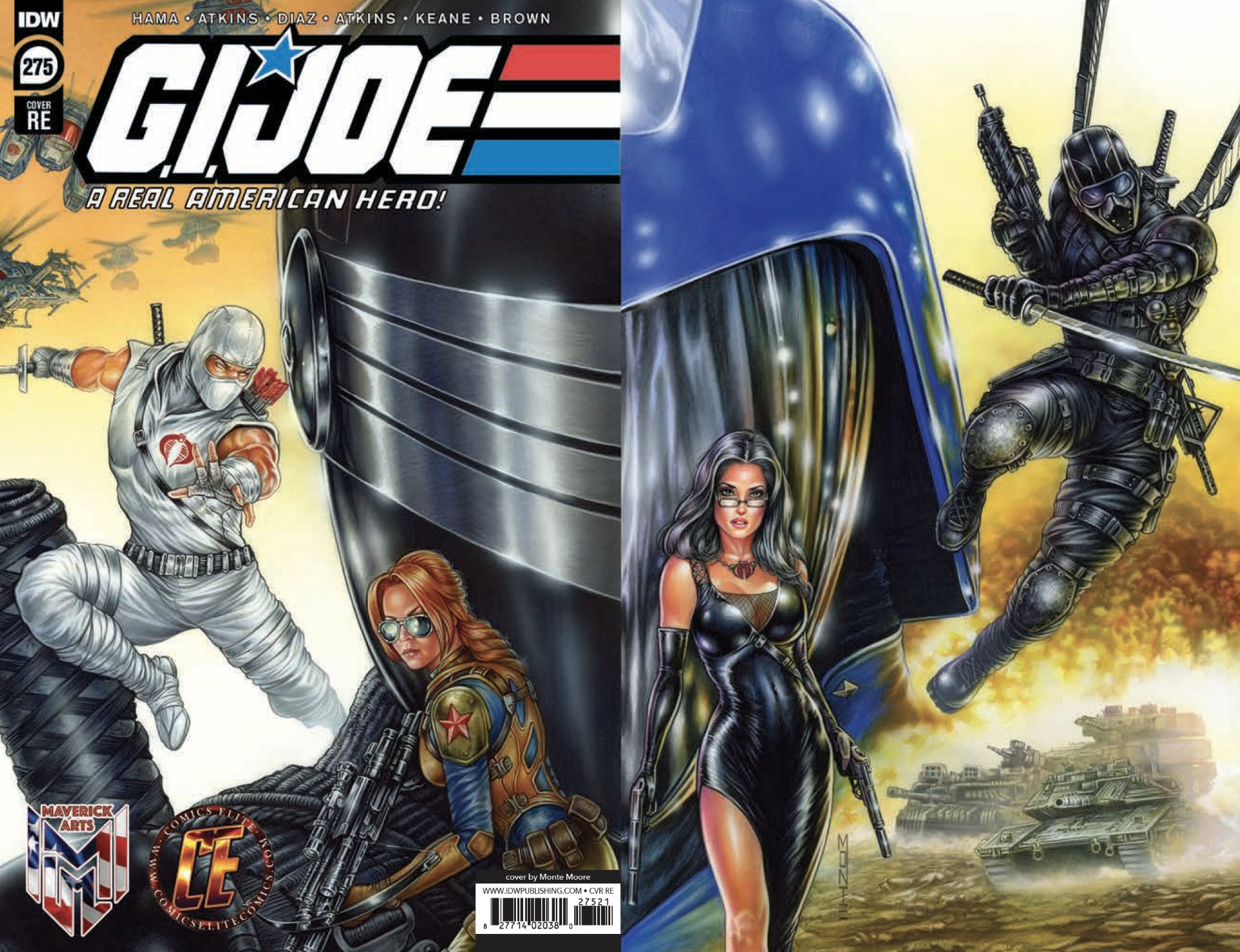
When Monte M. Moore wanted to draw G.I. Joe, he didn’t wait for an invitation.
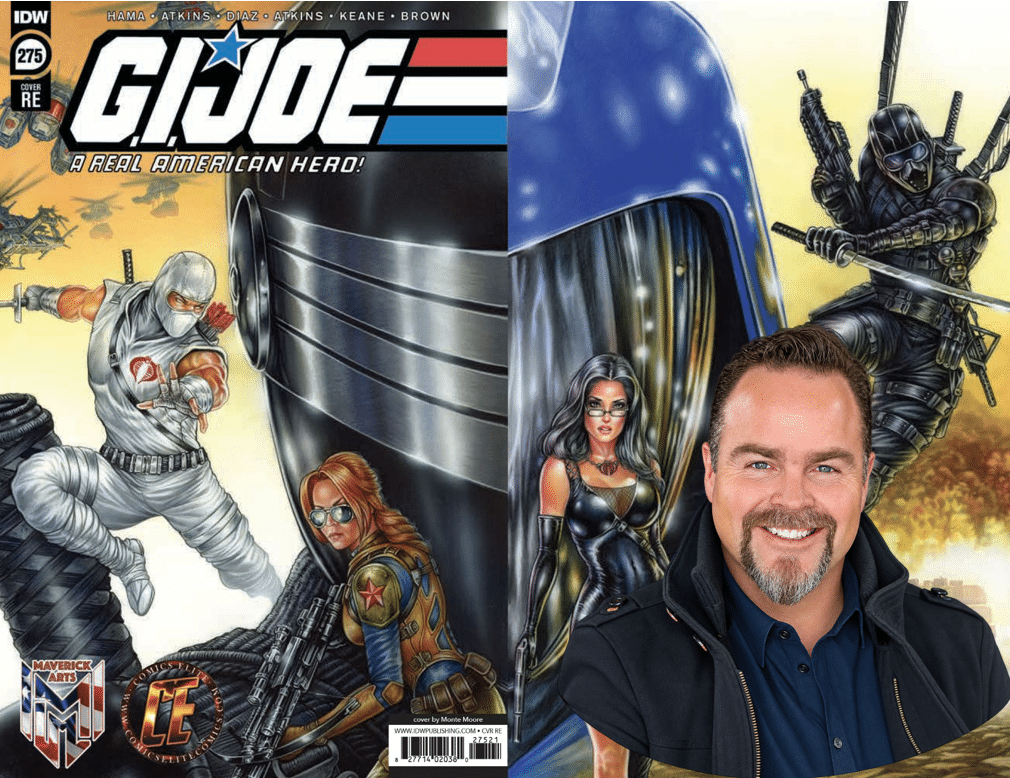
The veteran illustrator approached Comics Elite with an idea: create a spectacular wraparound variant cover for G.I. Joe: A Real American Hero #275 featuring the legendary heroes and villains he had grown up watching.
It was a passion project that brought together childhood memories, decades of artistic experience, and an extraordinary amount of creative freedom.
And its story came with a surprising twist. When the original artwork eventually resurfaced at auction, Moore tried to buy it back—but another collector outbid him.
Yet G.I. Joe represents only one chapter in Moore’s remarkable creative career.
From Star Wars and The Mandalorian to Teenage Mutant Ninja Turtles, Lady Death, fantasy illustration, sculpture, filmmaking, and his own graphic novels, Moore has spent decades moving between some of popular culture’s most recognizable worlds.
For this exclusive SerpentorsLair.com artist spotlight, we sat down with Moore to discuss the personal stories behind his artwork, the unlikely circumstances that launched his career, the original creations closest to his heart, and the future of professional illustration.
Interview lightly edited for spelling, punctuation, and readability.
01 | Bringing G.I. Joe to Life
ADAM JARED
Our readers at SerpentorsLair.com are especially passionate about G.I. Joe. One of your most exciting contributions was your spectacular wraparound variant cover for G.I. Joe: A Real American Hero #275. How did that project come together, what was your artistic approach, and did G.I. Joe have a personal significance to you before the assignment?
MONTE M. MOORE
That cover was one of the few that I personally sought out and wasn’t something assigned or offered to me.
It was during the pandemic, and I approached Comics Elite and told them that IDW had an opportunity with G.I. Joe. I asked whether they would partner with me on the sales and distribution part if I did the art.
Honestly, it was a passion project for me because I watched the animated cartoon every day after school, and to this day I tell people, “Knowing is half the battle!”
I chose characters that were my favorites, as there was no real art director on the project. It was up to me to do a wraparound, and that gave me the chance to add more characters and elements like tanks, helicopters, and action characters that I felt captured the flavor of G.I. Joe.
Recently, the original came up for auction online, and I tried to buy it back. But it was very desirable, and I got outbid many times, so it went to a good collector, I hope!
I believe during the creation I did a video discussing the composition and sketch phase, and that was posted during the San Diego Comic-Con@Home edition that year, which was all online instead of in person.
“That cover was one of the few that I personally sought out and wasn’t something assigned or offered to me.”
— MONTE M. MOORE
02 | The Beginning of an Artistic Journey
ADAM JARED
Monte, you’ve built a remarkable career spanning comics, fantasy illustration, fine art, sculpture, and filmmaking. But your story began far from the comic-book industry, growing up around your family’s ranching heritage in Idaho. What experiences first sparked your imagination, and when did you realize art was what you wanted to pursue?
MONTE M. MOORE
For me, the spark actually came from being a Dungeons & Dragons player and being inspired by all the art from the source books and magazines like Dragon magazine. There was so much really great drawn and painted art.
Other than drawing a bit like most kids, I didn’t do much art until I started playing D&D in the early ’80s.
The desire to draw better came from the fact that I really wanted to draw better character profile pictures in the little box at the top of the character sheet. Mine weren’t very good, and everyone had helmets, so no faces to draw!
My mom was an artist and had countless books on drawing and the human figure, so she gave those to me. I started from there and then grew as an artist by copying art from Larry Elmore, Keith Parkinson, and other great fantasy artists of the ’80s.
Even in high school, I wasn’t a standout artist in my early years. But by the time I graduated, I had risen to the top of the school and county and received a few scholarships to help with college costs.
I’m not a “talented” artist because people never say, “That guy or gal just gets more and more talented all the time.”
Skills grow over time, not talent. Talent you are born with. If anything, my strong suit is an unrelenting dedication to be a better artist than I was yesterday, and that has served me better than being talented at a really young age.
The only art contest I won when I was younger was because there were no other entrants in my age category!
03 | The Responsibility of Illustrating Legendary Characters
ADAM JARED
Throughout your career, you’ve worked with recognizable entertainment properties including Star Wars, Teenage Mutant Ninja Turtles, Transformers, Marvel, and DC. How do you balance honoring the established identity of these characters with introducing something uniquely your own? Is there a particular assignment that stands out because of its creative freedom?
MONTE M. MOORE
I think I’ve been fortunate to have some of the widest breadth of assignments of most artists, as my range has run from Disney to Playboy and Western to sci-fi.
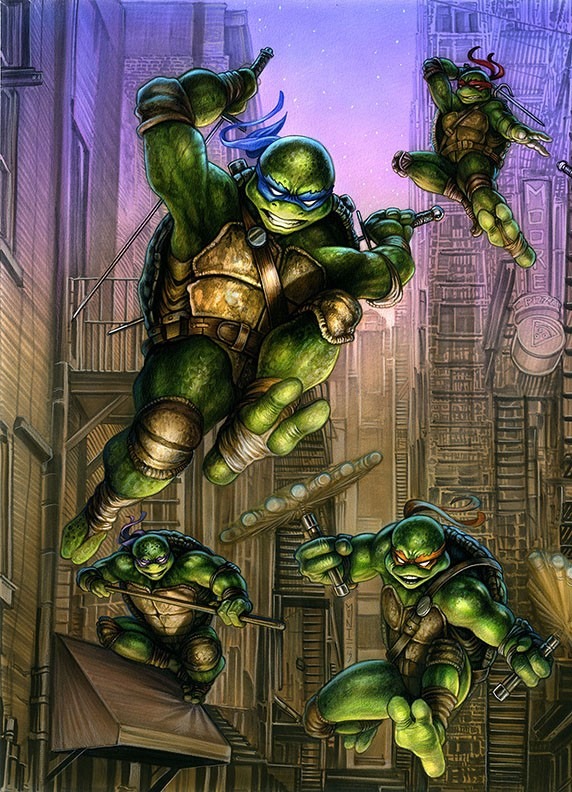
Each one was unique because I grew up with all of these things, from reading the first black-and-white TMNT issues to Star Wars being my number-one love.
I remember working on the Harry Potter game, and there were no movies out yet.
I asked the art director, “Hey, this card is the entrance to Hogwarts. What does it look like?”
He said, “No one has ever drawn or depicted it, so it’s up to you what it looks like!”
That was a cool moment, to be part of only 13 artists worldwide working on the hottest property in the world at the time, and to be among the first to create images of chocolate frogs, racing brooms, and other iconic characters and elements.
Most of the other times, you’re adding to an existing world and aren’t allowed to stray very far from anything that is canon, so you do your best to live up to the expectations of fans.
04 | The Mandalorian and the Art of Visual Storytelling
ADAM JARED
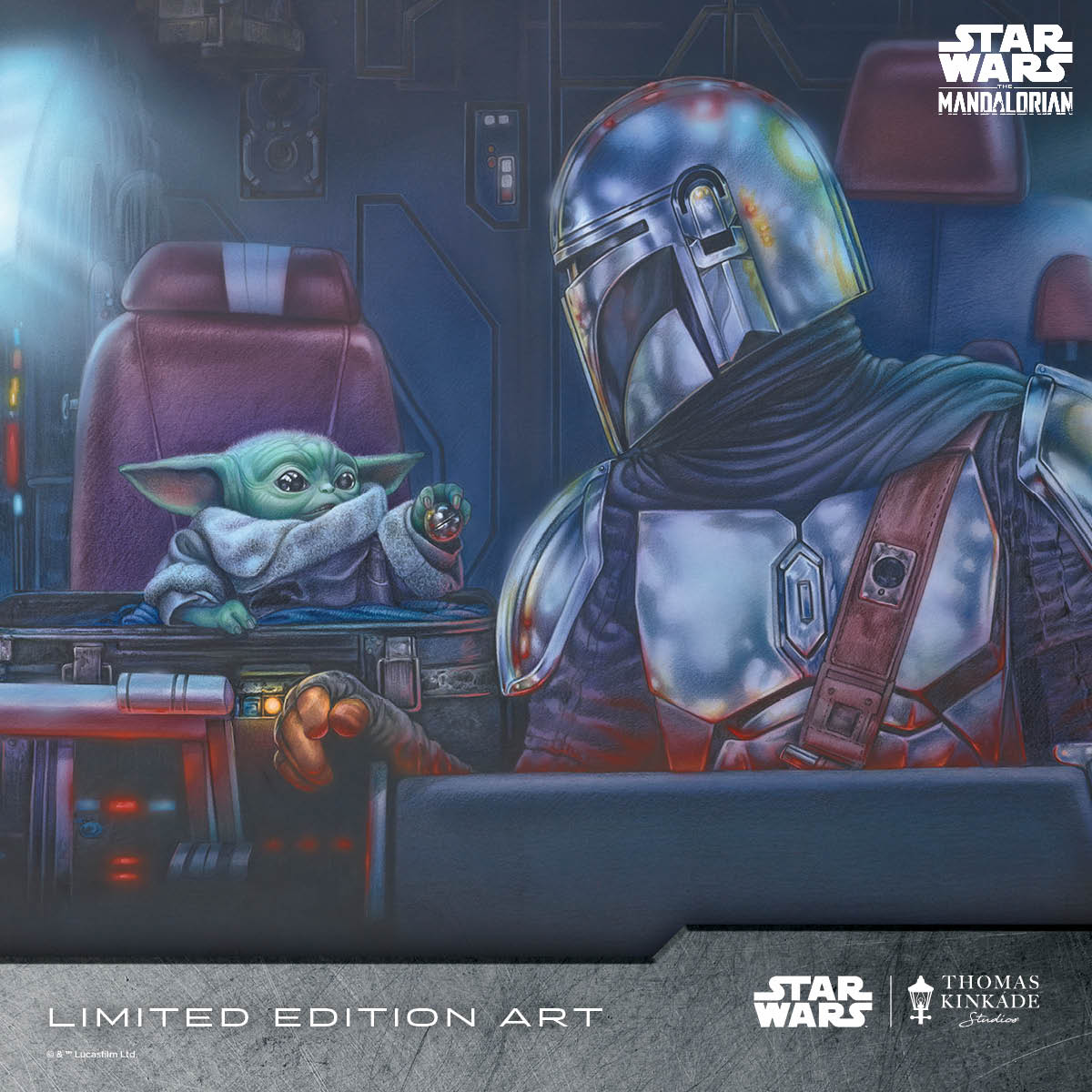
Your work on The Mandalorian fine-art collection for Thomas Kinkade Studios represents another fascinating dimension of your career. These paintings must capture atmosphere, emotion, and cinematic storytelling in a single image. What is the secret to making viewers feel as though they’ve stepped directly into that universe?
MONTE M. MOORE
The secret for me is to approach it as a fan and not just an artist.
I ask myself what I would want to put on my own wall as a Star Wars/Mandalorian superfan!
I was the one who approached the publisher, Art Brand Studios, and suggested that they release some art from this new series, The Mandalorian.
Once they agreed, they said, “When do you want to start?”
I thought they would assign a different artist, but they looked at me as the most knowledgeable Star Wars expert in their freelance stable.
So what I thought would be one to three pieces of art turned into over 20 Star Wars and Mandalorian fine-art releases, which are sold at Disney Parks galleries and other licensed fine-art galleries all over the country and the world!
I was shocked when I walked into the San Diego Comic-Con International Museum, and they had my art for sale from that series. What an honor and a shock!
The most successful pieces from the series have been the ones I personally suggested and fought for because I knew they would be successful.
There were a few suggested by others on the art team that I didn’t think would do as well, and they haven’t been nearly as desirable with the fans.
But you can’t knock every one of them out of the park, and at the end of the day, I am the artist, not the art director.
The other aspect of working on an intellectual property like this is that the characters, ships, and depictions have to be exact, no matter their size.
My pieces are all real traditional art and not digital, so you can’t zoom in and just paste a photo into the image and add a filter like much of the artwork on the market today.
05 | Lady Death and the Power of an Image
ADAM JARED
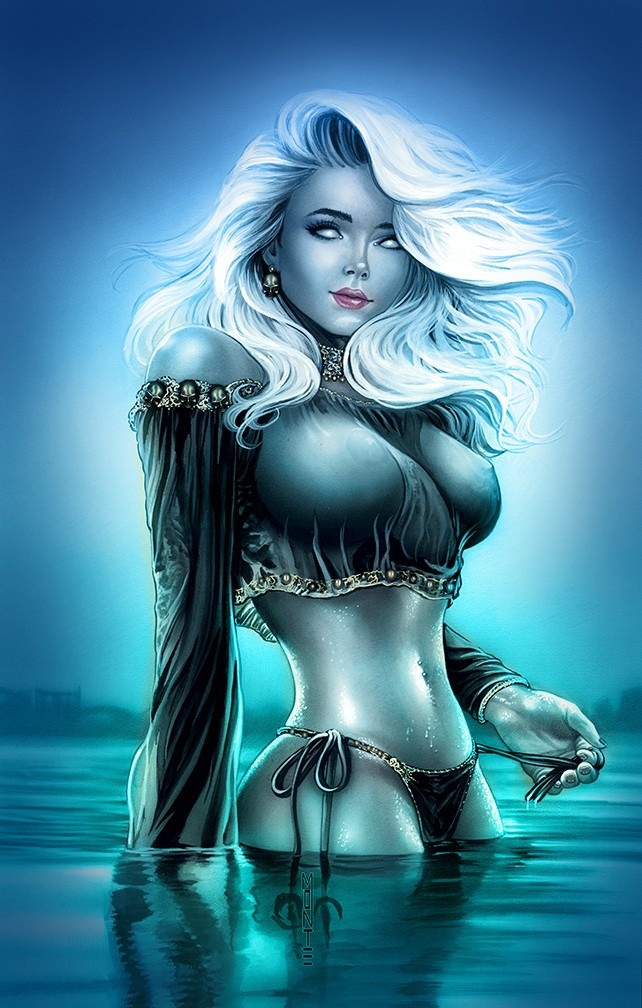
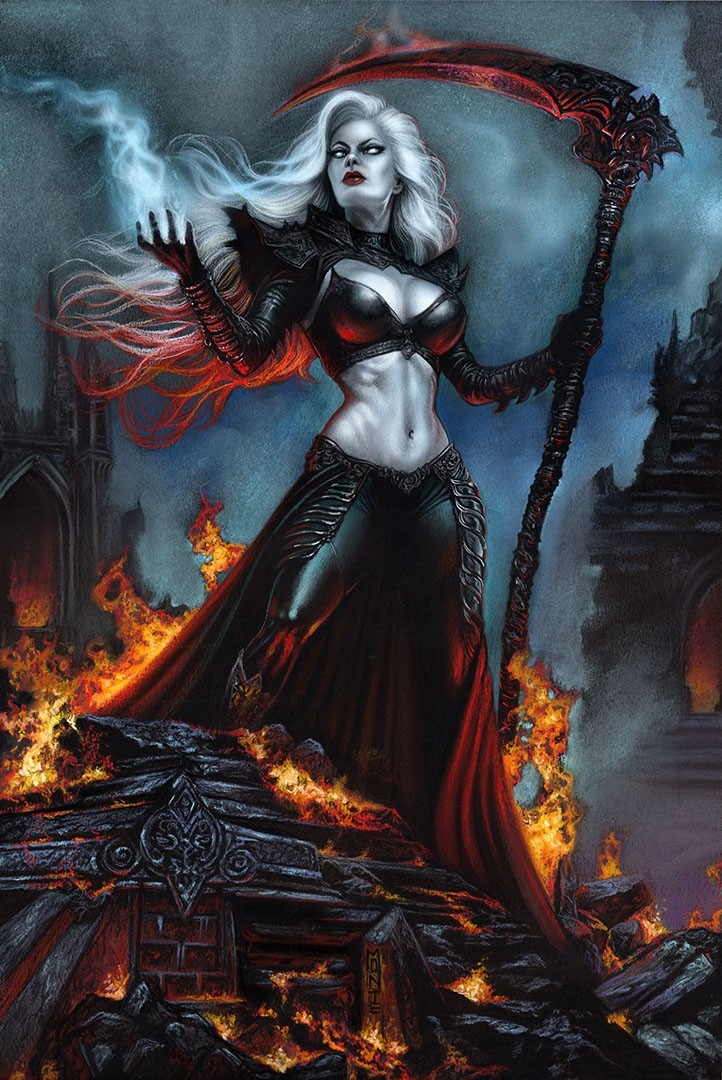
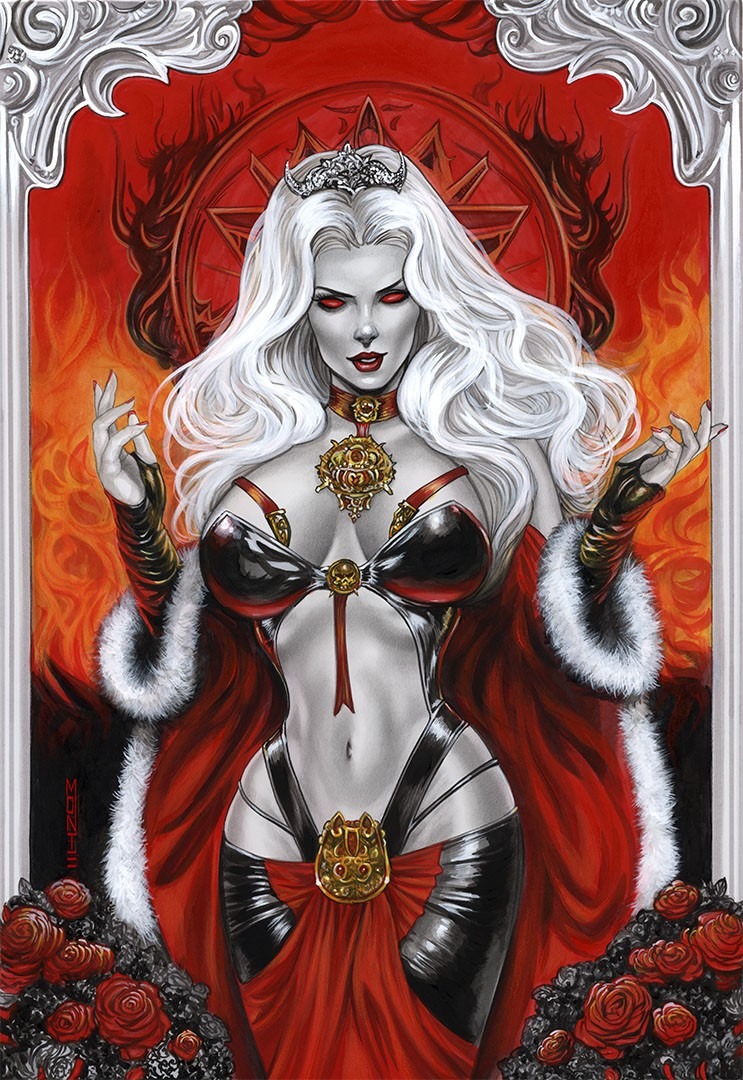
Your fantasy and pin-up illustrations, particularly your work involving Lady Death and Coffin Comics, have earned considerable appreciation from collectors. How do you use composition, expression, and lighting to communicate the personality of these characters beyond their appearance? Has your approach to powerful female characters evolved?
MONTE M. MOORE
When I was younger and just out of art school, I struggled a bit with the perception of others and how they would critique an artist for the choice to draw a provocative female figure.
But some of my biggest influences in that genre were the great illustrators of the 1940s and 1950s, like Vargas, Petty, and the great Gil Elvgren.
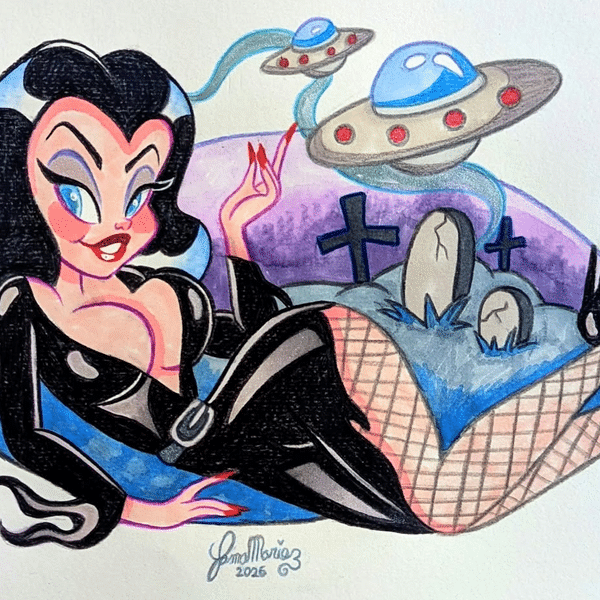
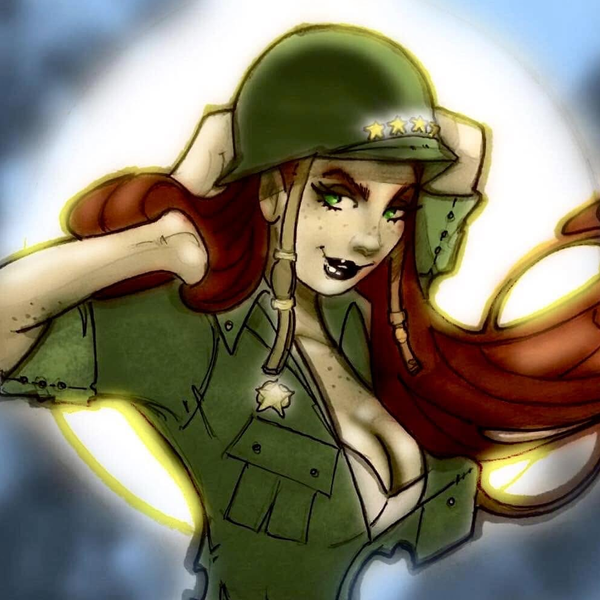
I started with more “good girl” art and then eventually started getting more comics assignments for “bad girl” art that has more edge to it.
Each piece is unique, and I’m certainly better at it now that I’ve done a few thousand pieces of pin-up art.
Early in my career, I became known for it, although that was never my personal goal. I think being known for one thing will stagnate an artist, and you see it all the time now if you look at how most artists stay in their lane and don’t deviate very much.
You won’t see a Western artist do a provocative pin-up, and you won’t often see a strictly pin-up artist paint a desert landscape.
I use a lot of reference material when doing covers for Lady Death and other characters. I think using photos as a basis helps you depict the character in different ways, with slightly different body styles, facial structures, and so on.
Using this approach helps me avoid getting stagnant and also gives me inspiration for different poses.
I keep folders on my computer of literally thousands of photos that I scan through, and when I see something really special and alluring, I might think, “This could be a great Lady Death.”
Then I’ll use that only as a starting point. I might change 10 to 20 elements in the initial pose, from the hands and face to the lighting, to make it my own.
This keeps my art more realistic and not as much in the traditional comic-book style.
I certainly enjoy depicting strong, powerful female characters the most, and I don’t often draw a damsel in distress.
I’d much rather draw a really ass-kicking female who is wreaking havoc like Lady Death, Vampirella, or Red Sonja than someone like Lois Lane tied to railroad tracks who needs to be rescued.
06 | Loco Hero and the Stories Behind the Superheroes
ADAM JARED
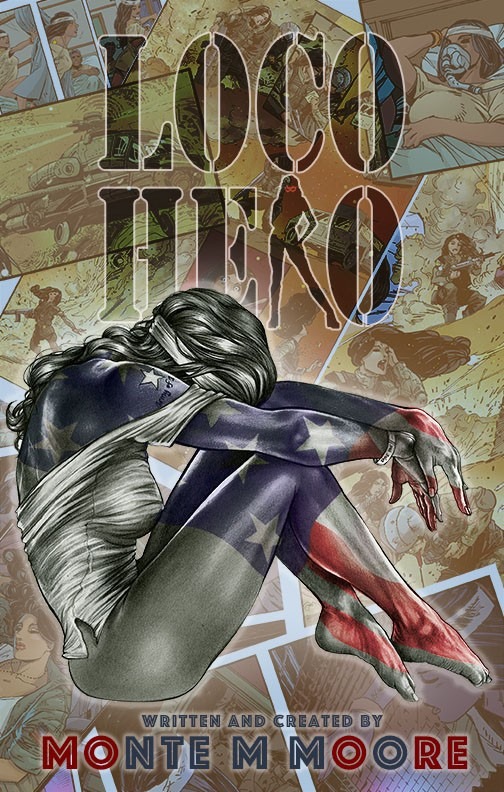
One of the most intriguing projects you’ve created is Loco Hero, featuring Brina Hernandez, a military veteran experiencing homelessness who becomes an unconventional crimefighter. What inspired you to create Brina, and what did you hope readers would understand about her that might challenge their expectations of a superhero?
MONTE M. MOORE
I’m thrilled to see this question, as it’s a really unique story.
I was at San Diego Comic-Con, which I have attended for over 30 years as an artist, and I was walking back to my car as the Masquerade contest had just let out.
As I’m walking down the sidewalk in front of the convention center, I’m passed simultaneously by a group of costumed fans going one way, and the other way I was passing an older homeless woman who was talking to herself very loudly as she pushed her shopping cart full of belongings.
At that moment, the idea came to me: what if I had a heroic character who acted like Batman, but with no money, and lived on the street while dealing with her own mental challenges?
In her mind, she thought she was a superhero and tried to dress the part like the costumed fans I had just seen.
On the way home, I had my buddy drive for a stretch so I could take notes.
As I developed the character, I knew I wanted her to be a strong female. Latina characters are often underrepresented, and then the perfect title of Loco Hero hit me. I knew it was lightning in a bottle.
My own family has military service spanning over 250 years, back to the Revolutionary War, and one of my ancestors fought directly under George Washington.
My grandfather retired as an admiral and commanded his own aircraft carrier in the U.S. Navy, so I knew I wanted to give her a military background.
I’ve lost several friends to suicide over the years and have known several who struggle with PTSD, so this was also an opportunity to shed some light on their struggles with sacrifice, trauma, survivor’s guilt, and the fact that so many veterans end up on the street.
I’ve never heard of a character quite like Brina Hernandez, whose names come from several of my Hispanic friends.
She’s like Batman but with no money, no gadgets, and no Alfred Pennyworth, yet she’s doing the same thing: defending her city and her neighborhood for the right reasons.
Due to head trauma suffered in the first issue, she wakes up thinking she is actually a superhero. She cobbles together an outfit from the donations bin and gets to work kicking ass and saving her neighborhood from a ruthless developer.
She thinks he wants the neighborhood to build a superhero headquarters!
Since 2020, I’ve published nearly 700 pages of graphic novels, but Loco Hero is closest to my heart and has raised the most money for charity of my titles.
07 | Blood N’Bullets and the American West
ADAM JARED
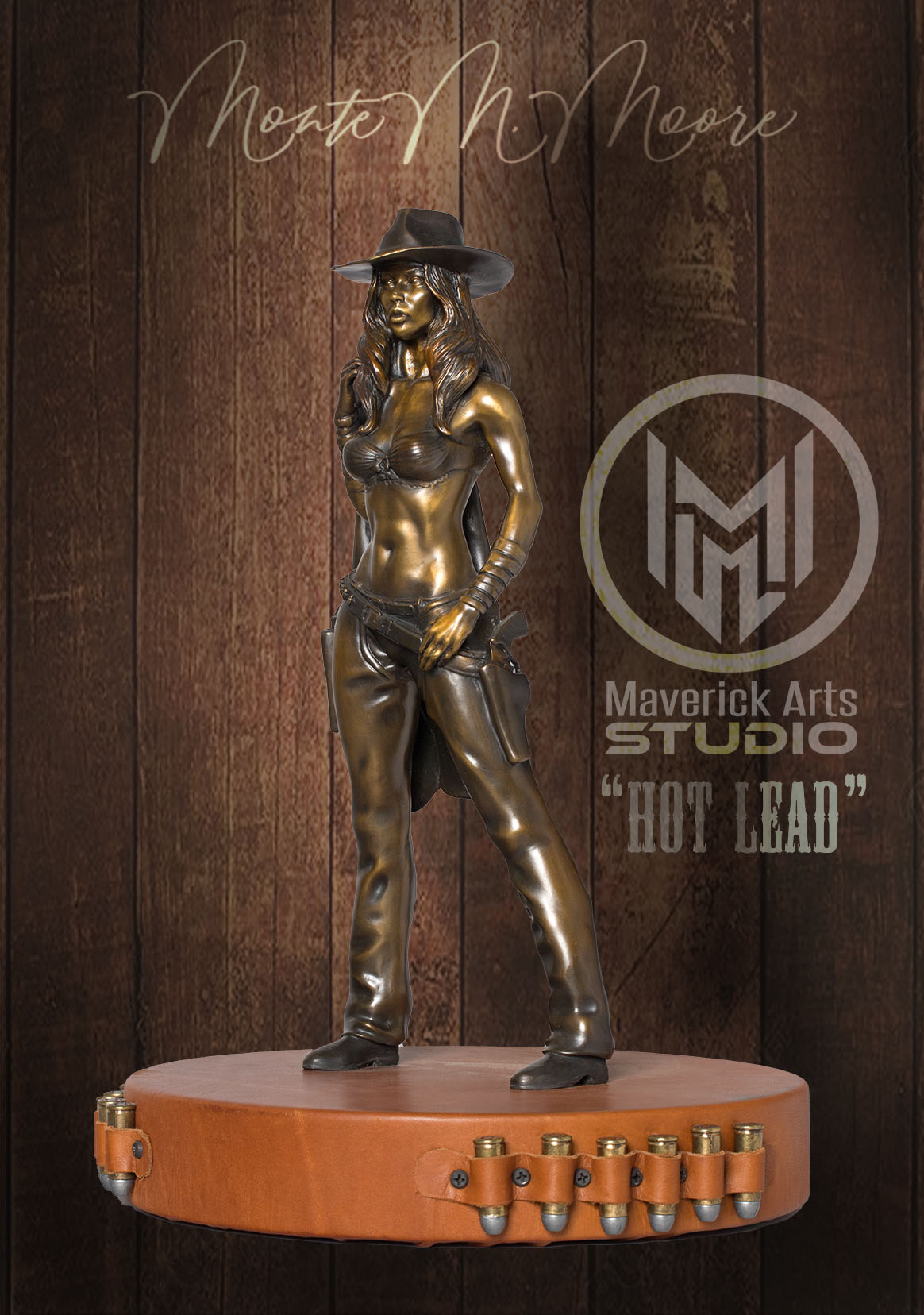
Your creator-owned Blood N’Bullets brings together the American West, supernatural horror, and unforgettable characters such as “Bloody” Mary Masterson and Blackbird. Considering your personal connection to ranching and Western history, what inspired you to combine the Western genre with supernatural storytelling?
MONTE M. MOORE
As you mention, I grew up on an actual working cattle ranch that was nearly 30,000 acres, and I was a crappy cowboy!
I hated building fences, working in alfalfa fields, hauling blocks of salt by horseback, and 15-hour cattle drives where you never left the saddle.
I really wanted to be an artist by the time I was 16 and have followed that path relentlessly ever since.
When I got into filmmaking in 2008, my first script was quickly optioned. Although the production never finished and I got my rights back, it was a limited-location horror screenplay that led me to meet a good friend, Ace Underhill of Brilliant Screen Studios.
We’ve remained collaborators and friends ever since.
On that set, he told me he had access to a Western town in case I wanted to write a Western.
Sitting around the set at night, we hatched a new screenplay idea that involved vampires in the Old West, and that script was called Dead by Sundown.
A few years later, I showed the script to a producer looking for a Western with a strong female character, and this one didn’t have that. Most of the larger roles were male.
So I quickly set about writing an all-new story that was a vampire Western but had strong female characters in all the lead roles!
The producer loved it and optioned it three different times, but the project was never funded or put into production, so it remains available today.
As for the character Blackbird, I don’t include and create characters like her because my story needs “inclusion.” I just follow my instincts for cool characters and let my stories develop naturally.
Otherwise, the stories suffer because the writer needs to tick a box for some producer or publisher, and that never works well in the long run.
I think being an artist helps me visualize sets, scenes, and characters when I’m writing.
I’m a huge movie and TV fan. I have the television on in my studio 40 to 70 hours a week, so I know what good characters sound like—or at least I hope I do!
When you’re a small, one-man-band publisher like myself, it’s very important what your fans say because one bad project can sink you if you lose all your investment in producing a large graphic novel.
So when fans say, “This was the best book I read all year,” that’s the proof in the pudding that keeps me going!
I usually have two or three projects in the writing or art-production phase at any one time because it often takes two to four years for the art to be created for larger projects like The Book of Mark, which was 100 pages.
08 | The Midnight Cafe and the Next Chapter of Maverick Arts
ADAM JARED
Your independent publishing work continues to expand, and The Midnight Cafe Volume 3 brings readers back into an anthology universe where stories intersect across space and time. What inspired the concept, what makes developing your own fictional worlds rewarding, and what should readers expect from the latest volume?
MONTE M. MOORE
Another great question!
When I was growing up, I loved The Twilight Zone, Amazing Stories, Tales from the Crypt, and comics of the same genre like Weird Tales.
You never knew what an episode or issue would have.
Some of my earliest stories that I wrote 30 years ago were short stories, not really designed to be an ongoing series.
I was brainstorming ideas for names and how I could create an anthology with different episodes.
My longtime friend and collaborator Joshua Andrews and I settled on The Midnight Cafe, an interstellar cafe where stories that were told or overheard could become one-shot stories that didn’t need to tie together.
The freedom to write or tell any story I want as a publisher and writer is immensely rewarding, with the ultimate goal of having these stories one day put on the big or small screen for a larger audience to enjoy.
My purpose in publishing graphic novels is to leverage my position and fan base in comics and use it as a springboard for film and television.
The latest volume finishes up two previous stories started in Volume II.
The other story is Bloodlines, which wasn’t written by me but was fully illustrated by me when I was hoping to get my work into Heavy Metal magazine 30 years ago.
That never happened with that story, so I’m reprinting it now because today’s digital printing is so much better than it was 20 years ago with newsprint.
09 | Traditional Art in an AI-Driven World
ADAM JARED
You’ve spent decades refining traditional artistic techniques. Today, the creative industry faces enormous changes from generative AI. How do you see these developments affecting the next generation of illustrators, and what do you believe human artists bring to their work that technology cannot easily replicate?
MONTE M. MOORE
This is a really tricky question, and it’s a time when the world of illustration, design, and imagination is experiencing a large change. Most of it is not for the better.
What I’m seeing is thousands of artists from all over the world shooting themselves in the foot by posting 100% AI-generated comics in comic groups, and the fans are having a field day shooting down this lazy creation that was generated and not made.
Most of it looks the same. It’s easy to spot, and that person is labeling themselves as lazy because they don’t want to put in the decades of work to become proficient like the rest of us did.
They don’t want to spend the money to hire a decent artist.
That approach could ruin the industry and make fans not want to read and buy comics and illustration when people are labeling work as their own when it isn’t their work.
That being said, there are great parts of AI. It’s helpful with refining text like a resume or biography, and in the end, I hope it cures mankind’s woes like cancer or Alzheimer’s.
But I really hope it doesn’t replace artists.
What I’ve seen is that countless companies making cheap art products for sale in gas stations, truck stops, online shops, Etsy, and more are flooding the market with AI images because they’re cheap or free.
They don’t have to pay and negotiate with artists, so in a few years I fear much of the generic art market will be gone and traditional illustrators like me won’t be hired for those gigs.
Conscientious fans, collectors, and companies with respect for artists will want to hire real artists.
The good thing for artists like me who are dinosaurs because we can draw, paint, design, and sculpt is that I believe our work will increase in value as fewer people enter the art field and spend decades perfecting their craft.
We pursue art because we love it, not because we think we’re going to become rich.
Art creation is a journey and a passion.
Those who don’t get to experience that for the sake of shortcuts are really shortchanging themselves.
They will never look at what was once a blank sheet of paper and, hours later, say, “Wow, I can’t believe I made that!”
“Art creation is a journey and a passion.”
— MONTE M. MOORE
10 | The Legacy, the Dream Project, and What Comes Next
ADAM JARED
After more than three decades bringing extraordinary characters and worlds to life, is there still a particular franchise or original story you dream of tackling? And looking ahead ten years, what would you most like people to remember about the body of work you’ve created?
MONTE M. MOORE
I’ve never really pursued licensing something that was already existing that I could add to, so I’m not sure what franchise that would be. There are so many, and new ones are being born all the time.
I love to see the new original stories being written by Taylor Sheridan, for example. Landman is amazing, and who would have thought we would fall in love with a series about the oil industry?
The future is open, and I’m always taking notes and developing new ideas.
A few years ago, after some struggles with printing and shipping, I thought about throwing in the towel with publishing because it was so stressful.
But I’m glad I pushed through it, got those issues ironed out, and learned some valuable lessons about sticking with a good thing.
The grass is seldom greener just to save a few bucks!
The next chapter is yet to be written, so stay tuned.
Thanks for all the support from the countless fans and collectors of my own work and the projects like Magic: The Gathering and hundreds of others that I’ve gotten to contribute to.
Until then, remember:
“Imagination knows no limitation and creativity has no boundary!”
#EXPECTMOORE
A Career That Refuses to Stay in One Lane
For collectors, the G.I. Joe #275 wraparound cover offers a spectacular entry point into Monte M. Moore’s creative world.
But what emerges from this conversation is a portrait of an artist who has never been content to simply repeat yesterday’s successes.
From his early Dungeons & Dragons drawings to licensed Star Wars fine art, powerful fantasy illustrations, and original characters like Brina Hernandez, Moore has built his career around a willingness to explore new artistic territory.
And despite the challenges of independent publishing, evolving technology, and a changing entertainment industry, his enthusiasm for creating new worlds remains unmistakable.
For the boy who once struggled to draw faces on his character sheets, that’s quite a journey.
And judging by his determination, there’s much more still to come.
MEET THE ARTIST
Monte M. Moore
Artist • Designer • Writer • Publisher
Website:
www.MavArts.com
Portfolio:
www.MonteMoore.com
Email:
montemmoore@gmail.com
Artwork provided for this exclusive SerpentorsLair.com artist spotlight. Art by Monte M. Moore. Licensed characters and trademarks remain the property of their respective rights holders.