Lost 1995 G.I. Joe Toys: Manimals, Replicators & Rangers
SERPENTOR’S LAIR • THE LOST TOYS FILES
THE G.I. JOE TOYS
HASBRO BURIED
Inside the Secret 1995 Line That Never Reached Stores
Lost Manimals. Alien Replicators. A completely redesigned
Baroness. Military vehicles that vanished. The remarkable
prototypes reveal what G.I. Joe nearly became.
BY ADAM JARED • NOVEMBER 23, 2026

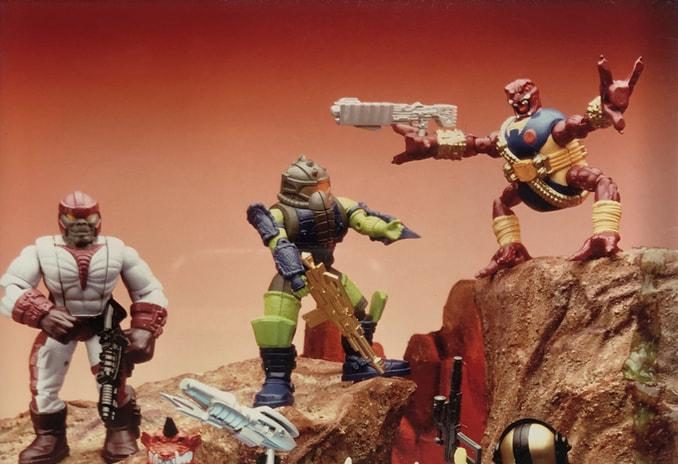
ARCHIVAL PHOTO: The original Manimals presentation
shows how far the abandoned concept had progressed.
Source: 3DJoes / MDesign collection. Used here as a
source preview; reproduction permission required.
In 1994, G.I. Joe wasn’t
finished dreaming. Behind the doors of Hasbro’s
toy-development operation, designers were creating some
of the strangest, most ambitious action figures in the
history of A Real American Hero.
There were soldiers who concealed grotesque alien
creatures inside their bodies. There were transforming
monsters with mechanical jaws and multiple heads.
There was a new Baroness with sculpted Cobra insignias
woven into her costume. There were experimental vehicles,
alien companions, and an entire military-oriented
assortment intended to continue the original 3 3/4-inch
G.I. Joe tradition.
Then the classic line was canceled.
Most children never learned these toys existed. Retail
shelves moved on, and the last years of the original
G.I. Joe era became a confusing mixture of fading
stock, new branding, and changing toy-store competition.
But the evidence did not vanish.
Surviving prototypes, photographs, engineering
drawings, presentation samples, packaging paintings,
and period magazine reporting now reveal an extraordinary
lost chapter in G.I. Joe history.
“These weren’t just ideas on a drawing board.
Some had already become physical toys.”
THE EVIDENCE: HASBRO’S LOST 1995 SHOWCASE
One of the strongest pieces of evidence comes from
the 1994 official convention issue of
Action Figure News & Toy Review. Its
coverage of the canceled assortment documented
actual prototypes, painted samples, and concept
packaging that collectors otherwise might never
have encountered.

ARCHIVAL EVIDENCE: A contemporary magazine
feature reveals Battle Corps Rangers artwork,
the Baroness prototype, and unproduced vehicles.
Source: 3DJoes archive of Action Figure News
& Toy Review.
This matters because it separates verified
preproduction work from the rumors that have
followed the franchise for decades. A painting is
evidence of a proposed design. A sculpted
two-up model shows that a design moved further.
A carded mock-up demonstrates packaging development.
None of these, by itself, guarantees that a toy
was approved for final mass production.
That distinction is essential to understanding
the lost 1995 line.
CHAPTER ONE • THE ALIEN EXPERIMENT
MANIMALS: THE MONSTERS
THAT ALMOST MUTATED G.I. JOE
In the early 1990s, action figures were fighting
a very different battle for attention. The Teenage
Mutant Ninja Turtles had demonstrated the enormous
appeal of strange creatures with exaggerated personalities.
Electronic effects, transformation mechanisms, and
spectacular action features were becoming increasingly
important to toy marketers.
G.I. Joe’s Star Brigade concept had already taken
the Joe-versus-Cobra conflict beyond Earth. In 1994,
the Lunartix aliens expanded that setting with
characters such as Predacon, Carcass, and Lobotomaxx.
But another group of creatures was being developed
that would have taken the concept considerably further.
The first six Manimals
The original assortment was intended for late
1994. The six planned characters were
Warwolf, Slythor,
Vortex, Iguanus, Spasma, and ZigZag.
Unlike standard G.I. Joe figures, each creature
featured a distinctive body-changing mechanism.
These were not ordinary repainted soldiers.
Their entire bodies were engineered around
dramatic physical transformations.
THE ORIGINAL PROTOTYPE
A particularly fascinating artifact preserved
by 3DJoes came from the collection of inventor
Ron Magers and his family. The handmade original
Manimals concept was a humanoid figure whose upper
torso opened to reveal a reptilian creature.
Remarkably, the prototype incorporated a body
from Kenner’s 1988 RoboCop action figure line.
The man’s apparent head and chest gave way to
a gaping reptilian mouth, complete with an
articulated tongue.

PHOTO FILE: The handmade transformation
concept showing the human appearance and
the reptilian creature emerging from the torso.
Archive: 3DJoes / Magers family collection.
It was an ambitious marriage of action-figure
engineering and creature-feature spectacle.
And the concept had considerable influence on
the subsequent figures.
IGUANUS: THE EGYPTIAN-INSPIRED NIGHTMARE
Designer Kurt Groen developed Iguanus in
1993. His design drew inspiration from ancient
Egyptian imagery, including the shape of a
pharaoh’s headdress.
The figure’s apparently armored torso opened
to expose an alligator-like head with a movable
jaw and tongue. Groen’s early working name for
the character was Dragon Lord.
One unusually elaborate detail was the
sculptural symbolism built into the legs:
hands wrapped around the calves, contributing
to the character’s unsettling supernatural
appearance.

PHOTO FILE: Factory-produced Manimals
samples reveal their complex creature
transformations and distinctive paint designs.
Archive: 3DJoes.
SLYTHOR, SPASMA, WARWOLF & ZIGZAG
The other prototypes were equally bizarre.
Slythor
had a head that tipped backward, allowing a
snake-like creature to unfold through multiple
hinges. Early design ideas incorporated animal
features with a surprising amount of mechanical
complexity.
Spasma
used a button-operated face mechanism that
opened to reveal a concealed monster.
Warwolf
used a torso transformation to expose a
reptilian head with a movable jaw and tongue.
ZigZag
was particularly unusual: two differently
facing heads occupied opposite sides of
the torso, and switching between them changed
the character’s appearance.

COLLECTOR ARCHIVE: A surviving Manimals
preproduction figure, with its unusual
alien design and weaponry. Source: 3DJoes.
And then there was Vortex, which incorporated
a hinged mechanism that split open to reveal a
smaller creature within. Its complicated construction
appears to have caused mechanical problems,
and working examples are exceptionally difficult
to find.
COLLECTOR DETAIL
A first-shot or test-shot figure is not the same
thing as a finished retail release. Surviving
Manimals samples can differ in plastic colors,
paint, construction, and mechanical operation.
Those differences are part of what makes
preproduction specimens so historically important.
THE EVEN STRANGER SECOND WAVE
The Manimals story did not end with the first six.
Hasbro also explored a second assortment that
would have featured additional grotesque creatures.
Documented names include
Slaver, Araknoid, Tarantulus,
Mantizoid, Eyeclops, and Vax.
Period photographs show painted models
demonstrating their unusual transformations.
Eyeclops, for example, had an enormous mouth
built into its torso, with a prominent central eye.
Its body design turned the idea of a conventional
humanoid action figure completely upside down.

PHOTO FILE: Eyeclops in closed and transformed forms.
Source: 1994 convention coverage preserved by 3DJoes.

PHOTO FILE: Araknoid with its concealed creature
mechanism opened and closed. Archive: 3DJoes.
These figures are important because the
photographs document more than abandoned character
names. They demonstrate that sculptors and model
makers had already begun translating some of the
designs into physical presentation pieces.
CHAPTER TWO • THE INVASION WITHIN
REPLICATORS: THE JOE FIGURES
WITH ALIENS HIDING INSIDE
Of all the canceled concepts, few were
more disturbing than the Replicators.
According to research published by Joe
Declassified, the project developed out of
interest in creature-based action toys, including
Kenner’s successful Aliens property.
The proposed storyline was chilling:
extraterrestrial beings would abduct important
people, create duplicates of them, and use the
impostors to infiltrate positions of influence.
Neither G.I. Joe nor Cobra was safe.
Planned Replicator identities included
Duke, Gung-Ho,
Hawk, Snake Eyes, Destro, and Cobra Commander.
Surviving period prototype photography also
identifies a Sci-Fi model, illustrating why
development photographs and proposed assortments
must be examined together rather than assumed
to be a definitive final lineup.
A MONSTER UNDER THE ARMOR
These figures were designed with hollow
torso sections that accommodated their alien
features. The concept called for opening the
body to reveal an extraterrestrial organism
concealed inside.
Research into the design identifies two
different approaches. Duke, Hawk, and Gung-Ho
were intended to use translucent latex-like
membranes across their chests. Pressing a
button on the figure’s back would push the
creature outward, giving the appearance of
an alien forcing its way through the body.
Snake Eyes, Cobra Commander, and Destro
were described as having removable tentacled
creatures rather than the same membrane
mechanism. The planned organisms featured
multiple flexible appendages, with Destro’s
design especially elaborate.

RARE PROTOTYPES: Period photographs identify
these approximately seven-inch development
models as Snake Eyes, Sci-Fi, and Duke.
The larger two-up sculpts were used in the
toy-development process. Archive: 3DJoes.

RARE PROTOTYPES: Cobra Commander, Destro,
and Gung-Ho Replicator two-up models.
Source: 1994 Action Figure News & Toy Review,
archived by 3DJoes.
These photographs show that the Replicators
were not limited to fanciful promotional
illustrations. The sculpting work was already
real enough to document.
THE UNRELEASED DEN BEAUVAIS PAINTINGS
The Replicators also received elaborate
packaging illustrations from fantasy artist
Den Beauvais.
His surviving acrylic paintings depict
the bizarre creatures that would have appeared
on the toy packaging. Beauvais later confirmed
that the artwork had been commissioned but the
figures never entered retail production.
The complete artwork archive can be examined
through 3DJoes, where the paintings were
originally displayed with the artist’s
permission.
VIEW ALL SIX ORIGINAL REPLICATORS CARD PAINTINGS
The illustrations offer an important clue
about the proposed marketing strategy. Hasbro
was not merely creating traditional soldiers
with new paint schemes; it was experimenting
with science-fiction horror imagery for the
G.I. Joe brand.
Whether the idea would have attracted a
new generation or alienated established
fans is a question no retail sales data
can answer. The line never reached that test.
CHAPTER THREE • RETURN TO THE BATTLEFIELD
BATTLE CORPS RANGERS:
THE MILITARY COMEBACK WE NEVER GOT
While Star Brigade was pushing G.I. Joe
toward increasingly fantastic adventures,
another planned assortment was moving
in the opposite direction.
Battle Corps Rangers was intended to
reconnect the 3 3/4-inch line with military
action, familiar characters, and new vehicles.
During development, the concept had also
used the name Secret Soldiers.
Collector research by Chris Murray documents
five planned individually carded characters:
Baroness, Dr. Mindbender, Frostbite, Flint,
and Footloose. Four associated vehicle
drivers were Duke, Hit & Run, Big Ben,
and Snow Serpent.
Several figures combined new sculpted
parts with existing tooling. That was an
established way for Hasbro to control
development and manufacturing costs.
THE BARONESS THAT ALMOST CHANGED EVERYTHING
One of the most striking canceled figures
was a completely redesigned Baroness.
The preproduction sculpt featured a different
uniform, separately attached hair, and elaborate
Cobra-themed detailing. Small repeating Cobra
symbols were sculpted into the design of her top.
Serpent heads decorated her belt and knee pads.
Her proposed equipment included a spring-loaded
snake-themed launcher and a wearable identification
tag for children.
Research also documents proposed color schemes
for more than one release of the figure.

THE LOST BARONESS: A painted presentation model
of the unreleased 1995 design. The contemporary
magazine report states that a Hasbro executive
secretary served as the model for the character.
Archive: 3DJoes.
DR. MINDBENDER’S STRANGE NEW BODY
Another surprising redesign was Dr. Mindbender,
who was being reimagined for aquatic operations.
The proposed figure had a newly sculpted
body and a webbed hand. The equipment included
a specialized helmet with breathing hoses.
A small submersible was also associated with
the concept.
Some of those proposed components eventually
appeared elsewhere in Hasbro’s G.I. Joe-related
product lines, even though the planned
Battle Corps Rangers Mindbender never reached
retail in its original form.
FOOTLOOSE, FLINT, AND THE CHARACTER-NAME MYSTERIES
Preproduction research suggests that
some Battle Corps Rangers figures passed
through multiple character identities
during development.
One design associated with Footloose had
previously been developed with a Shipwreck
identity. Another design identified in
development with the name Sure Shot
was also associated with Flint.
These inconsistencies are not merely
collector trivia. They demonstrate that
a toy’s intended name, sculpt, paint scheme,
and accessories could change between early
development and its proposed release.
Footloose’s planned accessories included
a rope-climbing device. Another figure
was associated with a motorcycle later
seen with the Sgt. Savage assortment.
THE VEHICLES THAT DISAPPEARED
The canceled range was not restricted
to action figures. Hasbro was exploring
new machines and returning vehicles
that would have expanded the battlefield.
The surviving 1994 reporting offers
especially useful images of these
proposed releases.
THE STRIKER XS-1
The Striker XS-1 was a heavily armed
four-wheeled vehicle with an aggressive
low-slung profile. Its proposed packaging
emphasized combat play and multiple
mounted weapons.

THE STRIKER XS-1: Prototype vehicle and
proposed retail packaging. Archive: 3DJoes.
COBRA’S EEL VEHICLE
Cobra was also expected to expand its
aquatic arsenal. One canceled design,
shown in period presentation photography
as the Eel, combined a futuristic
marine profile with Cobra styling.

COBRA EEL: A surviving photograph of the
vehicle prototype and proposed packaging.
Source: 3DJoes archive.
THE SEA WOLF: A LEGEND RETURNS
Among the planned vehicles was the
Sea Wolf, an arctic reinterpretation of
the classic G.I. Joe Killer W.H.A.L.E.
hovercraft.
Research into the canceled assortment
identifies a white upper structure and
an associated repainted Duke driver.
The concept is a particularly tantalizing
one for collectors because it connected
the closing years of G.I. Joe to one
of the most recognizable vehicles from
the line’s celebrated early period.
Other research identifies the Phantom
X5-3 stealth tank, which was subsequently
adapted into a vehicle released through
the Sgt. Savage line.
EXPLORE THE SEA WOLF, VORTEX XS-2 AND MORE LOST VEHICLES
CHAPTER FOUR • THE UNEXPECTED AFTERLIFE
THE LOST FIGURES THAT
RETURNED YEARS LATER
There is an unexpected final twist to
the Manimals story.
In 2001, Hasbro revisited the earlier
Manimals designs for a planned KB Toys
exclusive assortment.
Six figures were considered across
two waves. Warwolf, Iguanus, and Slythor
comprised the first wave. Spasma, Vortex,
and ZigZag were intended for the second.
The first three were released in revised
paint schemes. But the second wave was
canceled after the first wave performed
poorly at retail.
Even so, surviving carded second-wave
samples have been documented, giving
collectors another layer of rarity
to investigate.

THE SECOND CHANCE: Six 2001 Manimals packages,
including the canceled second-wave samples.
This is not a photograph of six mass-market
retail releases. Archive: 3DJoes.
The legacy is therefore more complicated
than the simple claim that none of the
Manimals were ever made. Their first
planned release was canceled, selected
figures received a later limited retail
opportunity, and additional planned
releases remained unproduced.
THE BIGGEST SECRET:
G.I. JOE’S ORIGINAL BODY DESIGN
WAS UNDER REVIEW
Perhaps the most revealing artifact
from the canceled period is not an
alien at all.
It is an experimental Duke.
Period reporting documented a prototype
in which Hasbro explored replacing
traditional O-ring figure construction
with a less complicated hip-and-leg
arrangement.
The stated reason was potential cost
reduction.

ENGINEERING ARCHIVE: The experimental
1995 Duke body documented in period
magazine coverage. It illustrates
Hasbro’s exploration of alternatives
to traditional O-ring construction.
Source: 3DJoes.
For collectors who associate the
original 1982–1994 line with its familiar
articulation and interchangeable construction,
the experiment is especially significant.
It suggests that Hasbro was considering
more than new costumes or character
lineups. The company was also
investigating changes to the basic
engineering of the action figures.
Of course, a prototype does not prove
such a change would have reached stores.
But its existence shows the breadth
of experimentation underway.
SO WHY DID HASBRO CANCEL EVERYTHING?
The most tempting explanation is also
the least useful: that Hasbro simply
ran out of ideas.
The surviving material makes that
interpretation difficult to defend.
The design teams had developed alien
figures, traditional military characters,
new articulation experiments, vehicles,
and elaborate action mechanisms.
Some designs were already far beyond
the sketching stage.
Instead, the end of the original
3 3/4-inch line came amid changing
retail competition, corporate
reorganization, and a shift in
how the G.I. Joe brand was managed.
The toy market had changed drastically
since 1982. Teenage Mutant Ninja Turtles,
superhero action figures, and Mighty
Morphin Power Rangers were among the
properties competing for the attention
of children and retailers.
Hasbro had acquired Kenner, and
management and development arrangements
changed. The traditional G.I. Joe
line was canceled in 1994, although
other G.I. Joe-branded toys continued
through different concepts.
Sgt. Savage would become one of
the brand’s immediate successors,
followed by G.I. Joe Extreme.
The classic 3 3/4-inch concept
would eventually return in later
retail programs.
The central historical point is
that a discontinued assortment
does not necessarily mean its
designers lacked promising ideas.
“The most fascinating G.I. Joe toys
of 1995 might be the ones that
children never had the chance to buy.”
THE G.I. JOE FUTURE THAT NEVER HAPPENED
Imagine a toy store in the fall of 1995.
On one shelf, a new Baroness stands
beside Dr. Mindbender and the Battle
Corps Rangers. Nearby, the Sea Wolf
offers another mission for the classic
G.I. Joe battlefield.
On another shelf, Star Brigade expands
into something far stranger. Manimals
transform before your eyes.
Replicators conceal extraterrestrial
creatures beneath familiar faces.
It would have been a very different
G.I. Joe experience.
Whether it would have revived the brand
or accelerated its decline is something
no one can establish from prototypes alone.
But more than three decades later,
the surviving artwork and models
provide extraordinary evidence of
the risks designers were taking
during the original line’s final years.
And perhaps that is what makes
these canceled toys so compelling.
They’re not just rare collectibles.
They’re physical evidence of
an alternate G.I. Joe history
that almost happened.
EXPLORE THE ORIGINAL ARCHIVES
3DJoes — Canceled 1995 G.I. Joe Products
3DJoes — Manimals Preproduction Collection
3DJoes — Replicators Original Card Art
3DJoes — 1994 Convention Magazine Archive
Joe Declassified — The Declassified Report, Issue 6
Joe Declassified — Battle Corps Rangers Research
Research acknowledgment: Original 1990s reporting,
the surviving collections documented by 3DJoes,
and historical research by Joe Declassified
including Chris Murray and Dan Klingensmith.
All historical names, art and associated character
likenesses belong to their respective owners.
Archival imagery requires separate reproduction
authorization.
YOUR TURN, G.I. JOE COLLECTORS!
If you could bring back only ONE
of Hasbro’s canceled toy projects,
would you choose the Manimals,
the Replicators, or Battle Corps Rangers?
TELL US IN THE COMMENTS!