The Film That Gave Us ‘White Christmas’ Before White Christmas Did – A Cozy, Old-Hollywood Look Back at Holiday Inn (1942)
There’s something special about slipping into an old black-and-white Christmas movie—like stepping through a time portal where everything is a little softer, a little slower, and a whole lot more charming. And if you’re in the mood for pure old-Hollywood warmth, you really can’t get much better than Holiday Inn (1942). This is the movie that not only teamed up Bing Crosby and Fred Astaire in a vintage showbiz showdown, but also gifted the world one of the most iconic holiday songs ever written: “White Christmas.” Yes—this film debuted it long before the movie White Christmas came along to expand that universe. If that’s not a quirky bit of Christmas trivia magic, I don’t know what is.
Whenever I rewatch Holiday Inn, I’m instantly transported into that dreamy, theatrical world where everyone can sing flawlessly, dance effortlessly, and wear tuxedos without sweating. The premise is such a wonderfully strange slice of ’40s imagination: Bing Crosby plays Jim Hardy, a performer who decides he’s sick of the exhausting entertainment life and buys a farm in rural Connecticut. As it turns out, farming is hard (who could’ve guessed!), so Jim pivots again, reinventing the property as an inn that opens only on holidays—a business model that would absolutely confuse Yelp today but works beautifully in movie land.
Enter the other big draw: Fred Astaire, playing Jim’s showbiz rival and friend, Ted Hanover. Now, if you’ve ever wanted to see Fred Astaire dance drunk—like, deliberately choreographed tipsy dancing—this movie has you covered. It’s one of the most bizarrely impressive things he ever did, and that’s saying something considering the man once danced on the ceiling. His smooth chaos is the perfect foil to Bing’s velvet-voice charm.
But the heart of the movie comes from the romantic triangle centered on Linda Mason, played by Marjorie Reynolds, who brings this effortless warmth to the screen. She’s talented, she’s sweet, and she ends up caught between Bing’s gentle sincerity and Fred’s relentless showman energy. The plot doesn’t try to reinvent the wheel—this is classic Hollywood musical storytelling—but there’s something comforting about knowing exactly where the emotional beats are going, even as you relax into the music and dancing.
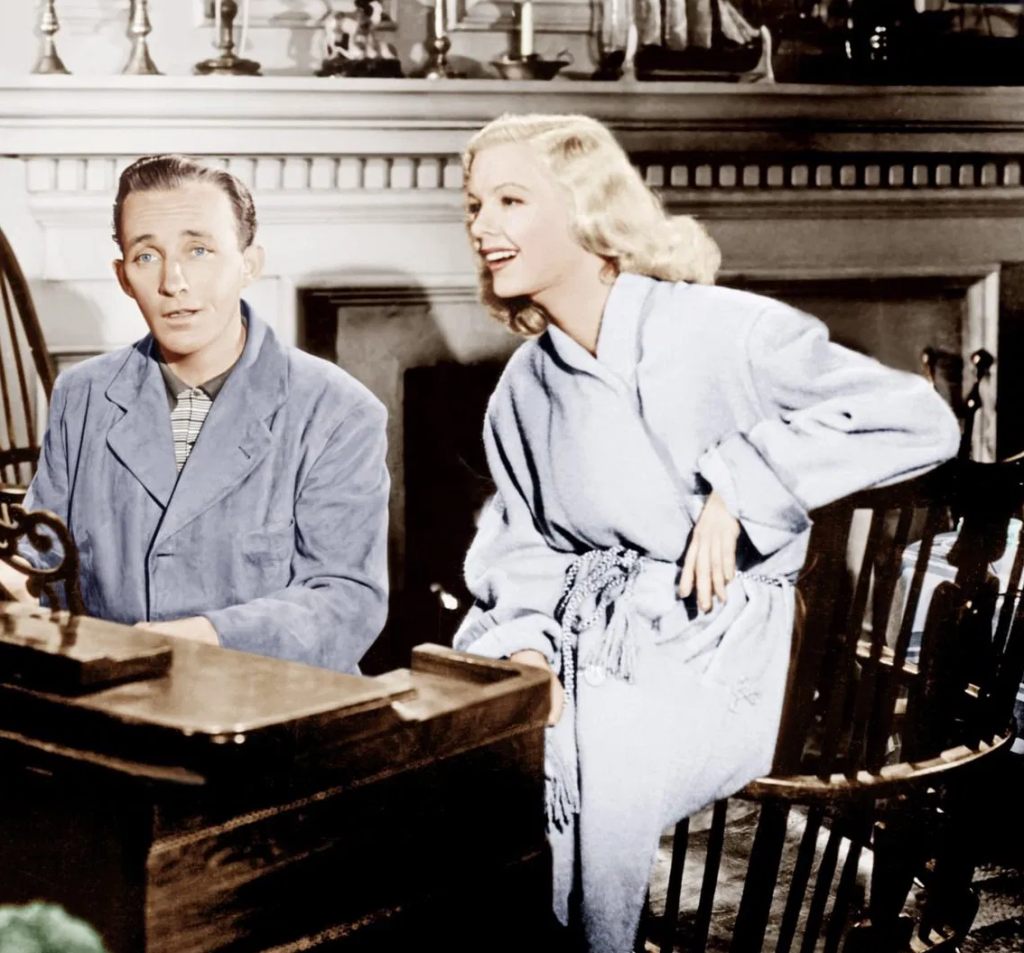
And then—that moment. Jim sits at the piano. Linda leans nearby, soft-eyed and listening. Snow falls gently outside. And Bing begins to sing: “I’m dreaming of a white Christmas…” It’s delivered so simply, so earnestly, that it catches me off guard every time. No big production number, no swirling chorus—just that voice and that melody. There’s a reason it became the best-selling single of all time for decades. It wasn’t designed to dazzle; it was designed to feel like a memory already forming.
What I love about Holiday Inn is that it really is a holiday movie for all seasons—literally. Its format lets you hop from New Year’s to Valentine’s Day to Easter, and finally back to Christmas, all through music and dance. It makes the year feel cyclical in a warm, sentimental way. And the finale, with the inn transforming into a Hollywood set recreating itself, is one of those delightfully meta touches old musicals would sometimes pull off without blinking.
Sure, the movie is a product of its time—glitzy, theatrical, sometimes corny—but that’s exactly what gives it its charm today. It’s nostalgic without even trying. It’s a time capsule of American movie magic, designed to make you smile and sigh and feel like the holidays last a little longer than they really do.
So if you want to dive into a true traditional Christmas film, and experience White Christmas before it was White Christmas, grab a mug of something warm and revisit Holiday Inn. It’s cozy, sweet, and timeless in all the ways that count.