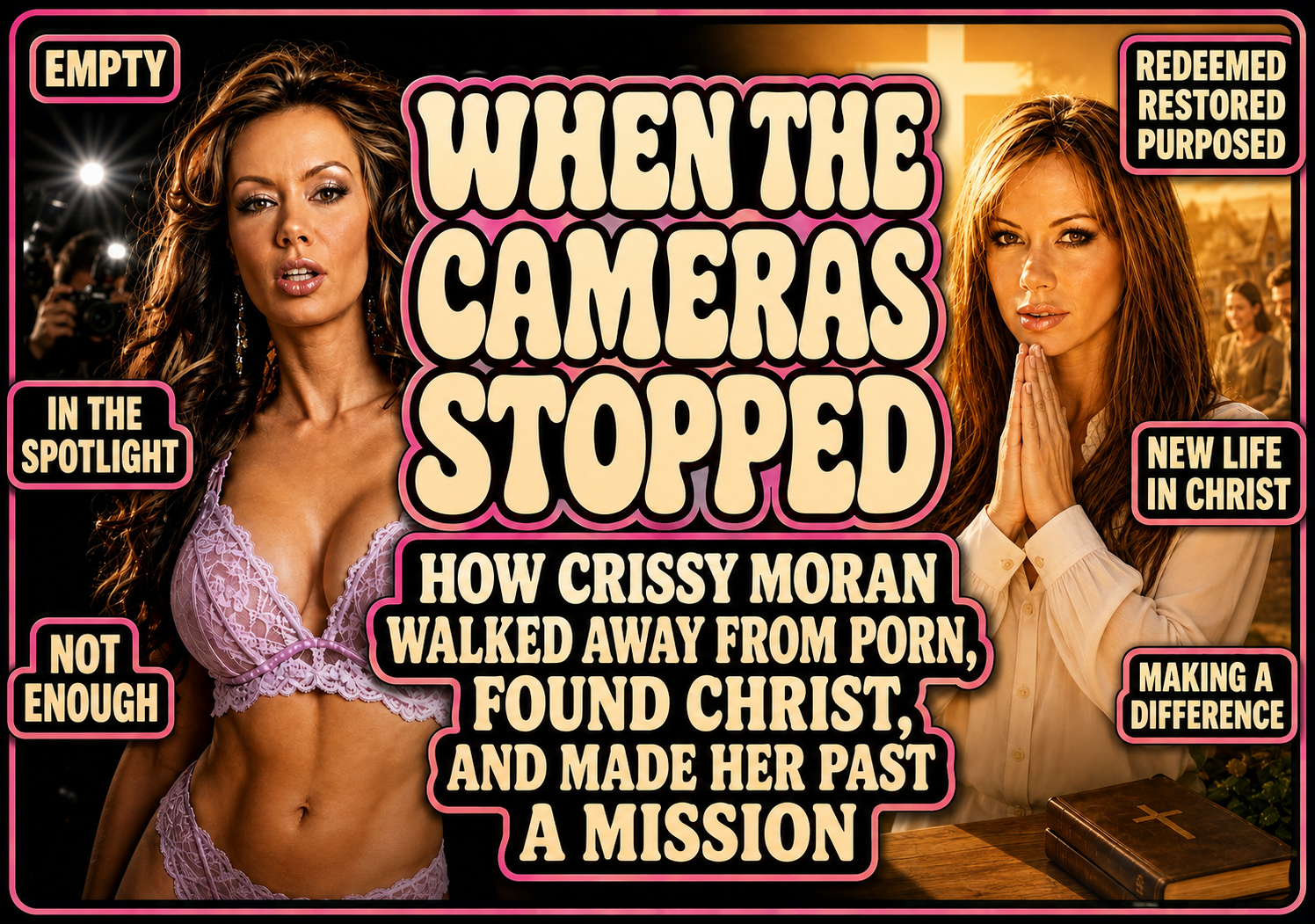
When the Cameras Stopped: How Crissy Moran Walked Away From Porn, Found Christ, and Made Her Past a Mission
There was a time when Crissy Moran’s face was part of an industry built to make people look larger than life.
Beginning in 1999, Moran entered adult entertainment through the internet, initially posting ordinary modeling photographs online while looking for paid work. According to her later account to Christianity Today, offers for nude modeling soon followed. She initially refused them. After a painful breakup, however, she accepted one—and what began as modeling rapidly became something much larger.
Moran eventually worked across several corners of the adult-entertainment business. She modeled, appeared in magazines, operated a highly profitable subscription website, and performed in adult films. Published accounts place her film appearances at more than 40—and some sources say more than 50—between roughly 2001 and 2006. Her website became particularly lucrative, reportedly producing approximately $15,000 per month at its height.
It was the internet, perhaps more than anything, that made Moran a recognizable adult personality. She could earn recurring income from her website while selectively taking magazine and film work. She told The Christian Post that she sometimes went months without filming because her website generated enough money to support her. She described preferring elaborate, glamorous productions to other forms of adult filmmaking, while also saying that she never became comfortable with the sexual performances themselves.
From the outside, it looked like success.
Inside, Moran has said, it felt increasingly empty.
By October 2006, money and recognition could no longer drown out what she describes as profound hopelessness. Moran told Christianity Today that deaths, drug overdoses and tragedies involving people around the industry forced her to confront where her own life was heading. She prayed desperately for God to reveal Himself to her. Days later, during a conversation with a television crew member, the subject of God unexpectedly arose.
For Moran, that conversation became the turning point.
She says she recommitted her life to Jesus Christ and decided to leave pornography behind.
Walking away, however, did not mean that pornography simply disappeared.
Moran later described desperately asking people connected with her website to remove it. Because contracts and business interests were involved, material featuring her continued circulating online. Years later, LA Weekly reported that images and films remained available even though Moran refused income generated from them. She wanted, she said, people considering entering pornography to understand that leaving could be far more complicated than entering.
That painful reality eventually became part of her ministry.
After leaving pornography, Moran became involved with Treasures, the nonprofit founded by former exotic dancer Harmony Dust. The organization works with women in different areas of the sex industry, offering outreach, support groups and practical assistance. LA Weekly reported that Moran worked with Treasures’ leadership and oversaw a support group.
Her Christian faith increasingly became central to her public identity. She appeared in churches, Christian interviews and media programs telling her story. She also starred in the 2008 short film Oversold, a modern interpretation of the biblical story of Hosea and Gomer built around themes of redemption, judgment and grace.
Most importantly, Moran began speaking directly to women.
She has described leading support groups and mentoring women seeking to leave the sex industry. In more recent public statements, she has said that she has spent years sharing her testimony and working one-on-one with women searching for a different life. A 2025 Our American Stories profile likewise described Moran—now also known as Crissy Outlaw—as someone who helps other women leave the world she once inhabited.
Her message is deliberately uncomfortable.
Moran does not romanticize pornography as the source of her former wealth or fame. From her Christian perspective, she argues that it can distort intimacy, exploit vulnerability and leave consequences that continue long after someone decides to walk away. Those conclusions come from her own experiences, and she now uses them as warnings to young women considering the industry.
But the most powerful element of Crissy Moran’s story may not be what she condemns.
It is what she believes can happen afterward.
Her life is built around the conviction that someone’s worst decisions do not have to become the final definition of who they are. The woman who once made thousands of dollars selling an image of herself now spends her public life attempting to convince others that their value cannot be measured by a camera, a paycheck, a website or someone else’s desire.
For Moran, leaving pornography was not simply retirement.
It was the moment the cameras stopped—and she finally began deciding for herself what the rest of her story would be.