Born to Roll: The Fast-Paced Origins of Hot Wheels

Since roaring onto the toy scene in 1968, Hot Wheels has been synonymous with speed, style, and imagination. Generations of kids — and adults — have raced, collected, and customized these die-cast wonders. But how did these iconic cars get their start? The origin of Hot Wheels is as colorful and cool as the cars themselves, complete with innovation, rivalry, and a drive to push the limits of what a toy car could be.
The Spark Behind the Wheels
Hot Wheels was born out of Mattel, the toy giant co-founded by Elliot Handler and his wife Ruth Handler (the creator of Barbie). While Barbie conquered the fashion doll world in the late ’50s and early ’60s, Elliot Handler wanted something to capture boys’ imaginations just as powerfully.
In the mid-1960s, Handler noticed that most die-cast toy cars on the market, like Britain’s Matchbox cars, were modeled after realistic vehicles but lacked the excitement and flair of custom hot rods that dominated American car culture. He had a vision: create die-cast cars that weren’t just miniatures — they were cooler, faster, and flashier.
He assembled a team that included car designer Harry Bentley Bradley (who had worked at General Motors), engineer Jack Ryan, and a group of ex-aerospace experts. Their mission? Build the best, fastest toy cars the world had ever seen.
The First Hot Wheels Roll Out
In 1968, Mattel launched the original 16 Hot Wheels cars, now famously known among collectors as “The Sweet 16.” These weren’t just scaled-down models — they were bold, colorful, and designed with attitude. Cars like the Beatnik Bandit, Deora, and Custom Camaro hit store shelves with vibrant Spectraflame paint jobs, redline tires, and low-friction axles that made them zip across playsets at unmatched speeds.
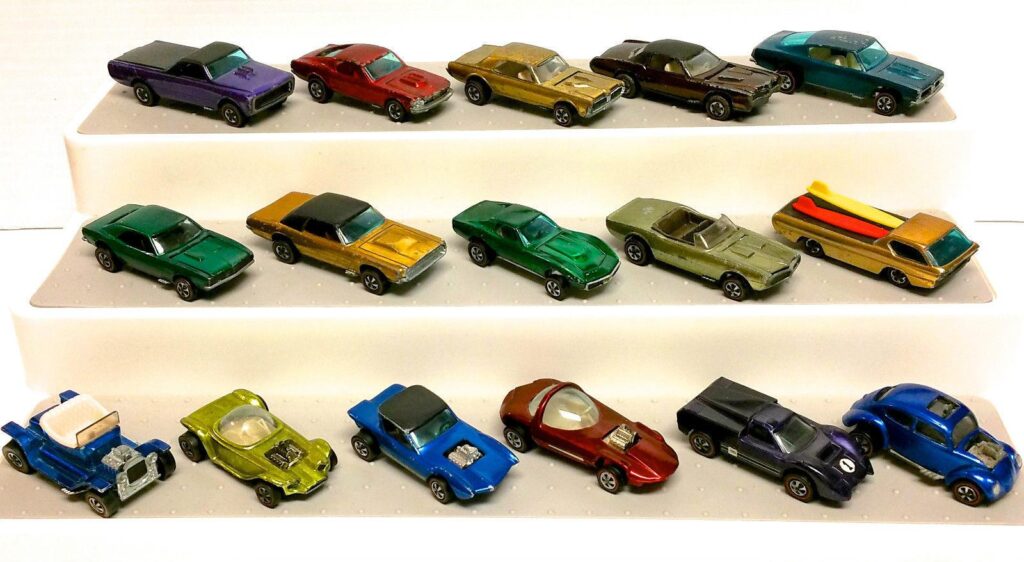
One of the biggest innovations was the use of Delrin plastic bearings in the axles, which dramatically reduced friction and allowed Hot Wheels to live up to their name. Coupled with the introduction of orange track sets and loop-de-loops, Hot Wheels quickly became more than just toy cars — they were part of an action-packed racing experience.
From Toybox to Collector’s Case
Hot Wheels exploded in popularity. By the early ’70s, Mattel had added new lines, new models, and themed cars inspired by fantasy designs, real-life racers, and even pop culture tie-ins. The cars evolved with the times, but the original charm — the fusion of fantasy, performance, and design — remained intact.
Collectors emerged almost immediately, especially with the Redline era (1968–1977), named for the signature red stripe on the tires. Today, original Hot Wheels from that period — especially in pristine condition — can fetch hundreds or even thousands of dollars.
Cultural Impact and Innovation
Hot Wheels didn’t just stay in the toy aisle. They became a cultural staple, influencing automotive design, appearing in video games, cartoons, and eventually being reimagined in life-sized versions. The brand constantly pushed boundaries, releasing cars with futuristic designs, glow-in-the-dark features, and motorized stunt sets.
Even today, Hot Wheels collaborates with automotive legends like Ferrari, Tesla, and Porsche, offering miniature versions of cutting-edge vehicles and concept cars. Whether it’s a muscle car, monster truck, or Batmobile, there’s a Hot Wheels version for nearly every fan.
The Legacy Rolls On
More than 50 years since its creation, Hot Wheels remains one of the most successful and beloved toy brands of all time. It all started with one idea: make toy cars that weren’t just replicas, but radically fun and fast.
Thanks to the creative genius of Elliot Handler and his team, Hot Wheels didn’t just roll — they raced into history.