
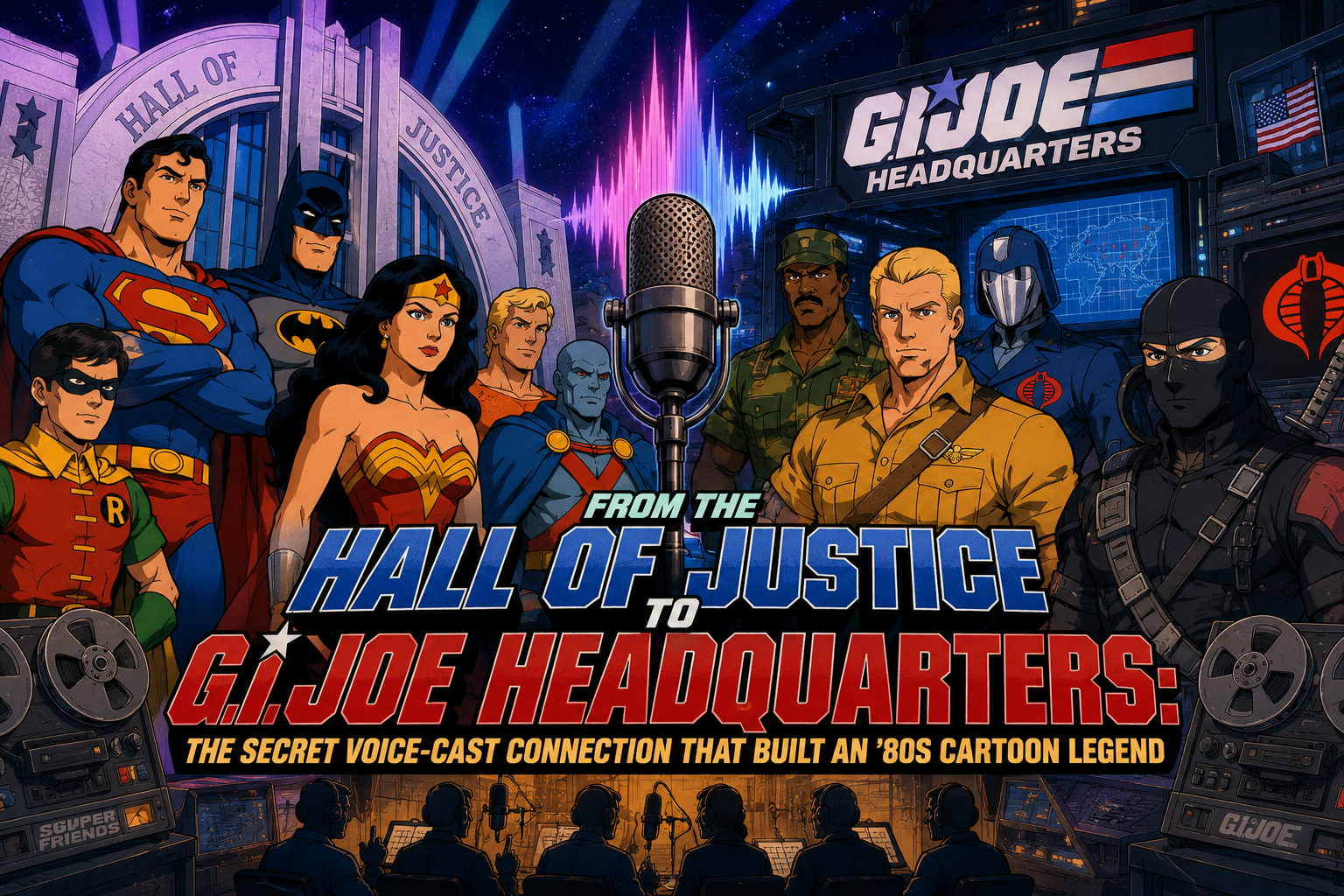
From the Hall of Justice to G.I. Joe Headquarters: The Secret Voice-Cast Connection That Built an ’80s Cartoon Legend
Long before Duke shouted, “Yo Joe!” and Cobra Commander began screeching about world domination, many of the voices behind G.I. Joe: A Real American Hero had already saved—or threatened—the world on Super Friends.
This was not simply a case of two cartoons hiring one or two of the same performers. The recording booths of Super Friends became something of a training ground for an entire generation of voice actors who later gave G.I. Joe its personality, humor and larger-than-life sense of adventure.
The most recognizable connection may be Michael Bell. On Super Friends, Bell voiced Zan, Gleek, the Riddler and numerous supporting characters. On G.I. Joe, he became the commanding voice of Duke while also playing Major Bludd, Xamot, Clutch, Blowtorch, Scrap-Iron and several Cobra soldiers. Bell could move from heroic authority to theatrical villainy within the same recording session.
Then there was the incomparable Frank Welker. He began the original 1973 Super Friends series as Marvin and Wonder Dog before later voicing Darkseid, Kalibak, Mister Mxyzptlk, Toyman, the Joker and countless creatures. On G.I. Joe, Welker supplied Wild Bill, Copperhead, Torch, Short-Fuse and Horrorshow—along with animal characters Timber, Junkyard, Freedom and Shipwreck’s parrot, Polly. His ability to create human characters, monsters and convincing animal sounds made the G.I. Joe universe feel enormous.
Several performers had already worked together on Super Friends well before the first G.I. Joe miniseries arrived in 1983. Buster Jones went from Black Vulcan to Doc and Zap. Jack Angel moved from the Flash, Hawkman and Samurai to Wet-Suit, Thunder and Cobra Vipers. William Callaway, the longtime voice of Aquaman, became Beach Head. John Stephenson, who played the military liaison Colonel Wilcox during the original Super Friends, later voiced General Flagg and General Hawk.
These were not necessarily lifelong social companions, but they were established professional colleagues. Jack Angel later identified Michael Bell, Buster Jones and Frank Welker among the Super Friends performers with whom he was most friendly. He explained that the actors were “professional friends” who occasionally shared meals or met at industry parties. That familiarity likely made the crowded G.I. Joe recording sessions feel less like assembling strangers and more like reuniting a seasoned repertory company.
The crossover became even larger during the final Super Friends seasons. Arthur Burghardt, who guest-starred as General Plankton, became Destro, Stalker and Iceberg. Gregg Berger went from supporting Super Friends characters to Firefly, Spirit, Rip Cord, Cutter and Colonel Brekhov. Pat Fraley played Captain Mystery before voicing Ace, Airtight and Wild Weasel. Mary McDonald-Lewis voiced Lois Lane and then gave Lady Jaye her instantly recognizable confidence and sarcasm.
B.J. Ward created one of the most fascinating reverse connections. She was already Scarlett in the 1983 G.I. Joe miniseries before becoming Wonder Woman—and even young Bruce Wayne—during The Super Powers Team: Galactic Guardians. Peter Cullen crossed over as Felix Faust after playing Airborne and Zandar, while Jerry Houser went from a Galactic Guardians guest character named Jack to the neon-green G.I. Joe warrior Sci-Fi.
Perhaps the most important bridge was Wally Burr. Burr voiced the Atom on The All-New Super Friends Hour before becoming the voice director of G.I. Joe. He even performed several smaller G.I. Joe roles. A little-known fact is that Burr had served as a U.S. Army tank commander during World War II and participated in the Normandy campaign. The man directing the voices of America’s fictional special-missions force had commanded soldiers and armor in an actual war.
Super Friends taught these actors how to sell impossible heroes, bizarre technology and outrageous villains with complete sincerity. G.I. Joe took that foundation and added military banter, interpersonal conflict, sharper comedy and serialized danger. Duke sounded like a leader because Michael Bell had spent years speaking the language of superheroes. Destro sounded monumental because Arthur Burghardt understood comic-book villainy. Doc sounded compassionate because Buster Jones had already brought dignity to Black Vulcan.
The Hall of Justice and G.I. Joe Headquarters never officially shared a universe—but behind the microphone, they absolutely shared a team.
That’s a really interesting connection to make! It makes sense considering how many actors were working across different shows at the time.