The Decepticon You Couldn’t Buy in Toy Stores: The Secret History of G1 Reflector
SERPENTOR’S LAIR | VINTAGE TRANSFORMERS ARCHIVES
TUESDAY, NOVEMBER 10, 2026
The Decepticon You Couldn’t Buy in Toy Stores: The Secret History of G1 Reflector
Three robots. One camera. A mysterious mail-away offer. And one of the greatest hidden treasures of the original Transformers generation.
BY DESTRO DESIGNS – VIPER DEN STUDIOS

Imagine being a Transformers fan in 1984.
Every afternoon, you raced home from school to watch Optimus Prime battle Megatron. The Decepticons were everywhere. Starscream was scheming. Soundwave was gathering intelligence. Thundercracker and Skywarp were tearing through the skies.
And among those sinister robots was a particularly unusual Decepticon.
Actually, there were three of him.
Three nearly identical robots who could somehow transform into a single camera, allowing Megatron’s forces to spy on the Autobots without being detected.
His name was Reflector.
But if you hurried down to Toys “R” Us, Kay-Bee Toys, or the toy department at your local department store hoping to add him to your collection, you were in for a disappointment.
Reflector wasn’t there.
Not in the familiar purple-and-black Decepticon packaging. Not hanging beside Soundwave. Not sitting on a shelf with Starscream and Megatron.
In North America, this mysterious character would become one of Hasbro’s most fascinating mail-away exclusives.
For the young collectors who discovered the offer, obtaining Reflector required something more than convincing their parents to make another trip to the toy store.
It required saving Robot Points, filling out paperwork, sending money through the mail, and waiting for a package to arrive.
Four decades after his American release, Reflector remains an extraordinary piece of Transformers history. And the story behind this strange little camera is far more interesting than many collectors realize.
G1 COLLECTOR INTELLIGENCE FILE
Name: Reflector
Faction: Decepticon
Function: Reconnaissance
Team members: Viewfinder, Spectro, Spyglass
Transformation: Three robots combine into one camera
Original design: Takara Micro Change, 1983
Japanese Transformers release: 1985, No. 21
American release: 1986–1987, mail-away
Original American offer: $10 plus 2 Robot Points
A Decepticon Who Appeared Before His Toy Was Available
Reflector’s bizarre history begins with the very first Transformers animated adventure.
In September 1984, Sunbow and Marvel Productions introduced American television audiences to The Transformers through the three-part story More Than Meets the Eye.
Reflector appeared as part of the original Decepticon team, acting as one of Megatron’s reconnaissance specialists.
One of his most memorable early scenes involved Thundercracker.
When the Decepticons needed a closer look at an approaching vehicle, the three Reflector robots combined into a camera small enough for Thundercracker to hold.
The Decepticon jet used the camera to take a photograph, and Reflector produced an image for the others to examine.
It was an unforgettable example of the cartoon’s wonderfully flexible approach to Transformers physics.
Three full-size robots somehow became a handheld camera in seconds.

Reflector’s animated appearance presented another unusual detail.
In the original cartoon, the three robots generally shared the same appearance, with matching heads, similar colors, and near-identical bodies.
They often behaved like separate parts of a single intelligence, sometimes even speaking together.
The character’s distinctive voice was provided by Chris Latta, the same performer who portrayed Starscream and Cobra Commander.
But the actual toys did not resemble three identical cartoon robots.
Each component had its own distinctive design, transformation, and accessories.
And that discrepancy leads us to the origins of Reflector, several years before the Transformers phenomenon began.
Before Reflector, There Was Camera Robo
Many Generation 1 Transformers were adapted from Japanese toy lines that existed before Hasbro created the Transformers brand.
Optimus Prime began life in Takara’s Diaclone series. So did many familiar Autobots and Decepticons.
Reflector, however, came from a different corner of Takara’s transforming robot universe.
In 1983, Takara released MC-05 Camera Robo as part of its Micro Change toy line, itself connected to the larger Microman franchise.
While Diaclone frequently concentrated on cars, aircraft, and vehicles, Micro Change explored an entirely different concept: ordinary household objects that secretly transformed into robots.
The line included objects such as cassette recorders, microscopes, and small electronic devices.
A camera was a natural addition.
But Camera Robo had a remarkable twist.
Rather than transforming into a single robot, it separated into three independent figures.

Even in 1983, this was an exceptionally ambitious concept.
Each miniature robot possessed its own personality within the Japanese Microman storyline.
They were known as Micro Shutter, Micro Finder, and Micro Winder.
The original fiction described the camera as a special device capable of detecting threats from another dimension and protecting its young human owner.
The three miniature robots could separate from the camera to fight invading enemies.
That original Japanese concept would later be transformed into the Decepticon intelligence specialist American viewers knew as Reflector.
The Original 1983 Micro Change Packaging

Look closely at the packaging.
Collectors familiar with Reflector will immediately recognize the three figures, but the artwork and labeling belong to an earlier era of Japanese transforming toys.
Instead of the familiar Transformers logo, the box carries Micro Change branding.
The camera is identified as MICROX, a name that appeared on the original toy before it became a Decepticon.
The basic engineering, transformation, and three-robot gimmick would survive into the Transformers era.
Here is another detail that makes Reflector especially interesting: early Camera Robo development reportedly explored a single transforming robot before the three-component design was adopted.
The surviving concept art and prototypes documented by Japanese toy researchers illustrate the evolution toward the more familiar combined camera.
Had the original design direction remained unchanged, one of the most unusual Decepticons might have looked completely different.
Japan Got the Transformers Reflector in 1985
When Takara launched the Transformers brand in Japan, Reflector was incorporated into its regular lineup.
In 1985, Japanese children could purchase the figure in conventional retail packaging.
It was identified as Destron No. 21 Reflector.
And the packaging was magnificent.

Unlike the comparatively plain American mail-away presentation, the Japanese release featured an illustrated retail box with the familiar Transformers branding.
It presented the three individual robots in a display window and showed their combined camera mode in colorful artwork.
For collectors today, the Japanese box is almost as desirable as the figure itself.
Its distinctive purple grid, Japanese lettering, and original artwork offer a glimpse of how differently Takara and Hasbro sometimes marketed the same toy.
The Japanese release also preserves an interesting packaging oddity: the camera name in some early artwork is rendered as REFLECTR, omitting a letter from the familiar English name.
Minor printing details such as these are exactly the kind of things vintage Transformers collectors enjoy discovering.
And yet American children watching the very same character on television still could not simply walk into their neighborhood toy store and purchase him.
The 1986 Secret Offer: A Transformer Not Sold in Any Store!
By 1986, Hasbro had established an enormously successful system of mail-away promotions for Transformers.
The company encouraged children to save Robot Points found on original toy packaging.
These points could be combined with money and mailed to Hasbro in exchange for special merchandise and figures.
Earlier promotions included the unusual Powerdashers and the three Autobot Omnibots.
Then came one of the most exciting offers of all.
1986 HASBRO MAIL-AWAY PROMOTION
INSIDE… A TRANSFORMER NOT SOLD IN ANY STORE!
REFLECTOR
$10.00 + 2 ROBOT POINTS
Editorial reconstruction of the historic offer’s wording and price, not a reproduction of the original advertisement.
Imagine discovering that advertisement inside a brand-new Transformers package.
Here was a character you already recognized from the cartoon, accompanied by the tantalizing promise that you could not buy him in stores.
The only way to obtain the official American figure was to participate in the mail-order program.
Collectors have documented several versions of Hasbro’s promotional paperwork used across 1986 and 1987.
These included flyers titled Inside…A Transformer Not Sold in Any Store! and You Have Been Chosen.
Later promotions continued to feature Reflector alongside other mail-order merchandise.
The required Robot Points were printed on Transformers packaging. Children who wanted Reflector had to save the appropriate points, fill out the paperwork, and send the materials with their payment.
For some children, that meant cutting into perfectly good Transformers boxes.
For others, it meant begging their parents to help complete a complicated mail-order form.
And then came the hardest part.
Waiting for the mail.
Unlike a normal trip to the toy store, the order offered no instant gratification.
But when the package finally arrived, it contained three Decepticons that were almost impossible for many young collectors to obtain any other way.
VIEW ORIGINAL REFLECTOR MAIL-AWAY FLYER AND PROMOTIONAL PAPERWORK AT TFSOURCE
Vintage collector and historian Maz documented the original mail-away advertisement, packaging, and order materials in his extensive feature on Hasbro’s mail-order Transformers.
Additional archival photographs, including different promotional leaflets, can be found in the Soundwaves Oblivion Reflector toy archive.
The Plain White Box That Became a Collector’s Treasure
Here is perhaps the most surprising difference between the Japanese and American versions of Reflector.
Japanese buyers received the beautiful Transformers No. 21 retail package.
American customers received something much less glamorous.
The Reflector set arrived in a relatively plain white box labeled Transformer Camera, with the pieces arranged in a protective polystyrene tray.
Some surviving examples also include an additional brown shipping carton.
There was no colorful American retail box featuring the famous Transformers artwork.
And there was no familiar shelf display designed to attract young shoppers.
The special packaging reflected the product’s unusual distribution.

Today, that plain white box is an important part of an authentic American Reflector collection.
The cardboard, interior tray, paperwork, and shipping materials can provide useful clues about a figure’s history.
Unfortunately, the original packaging has also become a target for reproduction and counterfeit products.
Collectors should never assume that a Reflector figure is genuine simply because it comes in a white box.
Meet the Three Robots Behind Reflector
Although the cartoon frequently presented Reflector as three nearly identical robots, the vintage toy was much more distinctive.
Each component had a different color scheme, transformation, and function within the completed camera.

SPECTRO — The Red Decepticon
Spectro is immediately recognizable by his bright red torso and black limbs.
In the combined camera configuration, he forms the right-side body section when viewed from the camera’s front.
Spectro incorporates the camera’s shutter mechanism.
In fact, one of the toy’s cleverest original play features is a button that produces a clicking sensation when pressed.
It gives the toy the feel of a real camera shutter, despite being entirely mechanical.
Spectro also carries his own accessory weapon, commonly known as the Shutter Gun.

VIEWFINDER — The Camera’s Heart
Viewfinder is the most recognizable member of the trio.
His chest incorporates the familiar circular camera lens, while his large shoulder components display portions of the Reflector name.
In camera mode, Viewfinder becomes the central section that holds the other two components together.
His navy-blue and gray coloring gives him an especially imposing appearance.
He is also the component most closely associated with the character’s familiar appearance in the original cartoon.
When transformed into robot mode, Viewfinder carries the Lens Laser accessory.

SPYGLASS — The Blue Decepticon
Completing the team is Spyglass, whose blue torso and gray legs help distinguish him from the other two robots.
Spyglass forms the left-side section of the camera body and incorporates the detachable flash assembly.
The original toy’s flash unit could accommodate missiles and provided another unusual transformation feature.
Spyglass also came with an accessory commonly known as the Opto Blaster.
When combined with Spectro and Viewfinder, the three robots form a surprisingly convincing miniature camera.
For a toy whose design originated in 1983, the engineering remains impressive.
VIEW THE COMPLETE G1 SPYGLASS PHOTOGRAPHY GALLERY AT SEIBERTRON
The Most Unusual Camera in the Transformers Universe
Once the three robots were assembled, Reflector took on the shape of a compact vintage camera.
The resulting toy featured a large detachable lens, a prominent flash unit, and mechanical details intended to resemble photographic equipment.
The camera mode was more than simply three robots pressed together.
It included play features that made the disguise surprisingly convincing.

One of the camera’s most interesting functions was its working optical viewfinder, which allowed children to look through part of the assembled toy.
The shutter button produced a satisfying click.
The flash accessory could accept the included missile pieces, although Hasbro’s American version omitted the firing mechanism found in some earlier releases.
Reflector was not a functioning photographic camera. But the original toy offered more camera-like interaction than many collectors might expect.
It is easy to imagine a young Transformers fan in 1986 pretending to photograph an Autobot collection before separating the camera into three Decepticon spies.
All Those Tiny Accessories: The Collector’s Nightmare
One reason complete vintage Reflector sets are especially interesting to collectors is the large assortment of removable accessories.
Unlike a typical Transformer with a single rifle, Reflector required several separate components to complete his camera disguise and equip the individual robots.
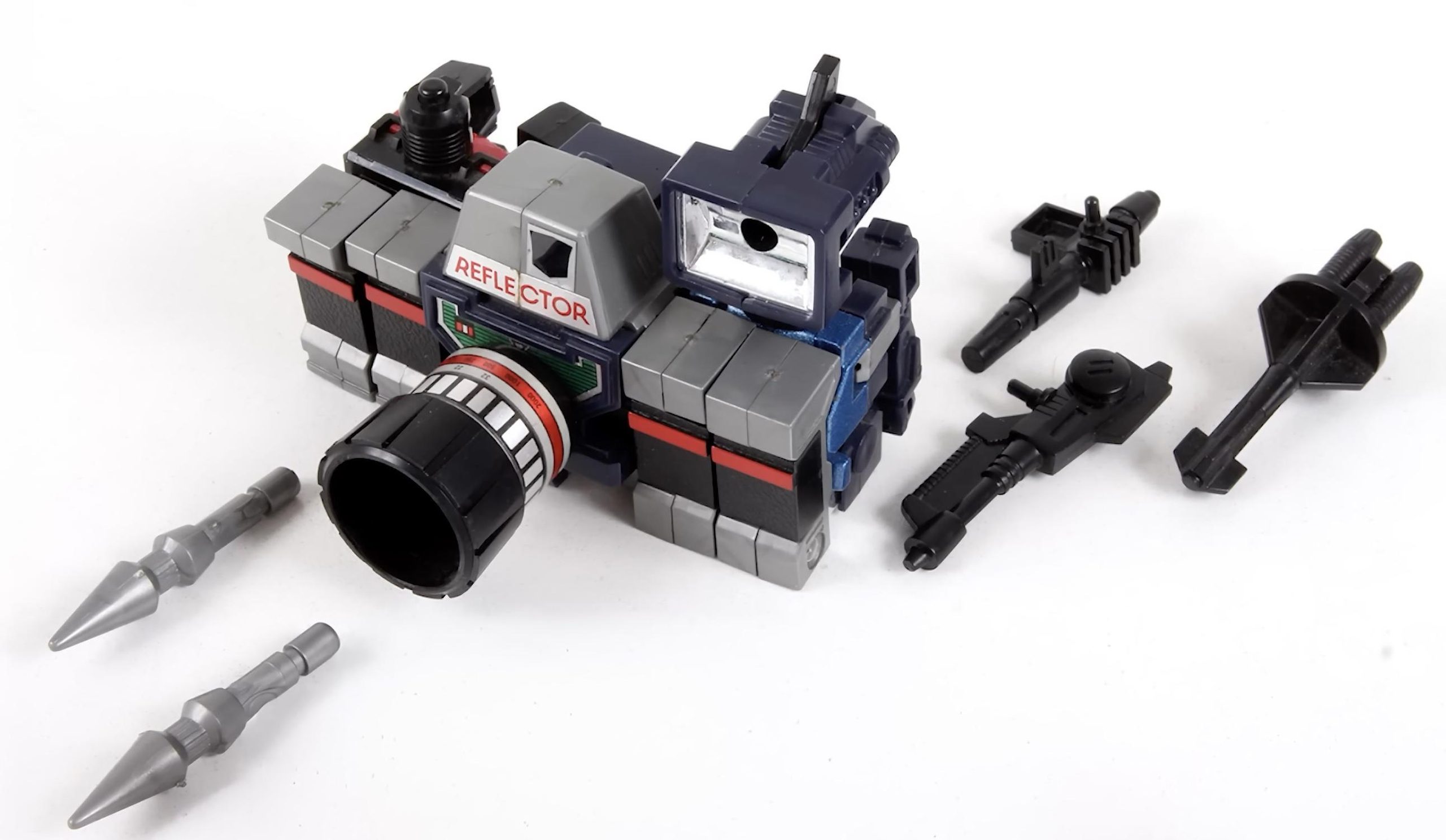
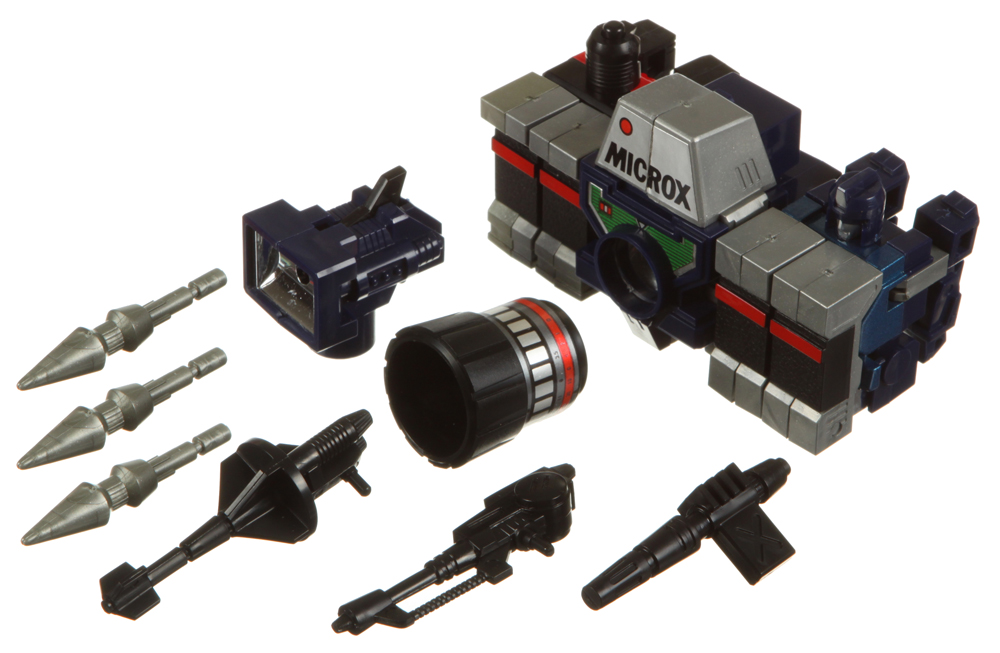
A complete original set includes three robots, a detachable telephoto lens, a flash cube, three individual weapons, and three missile pieces.
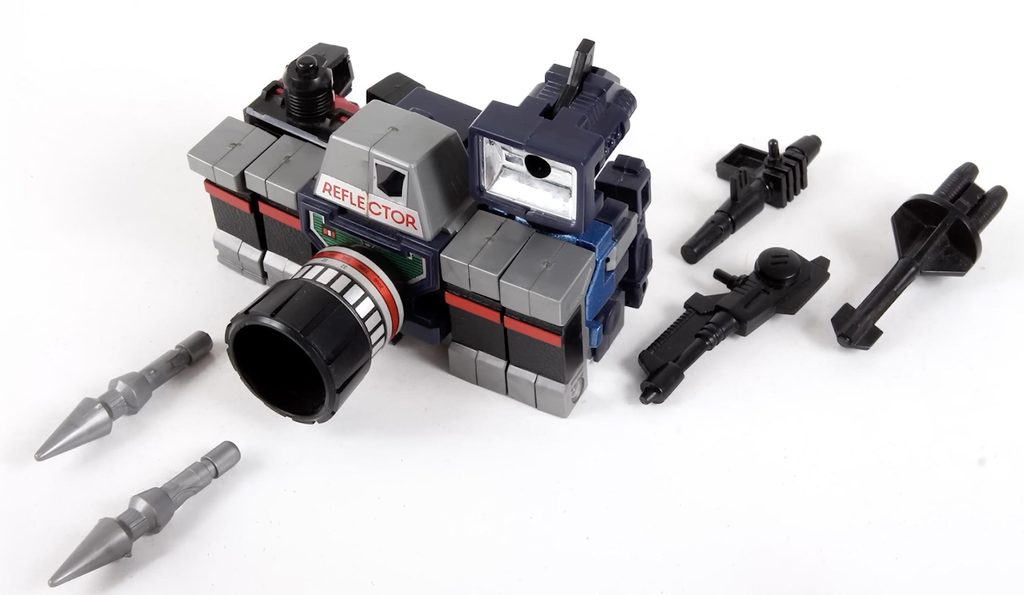
The original Generation 1 Reflector camera alongside its three distinctive black weapons and two visible silver missiles. Each robot carried its own weapon, while the complete vintage toy also included a flashcube, telephoto lens, and three missiles.
Collector photography:
ActionFigure411
.
For children, these small parts were easy to misplace.
A lens might disappear beneath a couch. A missile could vanish into a toy box. One of the three weapons might be borrowed by another Transformer and never returned.
Decades later, those missing pieces can make the difference between a complete vintage set and a collection that still needs considerable work.
Collectors seeking an authentic Reflector should carefully compare each accessory with documented originals, including the shape and construction of the missile pieces.
The Original Instruction Booklet

The instruction booklet is another appealing piece of the original package.
Its familiar grid-style artwork captures the look of early Generation 1 Transformers documentation.
For collectors, surviving paperwork can also help authenticate a set and reconstruct what the original owner received in the mail.
Reflector Was More Dangerous Than He Looked
At first glance, a camera might seem like one of the least threatening disguises for a Decepticon.
Reflector’s original character biography reveals otherwise.
According to his vintage Transformers tech specification, Reflector’s primary function was reconnaissance.
He possessed highly advanced infrared vision and could observe distant targets, including objects obscured by darkness or camouflage.
His combined camera mode also featured a fictional flash powerful enough to temporarily disorient enemies.
But his most interesting character trait was psychological.
Reflector enjoyed watching his fellow Decepticons make mistakes and was willing to use the information against them.
In other words, Megatron’s spy was not particularly trustworthy.
Even by Decepticon standards, that is saying something.

The Forgotten Variations Collectors Should Know
Vintage Reflector collecting becomes even more interesting when examining early production details.
According to the detailed toy research published by Soundwaves Oblivion, the earliest examples shared certain characteristics with Takara’s original Japanese releases.
Some early versions lacked the small gray retaining pegs added to Viewfinder’s shoulder assembly in later production.
There were also differences involving Spyglass’s weapon, including hollow and solid versions of part of the accessory.
These small manufacturing details are valuable points of comparison when studying surviving figures.
The Japanese retail packaging, original Micro Change version, and American mail-away release also had different labeling and presentation.
The original Micro Change center section carried the MICROX branding, while the Transformers version used the Reflector identity.
These distinctions help explain why collectors sometimes seek more than one version of the same basic toy.
For some enthusiasts, a complete American Reflector is enough. Others pursue the original Japanese No. 21 box or the earlier Micro Change edition.
Beware the Counterfeit Reflector
With the increasing popularity of vintage Transformers collecting came a problem familiar to collectors of other expensive 1980s toys.
Reproductions.
Reflector has been copied and reproduced in various forms, including products designed to imitate the original American mail-away packaging.
Some imitation sets are obviously different, with unusual colors or modified packaging. Others have been made to look remarkably similar to genuine vintage examples.
That means a plain white box and three robots are not enough to prove authenticity.
Collectors should examine molding differences, accessory construction, packaging materials, stickers, and provenance.
One commonly documented distinction concerns the plastic sprue used for the original missile accessories. Certain reproduction sets use a different sprue arrangement.
However, no single detail should be considered conclusive proof on its own.
When buying an expensive vintage Reflector, detailed photographs and comparisons with authenticated original examples are important.
Seibertron’s Reflector galleries include comparisons of authentic figures and reproductions.
A Look at Reflector’s Original Paperwork
One of the greatest pleasures of vintage Transformers collecting is discovering that the paper inserts often tell stories the toys themselves cannot.
Reflector’s original mail-away material reveals how Hasbro marketed the figure as something special.
It wasn’t simply another Decepticon.
It was an exclusive character children could obtain by following a series of instructions.

The original campaign created a powerful emotional connection between the child and the toy.
Saving points from other purchases, preparing the order, and checking the mailbox turned ownership into a small adventure.
There is also something wonderfully nostalgic about the idea of receiving a Decepticon in the same daily mail as household bills and ordinary letters.
For many collectors, that experience is just as important as the figure’s plastic components.
Reflector’s Strange Disappearance From the Cartoon
Despite appearing prominently in the original animated adventures, Reflector became much less significant as the Transformers series developed.
As new characters joined the franchise, the early Decepticon reconnaissance team gradually faded from regular appearances.
That timing made Hasbro’s 1986 release especially unusual.
By the time many American children finally had an opportunity to order the toy, Reflector’s most memorable cartoon appearances were already behind him.
Other popular characters had received major new toys, television stories, and promotional campaigns.
Yet Reflector’s importance to early Transformers history remained unmistakable.
He was present near the very beginning of the franchise, spying on the Autobots and supporting Megatron’s original schemes.
For collectors who grew up watching the 1984 episodes, his role in those early adventures is an essential part of his appeal.
Why Modern Collectors Still Want the Original
Over the years, Transformers collectors have gained access to several newer interpretations of Reflector.
In 2014, the character received a small transforming figure packaged with the Generations version of Skrapnel.
BotCon introduced another interpretation of the team in 2016.
Then, in 2019, Hasbro’s War for Cybertron: Siege toy line brought Reflector back under the name Refraktor.
Multiple figures could combine into a camera, bringing the original three-robot concept to a modern generation of collectors.
Hasbro also released a special Refraktor Reconnaissance Team three-pack with individually colored robots inspired by the original G1 toy.

Modern engineering has provided improved articulation, more detailed weapons, and updated appearances.
But there is still something special about the original 1986 mail-away version.
The small chrome details, unusual mechanical engineering, separate accessories, and humble white packaging make it unmistakably a product of the original Transformers generation.
And unlike a figure purchased from a store shelf, the original Reflector came with a story.
Someone had to send away for him.
Forty Years Later, Reflector Remains One of G1’s Most Fascinating Toys
By 1986, Transformers had become one of the most successful toy franchises in the world.
Children could find enormous numbers of Autobots and Decepticons at retail stores. The animated movie had arrived in theaters. New generations of characters were entering the cartoon.
And yet one of the original Decepticons remained a special-order curiosity.
Reflector was unusual from the moment he appeared on television.
He was three robots sharing one identity. He transformed into something almost comically ordinary. His toy looked different from his cartoon appearance. And American fans had to obtain him through a mail-away campaign.
Even his packaging differed from the standard Transformers experience.
Perhaps that is precisely why the original Reflector has remained so memorable to collectors.
He represents something that has become increasingly rare in modern toy collecting: the thrill of discovering a figure that seemed to exist just beyond the reach of ordinary store shelves.
For some children, he was the special Decepticon who arrived in the mailbox.
For others, he was the Transformer they always wanted but never owned.
And for collectors today, he remains an extraordinary reminder of just how inventive, surprising, and occasionally mysterious the original Transformers toy line could be.
Three robots. One camera. Forty years of collector fascination.
REFLECTOR: THE DECEPTICON YOU HAD TO SEND AWAY FOR!

THE SERPENTOR’S LAIR COLLECTOR QUESTION
Did YOU Ever Order Reflector From Hasbro?
Were you one of the lucky Transformers fans who saved their Robot Points and received Reflector in the mail?
Or was this mysterious three-robot Decepticon one of the figures you always wanted but never managed to obtain?
Tell us your memories in the comments, and share this article with a fellow Generation 1 Transformers collector!
Historical Sources and Collector Photo Archives
- Soundwaves Oblivion — Reflector (G1, 1986): original toy history, variants, prototypes, and mail-away documentation
- TFSource — Mail-Away G1 Transformers Part 1, by Maz
- Seibertron — Original G1 Reflector photo galleries and reproduction comparisons
- Transformerland — G1 Reflector collector identification guide
- Ben’s World of Transformers — 1986 Transformers movie promotional pamphlet and order form
- ActionFigure411 — Reflector original release and collector information
- TFSource — Historical Micro Change prototype research and Japanese catalog imagery
Photo credit and rights note: Archival toy photography and historical images are credited individually throughout this feature. Original images and Transformers characters belong to their respective copyright holders. Credits do not replace permission for republication; contact the relevant rights holders where required.