Changing G.I. Joe! A 1990s Toy Workshop — Hasbro Secrets Revealed
SERPENTOR’S LAIR • TOY HISTORY EXCLUSIVE
Changing G.I. Joe!
A 1990s Toy Workshop
The untold Hasbro stories behind G.I. Joe’s final years, a forgotten General Hawk playset, and the decisions that changed the toy industry.
Written by Ken Po
Edited by Adam Jared
What really happened to G.I. Joe in the 1990s? Why did Hasbro embrace brighter colors, create so many different sub-teams, experiment with larger figures, and ultimately move away from the original 3.75-inch A Real American Hero line?
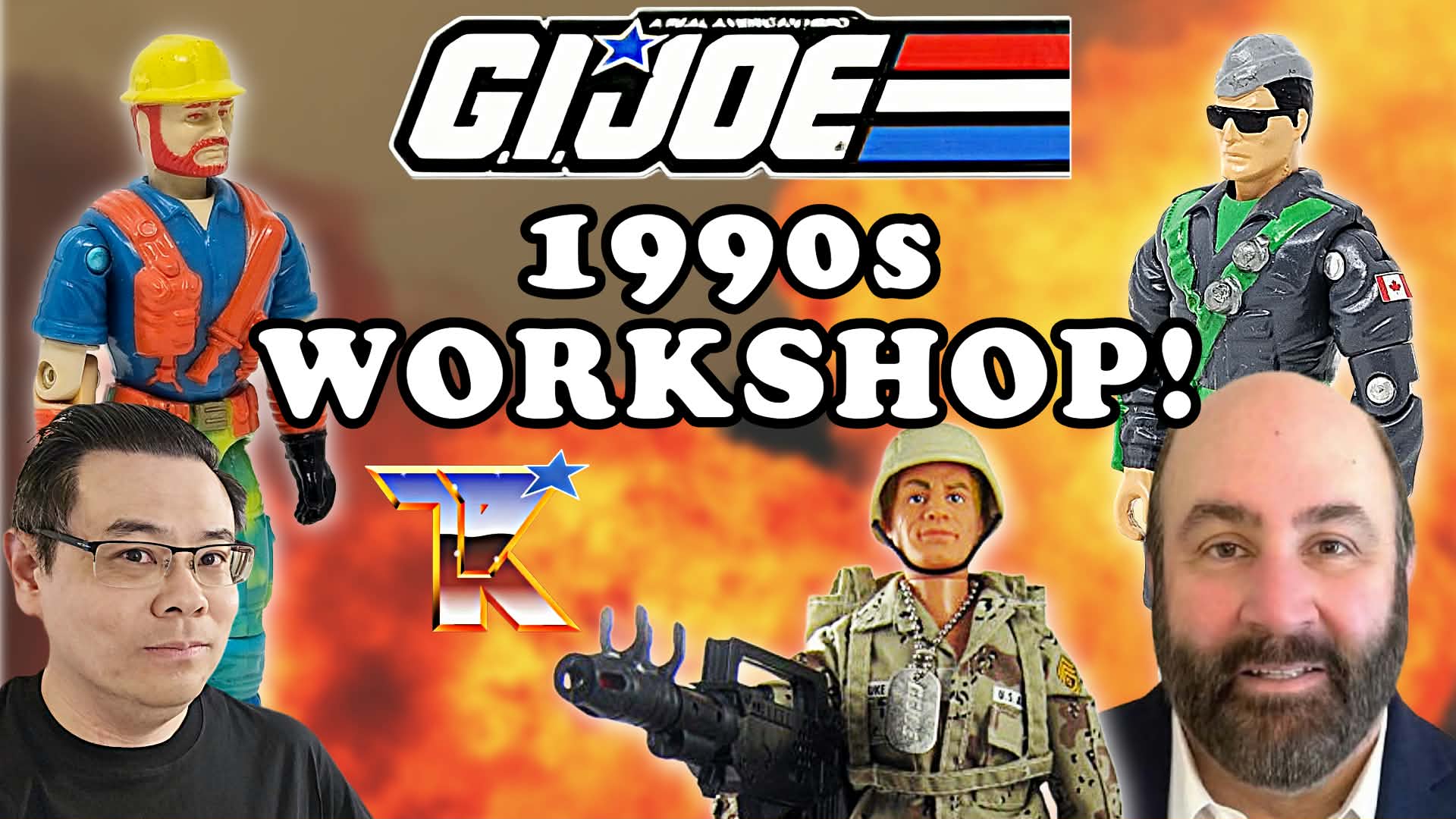
Recently on my Toy Kennections YouTube channel, I released a 73-minute discussion with former Hasbro executive Vinnie D’Alleva. Partially an interview and partially a toy history workshop, the conversation explores his experiences working on some of the most recognizable toy brands of the 1980s and 1990s.
Those brands include G.I. Joe: A Real American Hero, Transformers Generation 1, Beast Wars, and Hasbro’s WWF wrestling action figures.
Vinnie spent approximately ten and a half years at Hasbro, advancing from product management into a vice-presidential role. His time overseeing G.I. Joe from 1990 through 1994 placed him at the center of one of the most controversial and fascinating periods in the brand’s history.
As best I could, I tried to ask questions that either hadn’t been asked previously or build upon earlier interviews to clarify details that collectors and toy historians have discussed for years.
There are MANY interesting things Vinnie talked about. Some of his answers confirmed long-standing theories. Others offered entirely new perspectives on toys that have been sitting in our collections for more than three decades.
And one particular mystery involving an unreleased General Hawk figure finally received an answer.
THE COMPLETE TOY KENNECTIONS INTERVIEW
Vinnie D’Alleva: Behind the Scenes at Hasbro
Watch the complete interview here, or use the timestamp links throughout this article to jump to specific discussions.
The Real Problem Facing G.I. Joe in the 1990s
One of the most revealing parts of the interview concerns the changing toy marketplace and the enormous pressure Hasbro faced to keep G.I. Joe competitive.
During the early 1980s, G.I. Joe competed against a relatively small number of major action figure brands. But as cable television expanded, so did the number of cartoons, licensed properties, and competing toy lines.
Vinnie explained that the problem wasn’t simply more competition. The number of children buying toys hadn’t increased to match the number of competing brands.
Instead, the same audience was being divided among more products.
To combat this, Hasbro expanded G.I. Joe into different themed segments. Existing concepts such as Tiger Force and Sky Patrol provided a model for introducing new assortments throughout the year.
The strategy initially worked. Different segments gave Hasbro new products to advertise, new stories to tell, and additional opportunities to secure retail shelf space.
But eventually, the strategy created a problem of its own.
Instead of promoting one major Christmas item, Hasbro found itself supporting several large products across different G.I. Joe segments. Those products competed against each other for the same customers.
As Vinnie explained, the company wasn’t necessarily creating more sales. It was dividing existing sales among more products while increasing advertising costs.
That revelation helps explain why the early-1990s G.I. Joe line became so fragmented.
WATCH: 21:58 — G.I. Joe segments and the changing action figure marketplace
Why Did G.I. Joe Become So Colorful?
Few subjects generate more debate among vintage G.I. Joe collectors than the increasingly bright colors and unconventional designs introduced during the 1990s.
For fans who grew up with the more military-oriented figures of the early 1980s, the shift could feel like a dramatic departure from the original formula.
But Vinnie offered an important explanation: the traditional G.I. Joe business model was no longer performing the way it once had.
Hasbro was trying to adapt to changing trends while competing against action figures that were larger, more expensive, and increasingly driven by television and movie content.
Vinnie emphasized that G.I. Joe had historically been a vehicle-driven brand. Vehicles generated a major portion of its revenue, while the inexpensive individual figures served as a gateway into the larger product line.
That approach had worked extraordinarily well during the 1980s, but the marketplace was shifting toward higher-priced action figures.
In the interview, Vinnie contrasts G.I. Joe figures selling for approximately $1.99 with competing Batman figures priced around $5.99.
The bright colors were part of an effort to keep G.I. Joe visually competitive and relevant.
He also discussed how restrictions on projectile-launching features had affected vehicle development, making it harder for G.I. Joe to match the interactive features of competing toys.
Whether collectors love or dislike the later color schemes, Vinnie’s explanation provides valuable context for why those decisions were made.
WATCH: 27:28 — Why G.I. Joe changed colors and how action figure play evolved
G.I. Joe Was Going to Become a 4.5-Inch Toy Line!
One of the biggest revelations involves Hasbro’s long-term plans for the scale of G.I. Joe action figures.
Many collectors view Sgt. Savage and His Screaming Eagles as a separate experiment that followed the original 3.75-inch line.
But Vinnie confirmed that Hasbro was planning a broader transition toward the 4.5-inch scale.
The company believed G.I. Joe needed to become larger to compete with other action figure brands occupying retail shelves.
This helps explain why the planned Manimals and X-Soldiers were also designed around larger figure formats.
Rather than preserving the 3.75-inch scale indefinitely, Hasbro was considering another major reinvention of the franchise.
Vinnie pointed out that G.I. Joe itself had originally begun as a 12-inch action figure line, making changes in scale part of the brand’s history.
It’s fascinating to imagine how different G.I. Joe might have looked had those plans continued.
WATCH: 30:24 — Sgt. Savage, Manimals, X-Soldiers, and the planned scale change
Hall of Fame Duke: The Figure That Almost Never Happened
One of Vinnie’s proudest accomplishments at Hasbro was helping bring the 12-inch Hall of Fame Duke to market.
The concept was intended to appeal to fathers who remembered playing with the original large-scale G.I. Joe figures while introducing a new generation to the brand.
But the project faced resistance inside Hasbro.
Vinnie recalled that company leadership wasn’t initially enthusiastic about creating 12-inch versions of the familiar A Real American Hero characters.
He continued advocating for the project until Target expressed interest in an exclusive figure.
Eventually, Hasbro agreed to produce Duke.
The result was extraordinary.
The initial shipment of 20,000 figures sold out rapidly around Father’s Day 1991, reportedly within hours.
Target placed an additional order for 20,000 figures, followed by a much larger order of 80,000.
That brought total sales to approximately 120,000 Duke figures.
Vinnie explained that the enormous success came without traditional television advertising for the exclusive.
He also shared a remarkable production detail: to meet the launch schedule, the design team adapted an existing body associated with the Maxi fashion doll line, creating new components for Duke rather than tooling an entirely new figure from scratch.
The project became a significant personal achievement for Vinnie and helped demonstrate that G.I. Joe nostalgia could appeal to adult buyers.
WATCH: 31:56 — The creation of Hall of Fame | 41:23 — The 120,000-unit Target sales story
The Missing 1994 Sales Figures: $60 Million to $65 Million!
For years, G.I. Joe researchers have examined historical sales data covering 1982 through 1993.
Thanks to the work of 3DJoes and Joe Declassified, collectors have been able to study a historical sales chart illustrating the brand’s performance during its original run.
However, the chart lacked a complete figure for 1994.
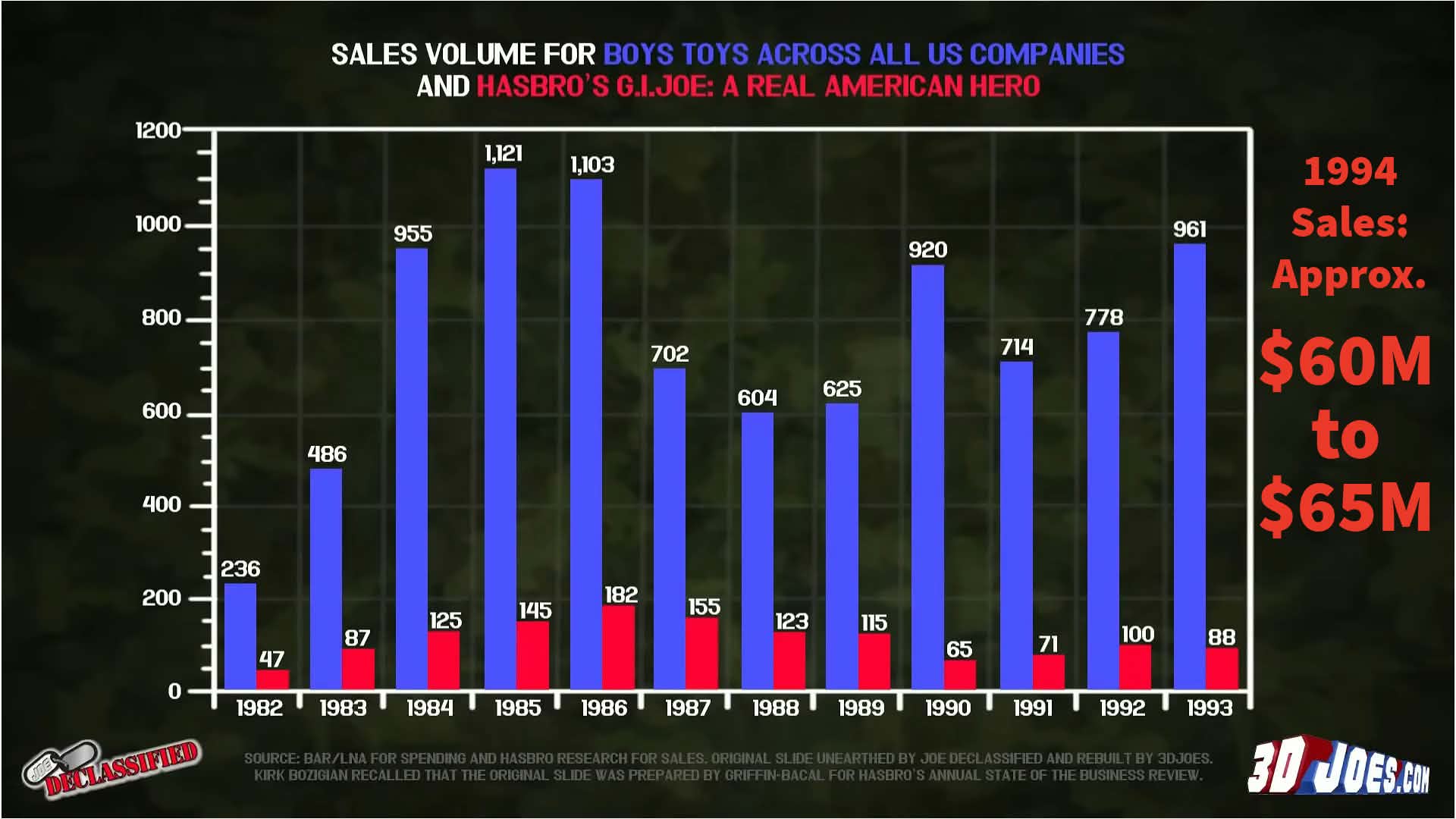
During our discussion, I brought up a contemporary magazine article that reported approximately $26 million in G.I. Joe sales during 1994.
But that number represented only a partial year, rather than the complete annual total.
Vinnie clarified that G.I. Joe finished 1994 with approximately $60 million to $65 million in revenue.
Importantly, this figure included the Hall of Fame line.
The distinction matters because the toy industry depended heavily on holiday-season sales. Comparing partial-year revenue against full-year totals can create a misleading picture.
Vinnie also explained that G.I. Joe had historically been an attractive business for Hasbro because it did not require royalty payments to an outside intellectual property owner.
However, the rising costs of television programming, manufacturing limitations, and increased competition were making the original business model more difficult to maintain.
His newly discussed 1994 figure gives collectors a much more complete picture of the brand’s performance during its final original A Real American Hero year.
WATCH: 34:49 — Historical G.I. Joe sales chart | 36:58 — The missing 1994 sales figure
A Record-Breaking G.I. Joe Convention Aboard the USS Intrepid
Vinnie also revealed a remarkable story about the 1994 G.I. Joe convention held aboard the USS Intrepid in New York City.
The event took place during the brand’s 30th anniversary celebrations, and Toys “R” Us was involved in selling merchandise at the convention.
According to Vinnie, the sales generated during the event were so substantial that they became an extraordinary benchmark for Toys “R” Us.
He recalled that the Intrepid event effectively represented the company’s highest-performing store during that period, despite operating for only a short time.
It was an extraordinary demonstration of G.I. Joe’s continuing popularity among collectors and enthusiasts, even as the brand faced an uncertain future.
WATCH: 39:17 — The USS Intrepid sales record
Recalled Roadblock (1992): What Actually Went Wrong?
The recalled 1992 Roadblock is one of the more fascinating production mysteries from the later years of G.I. Joe: A Real American Hero.
Collectors have long wondered whether the figure was simply discontinued, whether unsold figures were destroyed, or whether retailers were actually required to return their inventory.
During the interview, Vinnie helped clarify the circumstances.
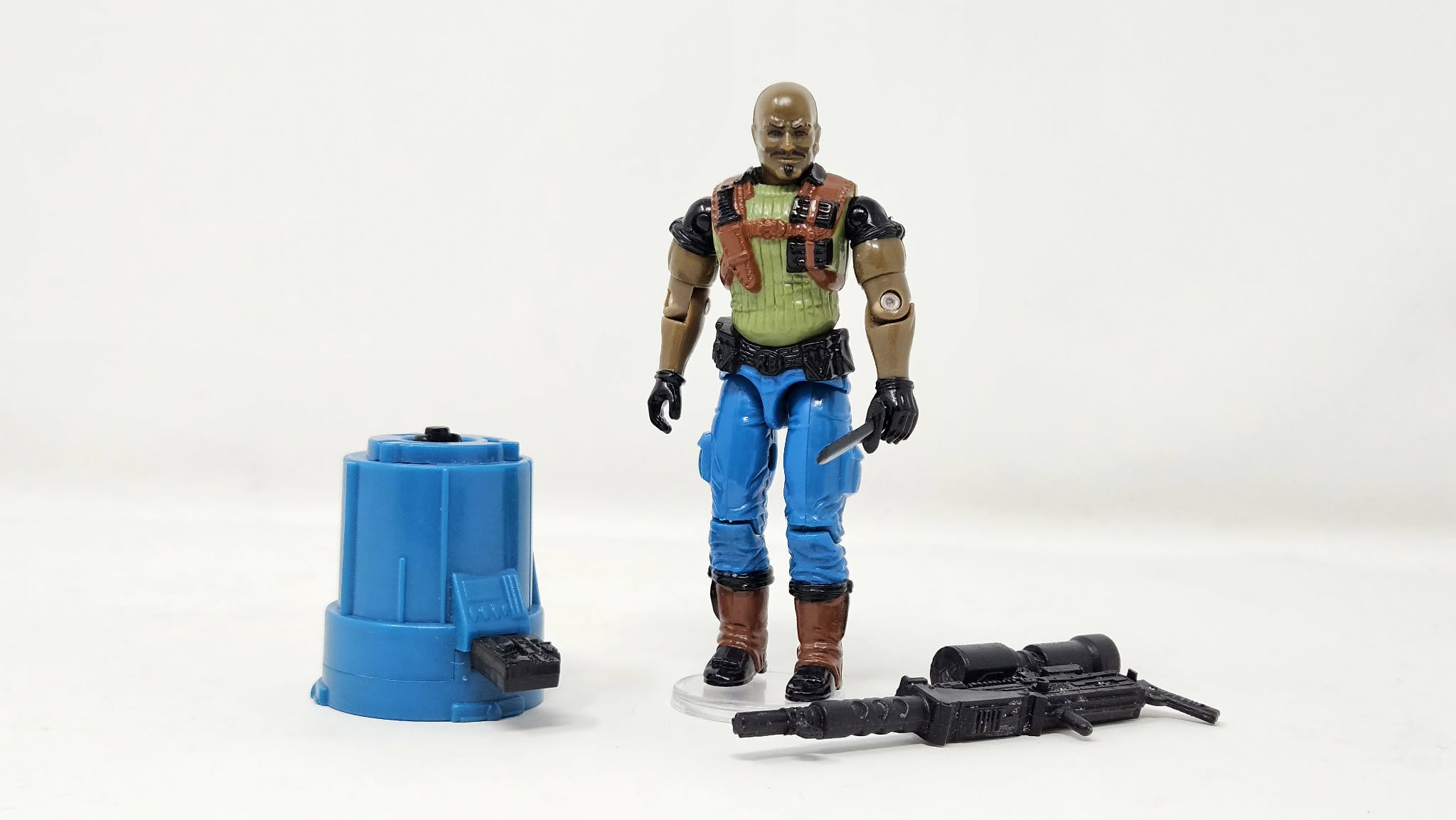
The problem involved the figure’s spring-powered accessory mechanism.
Vinnie explained that the spring was extremely powerful relative to its housing. Repeated winding could loosen the mechanism and eventually cause it to break.
Hasbro determined that the product should not remain on the market.
The company withdrew and destroyed its own inventory, but the recall did not end there.
Retailers also had to return unsold inventory.
This helps explain why the recalled figure is significantly harder to find than some collectors might expect based on historical shipment estimates.
Vinnie also clarified that the problem was primarily mechanical breakage during winding, rather than reports of the mechanism unexpectedly launching on its own.
Because Roadblock remained an important and popular character, Hasbro produced a replacement version with different accessories for 1993.
It’s a fascinating example of how a single engineering problem could dramatically affect the availability of an action figure decades later.
WATCH: 52:45 — The recalled Roadblock investigation
Outback’s 1993 Mystery: The Release Order Was Backward!
One of the most useful discoveries for G.I. Joe historians involves the two different 1993 Outback figures.
For years, collectors had relied on an archived release order that now appears to have been reversed.
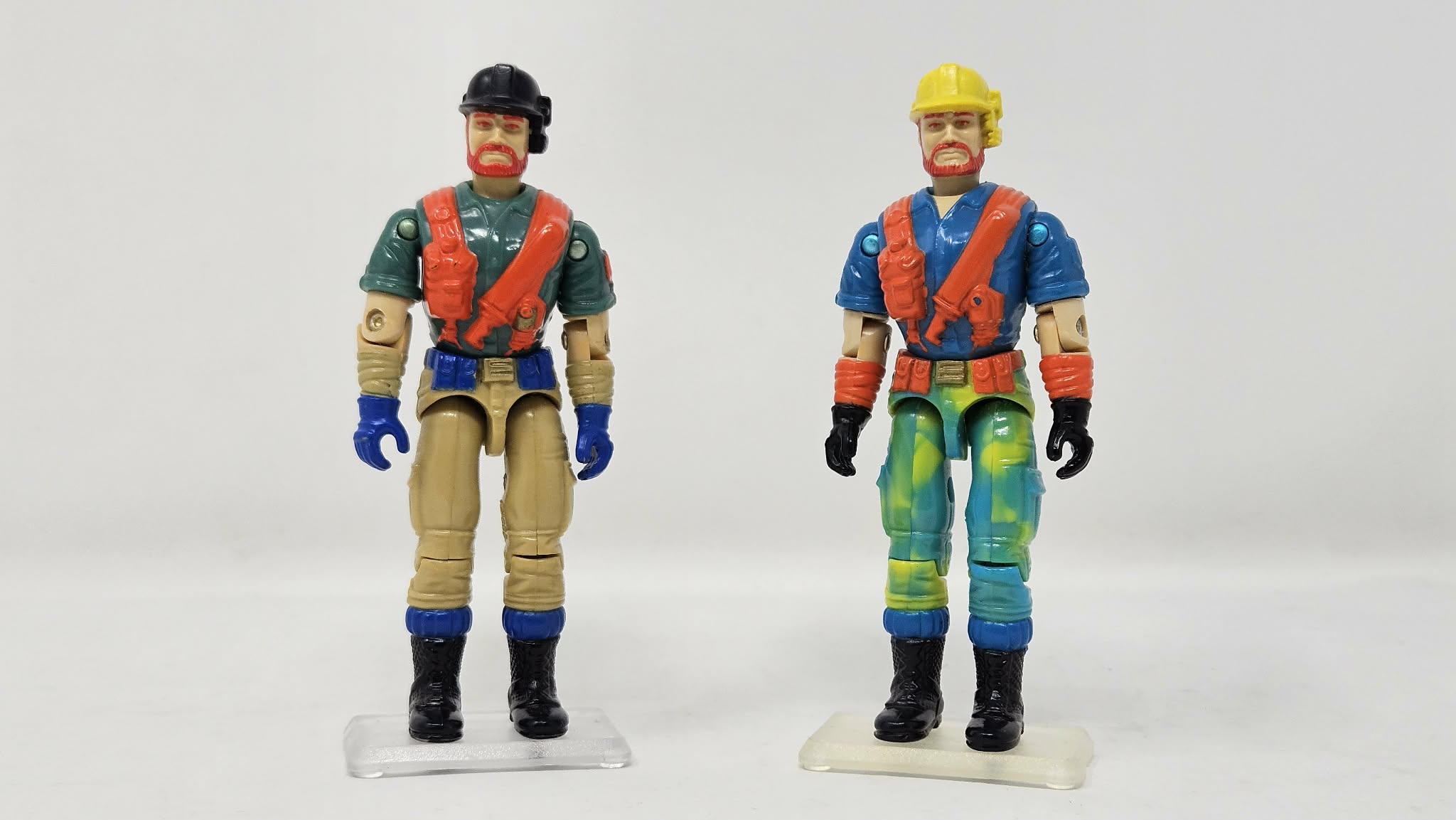
The green shirt, tan pants, and black hardhat version came first.
The blue shirt, tie-dye pants, and yellow hardhat version followed afterward.
Previously, YoJoe.com had archived the versions in the opposite order.
The explanation involves both the cancellation of Eco Warriors and Hasbro’s efforts to control manufacturing expenses.
The original green-and-tan Outback had been intended for a cancelled third year of Eco Warriors before being reassigned to Battle Corps.
During the interview, Vinnie explained how the later version used a manufacturing technique involving two differently colored plastics introduced into the mold.
Rather than completely blending, the colors produced a mottled effect that resembled camouflage.
This allowed Hasbro to create a more visually elaborate figure without paying for additional paint applications.
Vinnie credited Kirk Bozigian and his team with developing or advancing the cost-saving approach, while acknowledging that he could not recall precisely who first originated the idea.
The technique was subsequently used on additional figures.
For collectors, this isn’t simply a color variation. It’s an example of how manufacturing costs directly influenced the appearance and release history of a beloved G.I. Joe character.
Editor’s note: 3DJoes.com has been notified of the corrected release order and is working toward updating its records.
WATCH: 55:07 — The Outback mystery and cancelled Eco Warriors
Total Combat Hawk: A G.I. Joe Mystery Finally Solved!
Perhaps the most exciting discovery in the entire interview concerns the unreleased Total Combat Hawk figure and bunker playset.
For years, G.I. Joe researchers had been trying to establish exactly what Hasbro intended to release under that name.
A 1995 pre-Toy Fair listing referenced Total Combat Hawk, while surviving prototype photography showed a bunker that eventually appeared in the Sgt. Savage toy line.
One historical photograph showed a Backblast figure standing with the bunker before the intended General Hawk figure had been finalized.
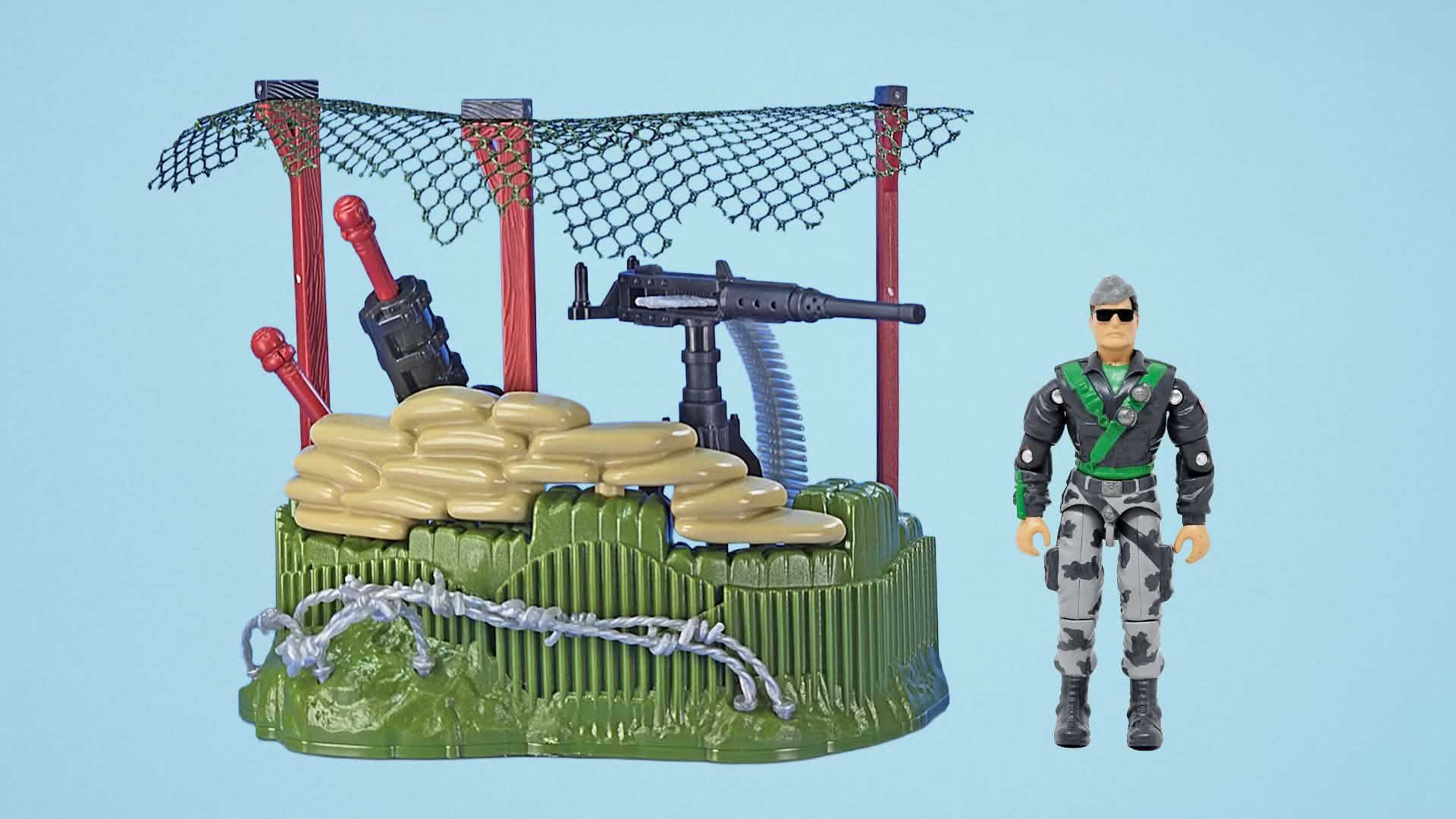
Additional documentation, including an October 28, 1992 figure source sheet and a November 2, 1992 memo, pointed toward a special General Hawk figure.
Research credited to 3DJoes, Joe Declassified, Articulated Points, and other collectors helped connect the surviving pieces.
But confirmation from someone who worked on the project was still missing.
During our interview, I presented Vinnie with the available evidence, including the proposed figure’s appearance and the historical paperwork.
And Vinnie confirmed it.
The unreleased General Hawk and bunker combination was indeed Total Combat Hawk.
That confirmation alone would have made the discussion worthwhile.
But Vinnie went further, explaining the surprising origin of the bunker itself.
The Talking G.I. Joe Technology That Never Happened
Before Total Combat Hawk, Hasbro had been experimenting with an ambitious interactive concept that could have changed the entire G.I. Joe action figure line.
The proposed system involved a special pattern molded into the bottom of a figure’s boot.
When the figure was placed onto a reader, the pattern would identify the character and activate a corresponding recording on a microcassette.
In theory, different G.I. Joe figures could speak their own dialogue without requiring electronic backpacks or individual sound modules.
Hasbro even envisioned additional microcassettes that could expand the available adventures.
But there was a problem.
When the working prototype was tested with children, they showed little interest in the talking feature.
Instead, they were much more interested in playing with the missile launcher incorporated into the concept.
The interactive talking system was abandoned.
However, Hasbro salvaged the idea of a small bunker equipped with a launcher and developed it into the proposed Total Combat Hawk set.
Vinnie explained that the later bunker was not itself the original microcassette reader. Rather, it was a separate product developed from the earlier concept.
That distinction helps explain how the design evolved.
Eventually, the bunker tooling found a home in the Sgt. Savage line, even though Total Combat Hawk never reached retail in its intended form.
During the interview, I also showcased a custom figure based on the surviving General Hawk documentation.
After years of questions, the identity of Total Combat Hawk was finally confirmed.
For researchers and collectors who have spent countless hours examining prototype photographs, design sheets, and cancelled product lists, this was an especially satisfying discovery.
WATCH: 1:04:54 — The Total Combat Hawk investigation begins | 1:07:10 — The abandoned talking-figure technology | 1:10:43 — General Hawk’s identity confirmed
BEYOND G.I. JOE
Transformers, Beast Wars, and WWF: More Hasbro Secrets
Although G.I. Joe is the central focus of the interview, Vinnie’s career at Hasbro also produced some fascinating stories about several other legendary toy lines.
Transformers Generation 1: The $300 Million Toy Brand
Vinnie recalled that Transformers reached approximately $300 million in annual sales during its peak years in the mid-1980s.
He also discussed the challenges of managing the brand as its popularity declined toward the end of the decade.
By the time he became involved in 1989, Hasbro was preparing the Action Masters concept and exploring ways to reinvent Transformers without the same level of animated television support.
Vinnie emphasized that television programming played an important role in sustaining action figure brands, and that reducing support could make continued growth extremely difficult.
He also reflected on the decision to replace major Transformers characters during the original era, acknowledging that the emotional connection children had developed with characters such as Optimus Prime was not fully understood at the time.
WATCH: 2:20 — Transformers Generation 1 and the brand’s commercial peak
Beast Wars: How King Kong, Terminator, and a Nissan Maxima Changed Transformers
Some of the most entertaining stories in the interview concern the creation of Beast Wars.
Vinnie explained that Hasbro was exploring numerous ways to reinvent Transformers, including new articulation systems, role-play concepts, and more organic-looking robots.
Eventually, the company became enthusiastic about realistic animal forms that transformed into robots.
The visual approach drew in part from Japanese science-fiction and monster-inspired designs.
But the most memorable details concern the names and characters.
The King Kong Connection
Vinnie recalled that the famous battle between King Kong and a Tyrannosaurus rex in the 1933 film helped inspire the choice of a gorilla for Optimus Primal and a T. rex for Megatron.
The contrast between warm-blooded mammals and cold-blooded reptiles also helped shape the identities of the opposing factions.
The Nissan Maxima Connection
One of the most surprising stories concerns the origin of the name Maximals.
Vinnie explained that he had been struggling to find a suitable name for the heroic faction.
Then, during a lunch outing, he noticed the Maxima badge on a colleague’s Nissan.
The name inspired him to suggest Maximals.
After receiving legal clearance, the name became part of Transformers history.
Where Did the Name Beast Wars Come From?
Vinnie also revealed that the name Beast Wars was inspired by the branding of the Terminator Future War toy line.
It’s remarkable how several unrelated influences helped shape one of the most recognizable Transformers reinventions of the 1990s.
The discussion also covers the creation of the Machine Wars assortment for KB Toys, using existing Transformers tooling that had not previously been released in the United States.
WATCH: 8:28 — Beast Wars development | 11:08 — King Kong inspiration | 12:19 — The Maximals name | 13:34 — The Beast Wars name
WWF Action Figures: How Black-and-White Packaging Saved the Deal
Vinnie’s experiences with Hasbro’s WWF wrestling figures provide another fascinating look at the economics of toy manufacturing.
He explained that Hasbro was developing a line of wrestling figures featuring built-in action mechanisms designed to recreate signature wrestling moves.
The team wanted the figures to retail for approximately $4.99.
However, when the proposed line was presented to Hasbro executive Stephen Hassenfeld, the projected profit margin fell slightly short of the required target.
Hassenfeld requested an additional one-tenth of a percentage point in profitability.
The solution was surprisingly simple.
Hasbro reduced the printing costs of the packaging by removing full-color decoration from the back of the cards, leaving a less expensive black-and-white presentation.
That small adjustment helped the line meet its financial target.
It’s an excellent reminder that even the packaging of a beloved toy can reveal the financial decisions that went into bringing it to market.
WATCH: 15:52 — Hasbro WWF action figures and packaging costs
The G.I. Joe That Might Have Been: Plans for 1995
One of the most poignant moments in the interview comes when Vinnie discusses the end of his time with G.I. Joe.
When asked whether he was relieved to move away from the brand, his response was that he wasn’t finished with what the team had been trying to accomplish.
According to Vinnie, the plans for 1995 involved returning G.I. Joe to a more recognizable military identity.
The brightly colored, heavily stylized approach was expected to give way to more modern military designs.
Hasbro still intended to use different segments, but the emphasis would have shifted toward a more grounded military presentation.
The planned Battle Corps Rangers direction reflected that thinking.
For collectors who have wondered what might have happened if the original G.I. Joe line had continued, this provides an intriguing glimpse into the brand’s unfinished plans.
WATCH: 52:00 — The end of the line and the plans for 1995
Preserving the Stories Behind the Toys
For collectors, these interviews are about much more than sales figures, release dates, or identifying obscure prototypes.
They’re about understanding the people, decisions, and circumstances that shaped the toys we grew up with.
Sometimes those decisions involved ambitious creative ideas. Sometimes they involved manufacturing costs, retailer demands, or changing consumer tastes.
And sometimes they involved a single conversation, a chance observation in a parking lot, or a prototype that children simply didn’t enjoy playing with.
That’s what makes discussions with former Hasbro executives such as Vinnie D’Alleva so important.
They preserve details that might otherwise disappear from toy history.
From the recalled Roadblock and the corrected Outback release order to the remarkable story behind Total Combat Hawk, this interview helps answer questions that G.I. Joe collectors have debated for decades.
And perhaps most importantly, it reminds us that even the toys that never reached store shelves have stories worth telling.
Watch the Complete Interview
Join Ken Po and Vinnie D’Alleva for the full 73-minute conversation about G.I. Joe, Transformers, Beast Wars, and Hasbro’s WWF action figures.
For more interviews, toy history, and collector discussions, visit Toy Kennections on YouTube.
About the Author — Ken Po
Ken Po is the creator of Toy Kennections, a YouTube channel exploring classic toys, action figure history, and the people behind some of the industry’s most memorable products. Through historical research and interviews with toy industry veterans, Ken helps preserve the stories behind the toys collectors love.
Edited by Adam Jared
Adam Jared is the founder of SerpentorsLair.com. He holds a Master of Science in Social Media Management and is pursuing a PhD in Strategic Communication. Through SerpentorsLair.com, he works to preserve and celebrate the history of classic toys, television, and popular culture.
SERPENTOR’S LAIR | TOY HISTORY • COLLECTOR CULTURE • CLASSIC ENTERTAINMENT