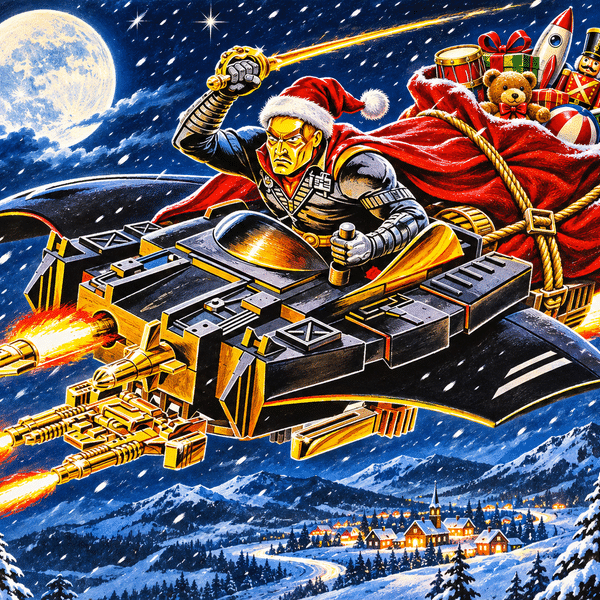
The 10 Greatest G.I. Joe Vehicles of the 1980s — Ranked!
THE 10 GREATEST
G.I. JOE VEHICLES
OF THE 1980s!
U.S.S. Flagg! Which legendary Hasbro
creation deserves the crown?
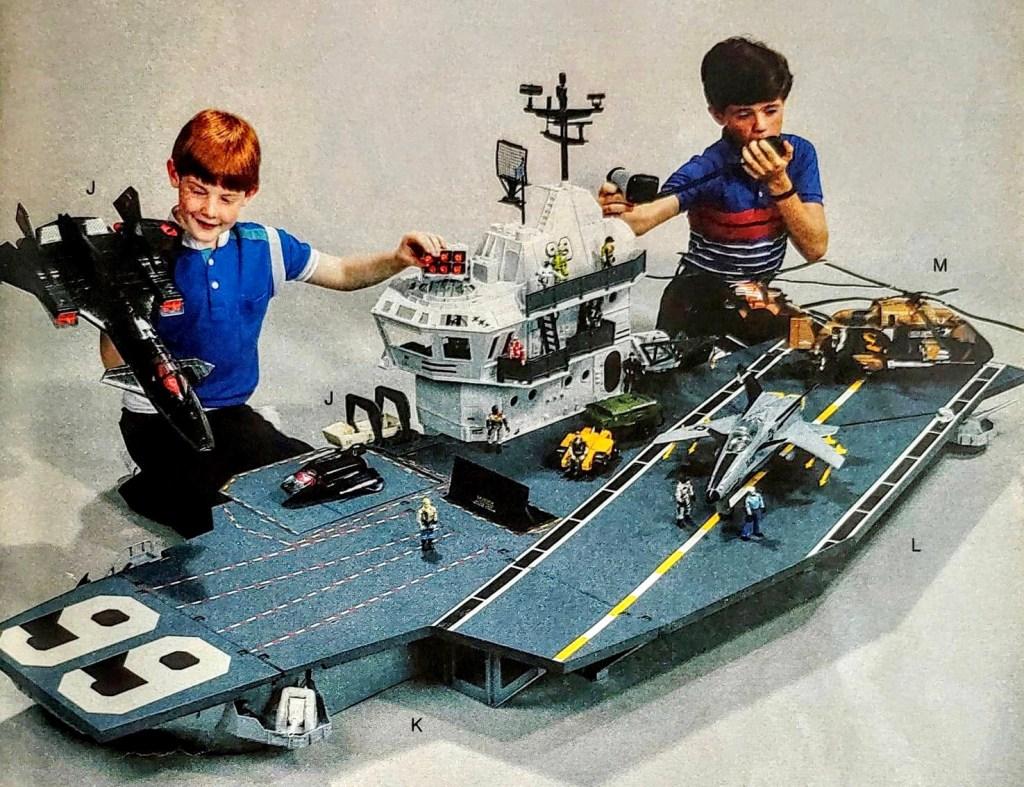
The enormous 1985 G.I. Joe U.S.S. Flagg in an original-era promotional image.
Source:
The Toy Collector’s Guide.
Hasbro product imagery.
There was nothing quite like walking into a toy store during the 1980s and seeing an entire wall of
G.I. JOE: A REAL AMERICAN HERO
vehicles staring back at you.
The fighter jets. The tanks. The helicopters. The attack boats. And that enormous aircraft carrier that seemed almost too incredible to be real.
For Gen-X kids, the G.I. Joe toy aisle was a battlefield of imagination. Hasbro didn’t merely produce military vehicles to accompany its 3.75-inch action figures. It created an entire miniature world of highly detailed fighting machines, each with its own personality, specialized driver, ingenious features, and unforgettable illustrated packaging.
Some vehicles became the centerpiece of an entire childhood collection. Others were the toys we desperately circled in the Sears Wish Book but never found beneath the Christmas tree.
Four decades later, collectors still debate which of these remarkable machines deserves to be remembered as the greatest.
This ranking covers original G.I. Joe: A Real American Hero vehicles released during the 1980s, judged on design, innovation, playability, childhood impact, and collector appeal.
The U.S.S. Flagg is included as an aircraft-carrier vehicle/playset. Stationary headquarters and bases are otherwise excluded.
And yes, Cobra vehicles absolutely count!
TOMAHAWK
HELICOPTER!

The original 1986 Tomahawk helicopter, shown with its pilot, Lift-Ticket, and original packaging.
Photograph:
Old School Toys.
Few G.I. Joe vehicles were better suited to staging a full-scale rescue mission than the 1986 Tomahawk. This enormous twin-rotor helicopter combined the impressive appearance of a military transport with the firepower of an attack aircraft.
It wasn’t simply a helicopter for one action figure. The Tomahawk featured a rear cargo access ramp, removable seating, twin rotors, a working winch, and weapons that made it feel like a vital part of the Joe team’s battlefield operations.
For kids staging rescue operations in the backyard, the Tomahawk was practically indispensable.
Why only No. 10?
Its size and play features were spectacular, but its twin rotors could be cumbersome in a crowded play area. Even so, collectors who owned one may argue it belongs much higher.
COBRA
WATER MOCCASIN!

The original Cobra Water Moccasin and Copperhead figure.
Photograph:
Old School Toys.
Cobra’s Water Moccasin was one of those wonderfully strange vehicles that could only have emerged from the golden age of G.I. Joe.
Released in 1984 with its memorable pilot Copperhead, the Water Moccasin was designed for the murky waterways and hidden swamp bases where Cobra could launch surprise attacks.
Its striking teal-green color, distinctive rear fan assembly, narrow body, and mounted weapons gave the vehicle an unmistakable silhouette. It also offered room for additional figures, making it more versatile than its relatively modest size suggested.
No Cobra swamp adventure felt complete without Copperhead’s Water Moccasin lurking nearby.
The collector argument:
Some fans believe the Water Moccasin deserves to outrank considerably larger vehicles simply because of its unique design and compact, accessible playability.
DRAGONFLY
XH-1!

The original Dragonfly XH-1 with its legendary pilot, Wild Bill.
Collector photograph via
Midwest Vintage Toys / eBay.
Long before the Tomahawk dominated G.I. Joe’s skies, Wild Bill and the Dragonfly XH-1 were already swooping into action.
Introduced in 1983, this military-style attack helicopter captured the excitement of aerial combat with its olive-green body, missile loadout, detailed cockpit, rotating weapons, and functioning rescue winch.
There was also Wild Bill himself, the mustachioed cowboy pilot whose personality helped give the vehicle a special place in the G.I. Joe universe.
The Dragonfly offered something every child wanted: the ability to launch an airborne rescue or attack mission anywhere in the house.
The debate:
Does the earlier Dragonfly deserve to rank above the larger Tomahawk because of its iconic look, legendary pilot, and enduring connection to the early years of the toy line?
A.W.E.
STRIKER!
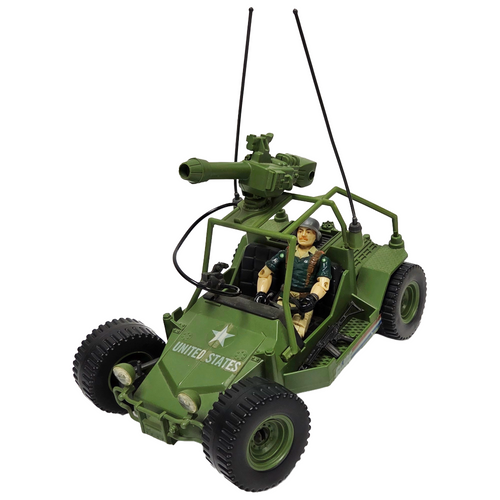
The original 1985 A.W.E. Striker with Crankcase.
Photograph:
Decades of Cool Toys.
Sometimes the greatest toys aren’t necessarily the biggest. Sometimes they’re the ones you could take anywhere, launch across the carpet, and incorporate into nearly every backyard battle.
The A.W.E. Striker, introduced in 1985 with driver Crankcase, was one of the best examples of that philosophy. Its open-frame design, four-wheel suspension, turning front wheels, mounted cannon, and removable engine cover gave children an impressive amount of interaction for a relatively compact vehicle.
The A.W.E. Striker was pure playability on four wheels.
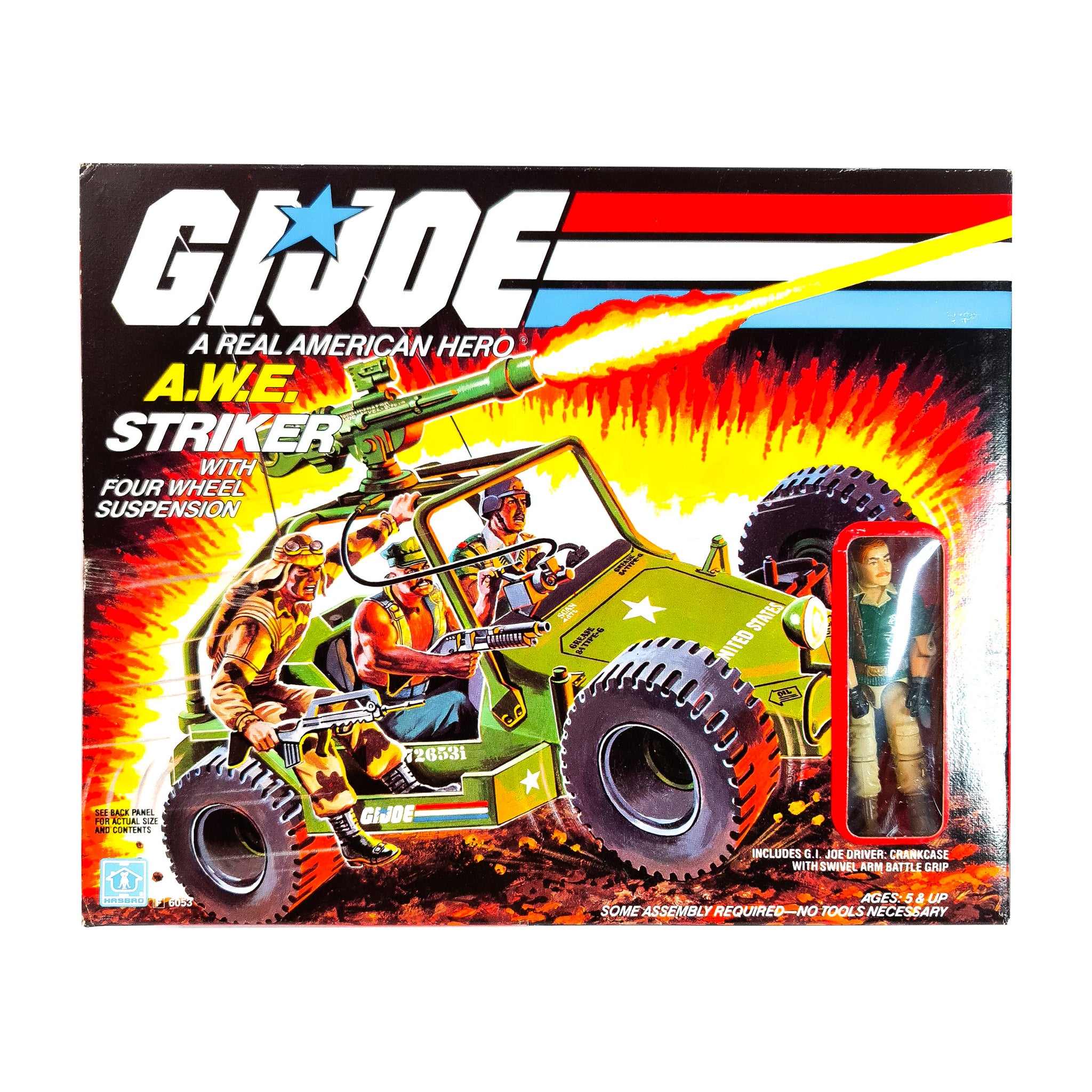
Original A.W.E. Striker packaging featuring classic Hasbro G.I. Joe artwork.
Image via
ToySack.
Artwork © Hasbro.
Why it belongs:
Its scale made it easy to use, its suspension made it fun to drive, and its incredible packaging made it nearly impossible to ignore in the toy aisle.
COBRA
NIGHT RAVEN!
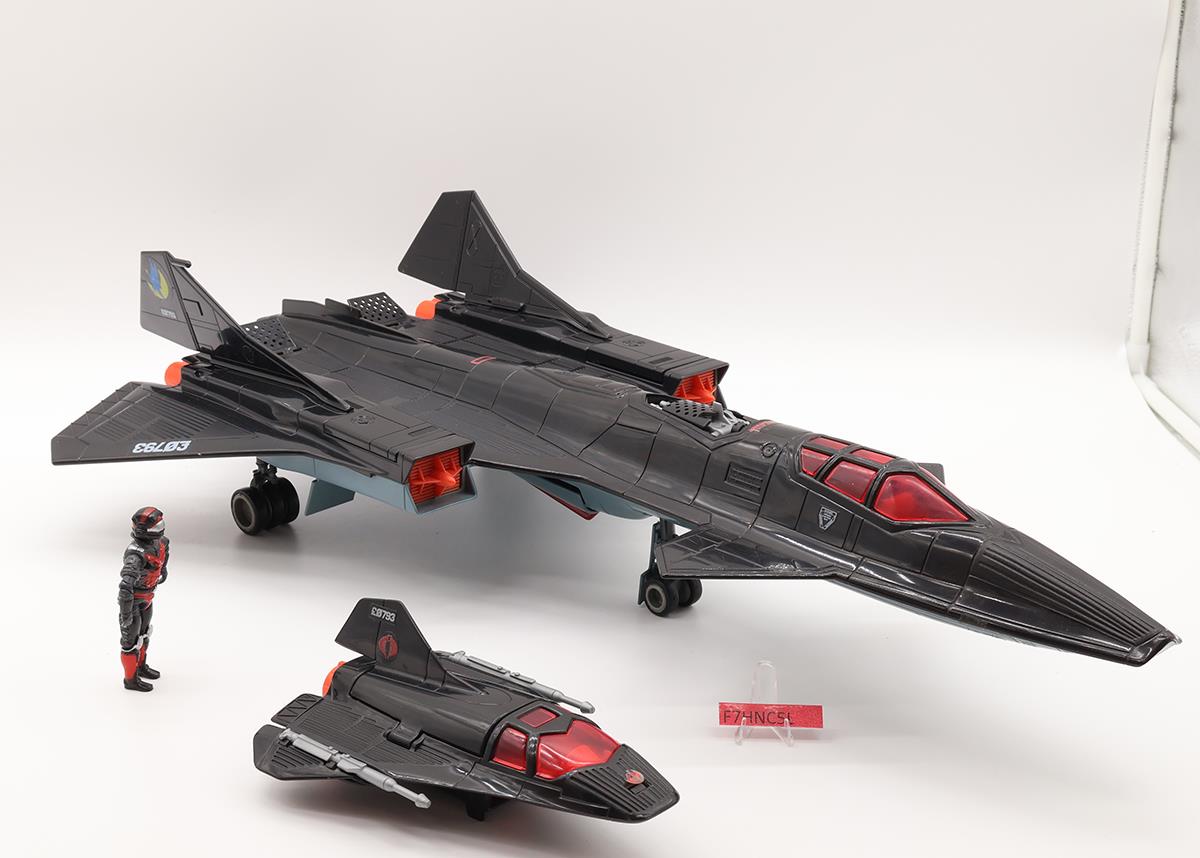
The original Night Raven S3P with reconnaissance jet and Strato-Viper.
Photograph via
Wheeljack’s Lab.
If Cobra wanted to terrify G.I. Joe pilots before a battle even began, the Night Raven was the perfect aircraft for the job.
Released in 1986, this enormous black reconnaissance and attack jet looked like something from a high-budget science-fiction movie. Its sleek fuselage, red cockpit detailing, retractable landing gear, and enormous wingspan gave it an unmistakably menacing presence.
But the Night Raven’s greatest trick was its smaller detachable reconnaissance aircraft, which rode on top of the main jet and could be removed for a separate mission.
One gigantic Cobra aircraft was impressive enough. Two aircraft in one made it unforgettable.
The collector controversy:
Plenty of Cobra fans would rank the Night Raven above the Skystriker and Rattler simply because of its futuristic design and incredible display presence.
COBRA
RATTLER!

The original blue Cobra Rattler ground-attack jet, released in 1984 with Wild Weasel.
Photograph:
Lulu-Berlu.
There are G.I. Joe collectors who believe the Cobra Rattler is not merely the greatest Cobra aircraft but the finest vehicle in the entire vintage toy line.
And it is difficult to argue against its incredible design. Introduced in 1984 with pilot Wild Weasel, the Rattler was inspired by the rugged appearance of real-world ground-attack aircraft, complete with multiple weapons, cockpit detailing, and a menacing blue color scheme.
Its most memorable play feature was the ability to rotate its engine-bearing wings upward to simulate vertical takeoff and landing. Add removable bombs, missiles, and simulated battle-damaged panels, and Hasbro had created a vehicle that could dominate almost any imaginary battlefield.
For Cobra fans, the Rattler wasn’t just a jet. It was an entire air force in one spectacular toy.
The argument for No. 1:
Its excellent scale, abundance of weapons, distinctive pilot, and unusual VTOL mechanism make it a legitimate contender for the crown.
KILLER
W.H.A.L.E.!

The original 1984 Killer W.H.A.L.E. hovercraft with commander Cutter.
Collector photograph via
eBay.
Few toys in the entire A Real American Hero line offered the sheer number of imaginative possibilities found in the Killer W.H.A.L.E.
Released in 1984 with its commander Cutter, the enormous hovercraft could carry a substantial crew of action figures while supplying plenty of offensive firepower.
It also included a remarkable assortment of features and accessories, including movable cannons, propeller assemblies, a small reconnaissance sled, and room for different kinds of battlefield missions.
Land battles. Water missions. Beach assaults. Rescue operations. The W.H.A.L.E. could do almost anything.

The legendary original Killer W.H.A.L.E. box artwork, featuring the craft in a blazing battle scene.
Image via
Collector Archive.
Artwork © Hasbro.
Why it isn’t No. 1:
Its sheer complexity and numerous small accessories could create maintenance and completeness headaches for collectors. Yet many fans rightly consider it the ultimate all-purpose Joe vehicle.
The Skystriker.
The U.S.S. Flagg.
COBRA
H.I.S.S. TANK!
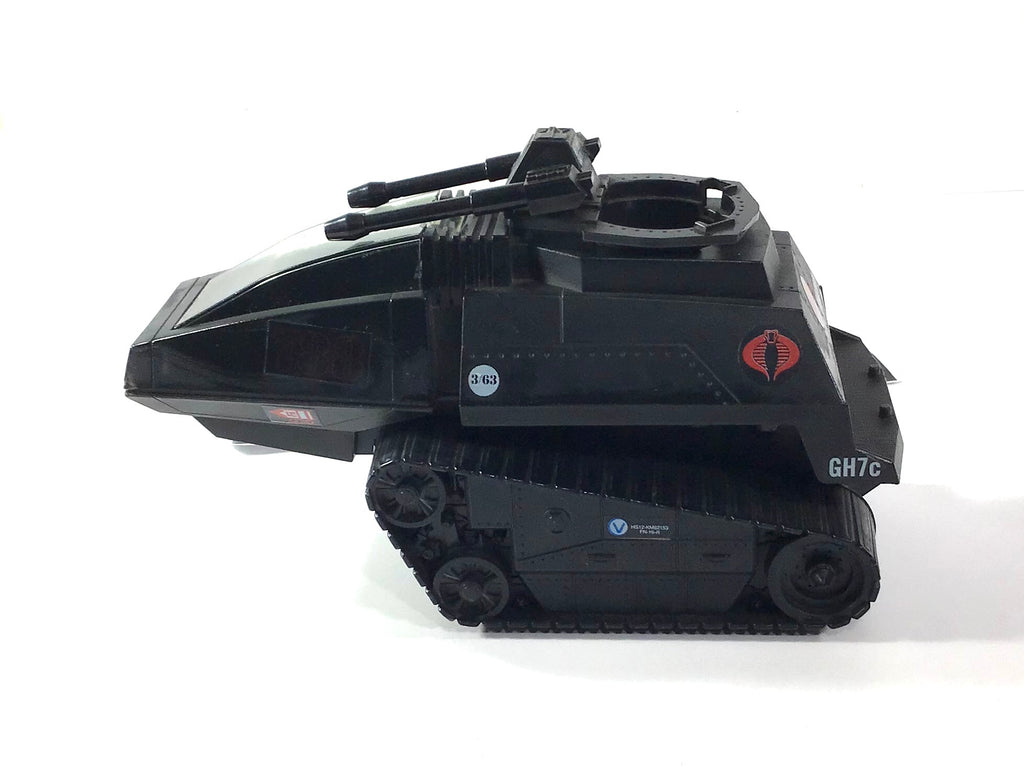
The original black 1983 H.I.S.S. Tank.
Photograph:
One Stop Joe Shop.
There might not be a more instantly recognizable Cobra vehicle than the original H.I.S.S. Tank.
Introduced in 1983, the black High Speed Sentry tank was a masterclass in toy design. Its aggressive wedge-shaped body, raised cockpit, red Cobra markings, and twin cannons made it look dangerous even when parked on a bedroom shelf.
Unlike many oversized vehicles, the H.I.S.S. was compact enough for children to collect multiples, creating an entire armored Cobra force.
And that was part of its brilliance. One H.I.S.S. Tank was threatening. Three or four charging across the carpet were an invasion.
It also had one of the strongest visual identities in the entire toy line. The sleek all-black design with its bright red insignia perfectly communicated Cobra’s sinister character.
If this list were judged purely on iconic design, the H.I.S.S. Tank might very well be No. 1.
SKYSTRIKER
XP-14F!

The original Skystriker XP-14F and pilot Ace.
Photograph via
Transformerland.
For many G.I. Joe collectors, the debate ends right here. The Skystriker XP-14F is the greatest vehicle Hasbro ever produced for the original A Real American Hero line.
Introduced in 1983 with its pilot Ace, the Skystriker brought the excitement of real military aviation into the world of 3.75-inch action figures. Its striking white fuselage, red and blue markings, sleek cockpit, and realistic weapons helped make it an instant classic.
But the Skystriker’s greatest feature was its synchronized wing and landing-gear mechanism. Operating a lever caused the swept wings and wheels to move between flight and landing configurations.
That kind of engineering helped make the vehicle feel like something far more impressive than a plastic toy.
It was also the perfect size for imaginative battles. Children could launch it from a bedroom runway, stage aerial confrontations with Cobra Rattlers, or prepare dramatic missions from the deck of the U.S.S. Flagg.
In terms of the balance between realistic design, play features, and childhood excitement, the Skystriker is almost impossible to beat.
Why No. 2?
Because one legendary Hasbro creation managed to expand the idea of a G.I. Joe vehicle into something almost unimaginable.

The legendary U.S.S. Flagg original 1985 package illustration.
Image via
ActionFigure411.
Artwork © Hasbro.
Imagine being a kid in 1985, walking into a toy store, and suddenly seeing a G.I. Joe aircraft carrier that measured approximately seven and a half feet long.
It barely seemed possible. While most action-figure vehicles fit comfortably on a bedroom floor, the U.S.S. Flagg practically demanded an entire room.
Released in 1985 with Admiral Keel-Haul, the massive aircraft carrier wasn’t merely a vehicle or an ordinary playset. It was a miniature military command installation, complete with a sprawling flight deck, a large tower structure, weapons, aircraft-support equipment, and an electronic sound system.

An original U.S.S. Flagg aircraft carrier showing its enormous flight deck and command tower.
Collector photograph via
eBay.
With the Skystriker parked on its flight deck, helicopters preparing to land, and action figures manning the command tower, the Flagg looked like something straight out of the pages of a G.I. Joe comic book.
Its features included an aircraft elevator, arrestor-cable details, deck-support equipment, a crane, weapons, and a working electronic public-address system.
This was not simply a place to park G.I. Joe vehicles. It was the center of an entire imaginary military operation.

A close look at the U.S.S. Flagg’s command tower and detailed construction.
Photo via
3DJoes,
which credits its Flagg detail photography to collector Chad Hucal.
For many children, however, the Flagg’s greatest appeal was also its greatest obstacle.
It was enormous, expensive, and difficult to accommodate in an ordinary home. Plenty of kids could only stand in the toy aisle and stare at the box, imagining what it might be like to command their own aircraft carrier.
And perhaps that is precisely why it remains so important to collectors today.
Owning a complete original Flagg is not merely a matter of collecting another vintage Hasbro product. For many fans, it represents finally fulfilling a childhood dream that began four decades ago.
The Skystriker may be the finest individual vehicle, but the U.S.S. Flagg remains the ultimate expression of what G.I. Joe could be.
For its astonishing scale, remarkable ambition, enduring collector mystique, and unparalleled childhood dream factor, the U.S.S. Flagg takes our No. 1 spot.
HONORABLE
MENTIONS!
There are far too many incredible G.I. Joe vehicles to fit into a single Top 10.
1982 V.A.M.P.
1982 M.O.B.A.T.
1984 Cobra Stinger
1985 Cobra Hydrofoil
1985 Snow Cat
1986 Cobra Conquest X-30
1986 Cobra S.T.U.N.
1987 Cobra Mamba
And if we expanded the contest to stationary playsets, the Terror Drome and G.I. Joe Headquarters would introduce an entirely different debate.
WHY THESE TOYS
STILL MATTER TODAY!
The vehicles of G.I. Joe: A Real American Hero weren’t merely accessories. They gave children the tools to build entire stories of heroism, betrayal, rescue, and adventure.
Every opening hatch, moving cannon, detachable missile, working suspension system, and distinctive driver made those stories feel more real.
And thanks to the unforgettable artwork that decorated their boxes, these vehicles often felt like miniature versions of the exciting battles we watched on television and read about in Marvel’s G.I. Joe comics.
That was the real magic of G.I. Joe in the 1980s. The toys didn’t just tell us a story. They invited us to create our own.
NOW IT’S
YOUR TURN!
vehicle of the 1980s?
which one we ranked too low,
and which classic we left off entirely!
No matter where your favorite ranks, one thing is certain: Hasbro gave Gen-X an extraordinary collection of vehicles that still inspire collectors more than 40 years later.
And knowing really is half the battle. YO JOE!
EDITORIAL SOURCES & PHOTO CREDITS
Historical reference material:
3DJoes: The G.I. Joe Yearbook
3DJoes: Skystriker XP-14F
3DJoes: Cobra Rattler
3DJoes: Cobra Night Raven S3P
3DJoes: U.S.S. Flagg
The File Card: Vintage Vehicle Catalog
Photography:
The Toy Collector’s Guide, Old School Toys,
Midwest Vintage Toys, Decades of Cool Toys,
ToySack, Wheeljack’s Lab, Lulu-Berlu,
eBay collectors, Collector Archive,
One Stop Joe Shop, Transformerland,
ActionFigure411, and 3DJoes.
Photographers and retailers are credited
beneath their respective images.
G.I. Joe: A Real American Hero and its
associated characters, logos, vehicles,
and packaging artwork are trademarks
and intellectual property of Hasbro
and their respective rights holders.
Images are used to illustrate historical
editorial discussion. Attribution does
not replace any required reuse permission.
ABOUT THE AUTHOR: ADAM JARED
Adam Jared is the founder of SerpentorsLair.com,
where he covers pop culture, vintage nostalgia,
G.I. Joe, retro toys, and entertainment history.
He holds a Master of Science in Social Media
Management and is currently pursuing his
PhD in Strategic Communication.