Who Painted G.I. Joe’s To the Rescue? The 1982 Art Mystery
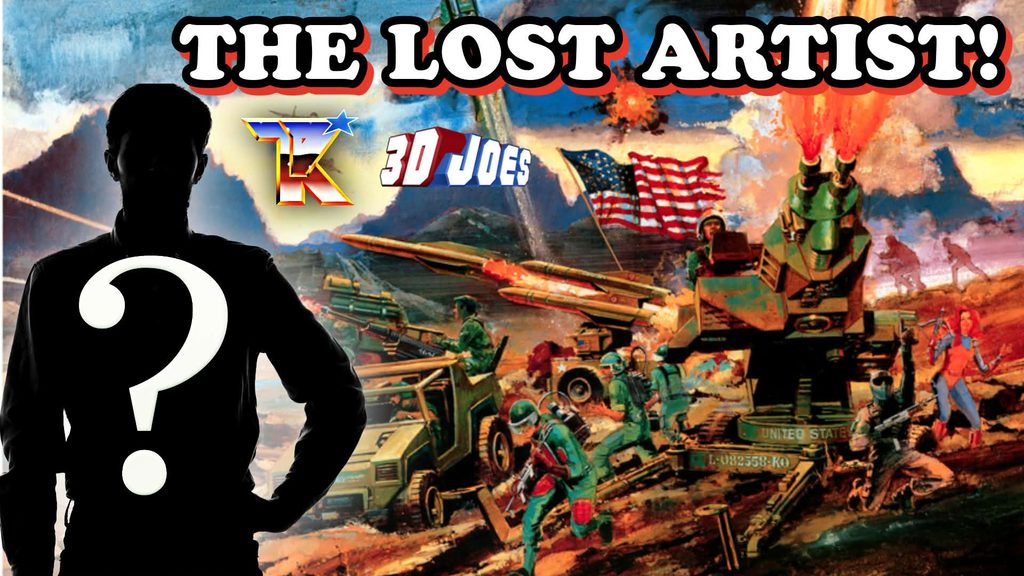
SERPENTORSLAIR.COM EXCLUSIVE FEATURE
G.I. Joe’s Greatest Unsolved Art Mystery: Who Painted “To the Rescue” in 1982?
A forgotten lunchbox connection, an unidentified illustrator, and a legendary G.I. Joe painting have left collectors searching for answers more than four decades later.
By Adam Jared and Ken Po

Somewhere in the history of G.I. Joe: A Real American Hero, a remarkable artist has been forgotten.
Not an ordinary illustrator. Not someone responsible for a disposable advertisement or a quickly forgotten piece of packaging. This was the artist behind one of the most striking battlefield paintings ever associated with Hasbro’s revolutionary 1982 toy line.
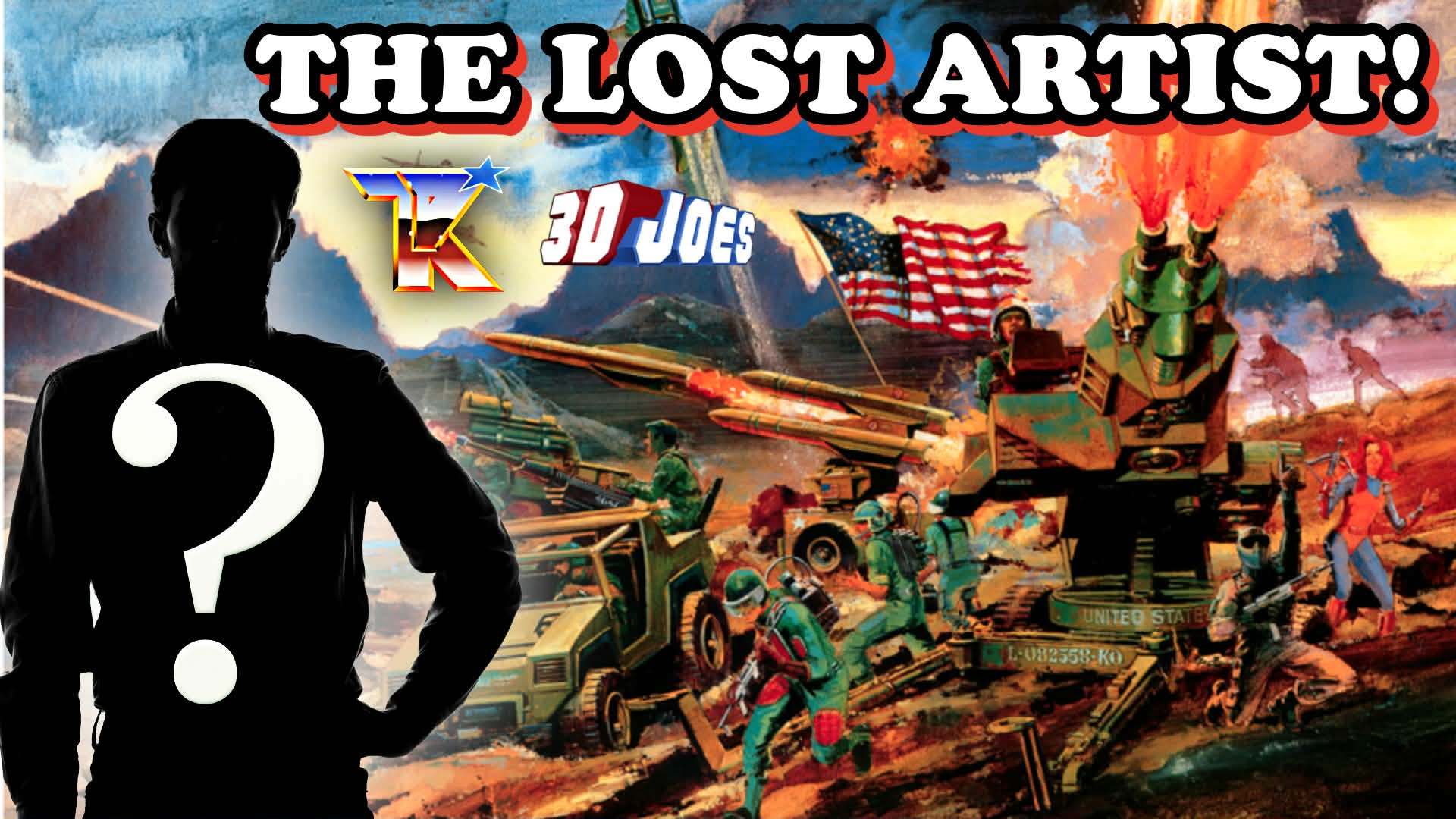
The painting was called To the Rescue.
It captured everything that made the original G.I. Joe phenomenon irresistible to a generation of children: military vehicles charging into battle, explosions ripping across a dramatic landscape, soldiers rushing into action, and an entire imaginary war unfolding in a single magnificent scene.
For countless young collectors, artwork like this was more than advertising. It was the spark that transformed plastic action figures into living heroes.
Yet more than forty years after the painting first appeared, one astonishing question remains unanswered.
Who actually painted it?
An Unsolved Mystery from the Golden Age of G.I. Joe
A fascinating installment of the Unsolved Toy Mysteries video series investigates this forgotten chapter of G.I. Joe history, with valuable insights from collector, historian, and archival researcher Carson Mataxis, the creator of 3DJoes.com.
Mataxis has devoted years to preserving the artwork, packaging, advertising, and contributions of the creative minds responsible for the original G.I. Joe: A Real American Hero phenomenon.
His historical research has helped identify the illustrators responsible for an extraordinary amount of Hasbro’s vintage artwork.
But To the Rescue has stubbornly resisted identification.
“After all these years, we don’t know who painted it.”
The mystery has produced tantalizing leads, interviews with former Hasbro personnel, discussions with legendary comic book artists, and a possible connection to one of the most beloved school lunchboxes of the early 1980s.
Watch the Original Investigation
Original video investigation featuring historical research and commentary from Carson Mataxis of 3DJoes.
1982: When Artwork Helped Launch a Toy Revolution
When Hasbro prepared to introduce its newly reinvented G.I. Joe action figure line in 1982, the company faced an enormous challenge.
How could it introduce an entire military adventure universe, complete with specialized soldiers, vehicles, personalities, and an emerging storyline, to millions of children?
Former Hasbro marketing executive Kirk Bozigian understood that G.I. Joe needed something bigger than ordinary product advertising.
Hasbro’s collaboration with Marvel Comics would become central to that effort. The comic book established a world populated by unforgettable heroes and villains, while animated advertising helped introduce its stories to television audiences.
The video explains how advertising restrictions applying to toy commercials made the promotion of comic books particularly important to Hasbro’s marketing strategy.
But another vital storytelling opportunity existed directly on toy-store shelves.
The packaging itself.
Rather than relying exclusively on product photography, Hasbro invested in original paintings for action figures, vehicles, playsets, and accessories.
Children encountering these products could immediately imagine the adventures waiting inside the boxes.
The famous character file cards contributed another essential layer of storytelling, giving individual figures backgrounds, specialties, and personalities.
Before a child even opened the package, G.I. Joe had already begun telling a story.
The Surprising Thermos Lunchbox Connection

One of the investigation’s most compelling discoveries concerns an everyday object that many children carried to school.
A 1982 G.I. Joe metal lunchbox.
Produced by Aladdin in association with the Thermos brand, the lunchbox featured elaborate original paintings depicting characters, military hardware, and battlefield action.
The artwork covered multiple surfaces of the metal case, creating a miniature gallery of early G.I. Joe imagery.
The illustrations were so impressive that they captured the attention of Kirk Bozigian.
According to the investigation, Bozigian recognized the artist’s talent and wanted to use similar imagery for Hasbro’s own promotional efforts.
The connection led him to a Thermos contact identified as Woody Brown, who explained that the company used independent contract illustrators rather than maintaining all its artistic talent in-house.
This made it possible to commission artwork specifically suited to each licensed product.
And somewhere within those outside artistic relationships may lie the identity of the person responsible for To the Rescue.
Archival information published by 3DJoes supports the connection between the lunchbox and the mysterious poster. However, whether the poster painting was created specifically for Hasbro, adapted from another assignment, or originated as unused lunchbox artwork remains unresolved.
VIEW THE COMPLETE 1982 THERMOS LUNCHBOX PHOTO ARCHIVE AT 3DJOES
Two Posters That Became G.I. Joe Legends
In G.I. Joe’s early years, collectors could save the familiar Flag Points printed on action figure cards and vehicle packages and redeem them for special mail-order merchandise.
Among the early offerings were two magnificent illustrations that would become treasured pieces of G.I. Joe history.
One was Stars and Stripes Forever, painted by legendary Hasbro designer Ron Rudat.
The other was To the Rescue.
Rudat’s contributions to G.I. Joe are well documented. His creative work helped establish the look of the Real American Hero toy line, including the famous Cobra insignia.
But the second poster came from an artist whose name has disappeared from the surviving historical record.
The two posters were offered through Hasbro’s mail-order program beginning in late 1982 and remained available into the middle of the decade.
To the Rescue also appeared prominently in the 1983 G.I. Joe product catalog, introducing its explosive battlefield imagery to additional young fans.
Its influence extended beyond the mail-order program. The illustration was also used on a 1983 G.I. Joe Footlocker Toy Chest produced by American Toy & Furniture Company.
For an anonymous painting, its legacy was remarkable.
EXPLORE BOTH ORIGINAL MAIL-ORDER POSTERS AND HISTORICAL PHOTOGRAPHS
The Hunt for the Forgotten Illustrator
Determined to uncover the mystery, Carson Mataxis began following the surviving historical clues.
One important lead came directly from Kirk Bozigian, who remembered his working relationship with Woody Brown.
Mataxis eventually contacted Brown, hoping that the former Thermos representative might remember the illustrator responsible for the celebrated paintings.
Unfortunately, the name had faded from memory.
Brown did, however, identify another possible source of information: Jeff Mills, an art director associated with those early projects.
For a moment, the mystery appeared closer to a solution.
But locating the right Jeff Mills proved difficult, and the investigation once again reached a dead end.
Without surviving documentation that definitively connected an artist to the painting, even eyewitness recollections could only carry the investigation so far.
Was It Legendary Comic Artist Bill Sienkiewicz?
Perhaps the investigation’s most intriguing possibility involved one of the most distinctive illustrators in comic book history.
Bill Sienkiewicz.
Celebrated for his groundbreaking work on titles such as Moon Knight, New Mutants, and Elektra: Assassin, Sienkiewicz developed a painting style characterized by expressive brushwork, dramatic compositions, and unconventional textures.
Former Hasbro designer Erik Araña remembered seeing the original To the Rescue painting hanging near the office of Hasbro executive Aaron Archer.
The original painting reportedly carried no identifiable signature.
As Araña and Archer examined the image and its distinctive brushwork, they considered whether Sienkiewicz might have been responsible.
It was a tantalizing theory, particularly because of the artist’s history of commercial illustration and animation-related work.
But Mataxis did something critical.
He contacted Sienkiewicz himself.
The celebrated illustrator examined the artwork and confirmed that it was not his painting.
He did acknowledge having contributed character design work for G.I. Joe animation during the late 1980s and early 1990s.
But the mysterious 1982 painting was not among his creations.
One of the investigation’s most promising leads had been eliminated.
And the search continued.
Could It Have Been a Seventh Lunchbox Painting?
One particularly fascinating theory suggests that To the Rescue may originally have been intended for the 1982 Thermos lunchbox project.
The reasoning is straightforward.
The lunchbox already featured multiple original military-themed paintings, and the overall artistic treatment resembles the mysterious poster.
Could the artist have created an additional illustration that was simply too large or complex to fit the lunchbox layout?
Could that rejected composition subsequently have been offered to Hasbro for its poster promotion?
Or might the painting have originated with an entirely separate, unrealized licensed product?
Each possibility offers a compelling explanation for how the illustration reached Hasbro.
But none has been conclusively established.
Mataxis explores these possibilities as part of his ongoing historical research, including material documented in The Art of G.I. Joe: A Real American Hero omnibus hardcover.
The theory is intriguing because it raises an additional question.
Somewhere, might surviving Thermos or Aladdin production paperwork still contain the artist’s name?
One Painting, an Entire Battlefield
What makes To the Rescue so extraordinary is not merely its historical significance.
It is the remarkable composition itself.
Rather than presenting a single character in a dramatic pose, the artist assembled much of G.I. Joe’s original military universe into one enormous moment of battlefield action.
The VAMP charges into the fight.
The RAM motorcycle powers forward, its front wheel lifting dramatically from the ground.
The MOBAT tank appears deeper in the landscape, introducing a sense of tremendous distance and scale.
The MMS missile system contributes to the chaos as military hardware converges on the unfolding confrontation.
Meanwhile, Flash becomes a crucial focal point amid the scene’s dramatic visual energy.
The artwork is filled with movement.
Vehicles and soldiers seem to erupt outward from a common central area, while explosive effects and diagonal lines guide the viewer’s eye across the landscape.
It creates the remarkable illusion that the entire battle has sprung into motion in a matter of seconds.
This was precisely the type of visual storytelling that helped define Hasbro’s early G.I. Joe identity.
A child studying the image could imagine what happened immediately before the painting—and what might happen next.
That was the magic of the original G.I. Joe artwork.
It did not simply illustrate the toys.
It brought their universe to life.
Carson Mataxis and the Mission to Preserve G.I. Joe History
One of the most meaningful aspects of the video is its emphasis on recognizing the talented individuals responsible for creating the objects that shaped our childhoods.
Since establishing 3DJoes in 2012, Carson Mataxis has worked to document the original G.I. Joe figures, vehicles, packaging illustrations, advertising artwork, and their creators.
His extensive archival projects culminated in the release of The Art of G.I. Joe: A Real American Hero Omnibus Hardcover in December 2023.
But preserving the artwork is only part of the mission.
Mataxis also wants collectors to recognize the people whose talents made those images possible.
As he explains in the video:
“I believe that artists deserve credit for their work.”
That philosophy reaches far beyond toys.
Behind every iconic action figure, unforgettable comic book cover, colorful package illustration, and cherished childhood memory is a person whose imagination helped make it possible.
For collectors, meeting those creators at conventions and hearing their stories offers an opportunity to express appreciation while they are still able to receive it.
Those encounters have become part of the larger mission of preserving G.I. Joe history for future generations.
Through projects such as Operation: Recall, original G.I. Joe creators have also been given opportunities to contribute their talents to entirely new action figures.
The result is more than nostalgia.
It is the preservation of an important chapter of American toy and illustration history.
VISIT 3DJOES — THE G.I. JOE ART AND HISTORY ARCHIVE
The Mystery That G.I. Joe Fans May Still Solve
Somewhere in the surviving records of a long-forgotten advertising agency, a retired commercial illustrator’s personal portfolio, or a collection of early 1980s production materials, the answer may still exist.
Perhaps the artist went on to work in comic books.
Perhaps the illustrator spent an entire career creating commercial paintings for products that millions of Americans encountered without ever learning the creator’s name.
Or perhaps a relative still possesses a photograph of the original assignment.
There is no confirmed answer.
But there is still hope.
What began as a promotional illustration for a toy franchise has become a lasting piece of Gen-X popular culture.
Children who first admired To the Rescue in the early 1980s are now adults with decades of memories attached to the illustration.
For those fans, identifying its creator would provide something more meaningful than simply adding another name to a collector’s database.
It would finally give a forgotten artist recognition for a piece of work that has inspired generations.
And somewhere out there, someone may recognize the painting.
Someone may remember the assignment.
Someone may know the name.
Until then, one of G.I. Joe’s greatest artistic mysteries remains unsolved.
Calling All G.I. Joe Collectors and Toy Historians
DO YOU KNOW WHO PAINTED “TO THE RESCUE”?
If you worked in commercial illustration, licensed product development, advertising, or the toy industry during the early 1980s—or know someone who did—your information could help solve this enduring mystery.
The original illustration may have connections to Thermos, Aladdin, an outside advertising agency, or an independent freelance artist.
Collectors with original artwork, production documentation, artist portfolios, or credible historical leads are encouraged to contact the researchers at 3DJoes.
Let’s help give this forgotten G.I. Joe artist the recognition they deserve.
Historical Sources and Further Reading
- Original Unsolved Toy Mystery video investigation
- 3DJoes: 1982 Mail-Order Posters
- 3DJoes: Original 1982 Thermos Lunchbox
- 3DJoes: 1983 Product Catalog
- 3DJoes: 1983 Licensed Toy Chests
- 3DJoes: The Art of G.I. Joe Omnibus
Editorial note: Historical observations and recollections attributed to interview participants are based on the featured video and publicly available 3DJoes archival information. The identity of the artist has not been established. Images are reproduced for historical commentary with attribution to their respective archives and owners.
About the Author
Adam Jared is the founder of SerpentorsLair.com. Holding a Master of Science in Social Media Management and pursuing a PhD in Strategic Communication, Jared explores the history of G.I. Joe, Transformers, classic television, comic books, and the pop culture that defined Generation X.
FOLLOW SERPENTORSLAIR.COM FOR MORE G.I. JOE HISTORY, COLLECTOR FEATURES AND GEN-X NOSTALGIA!