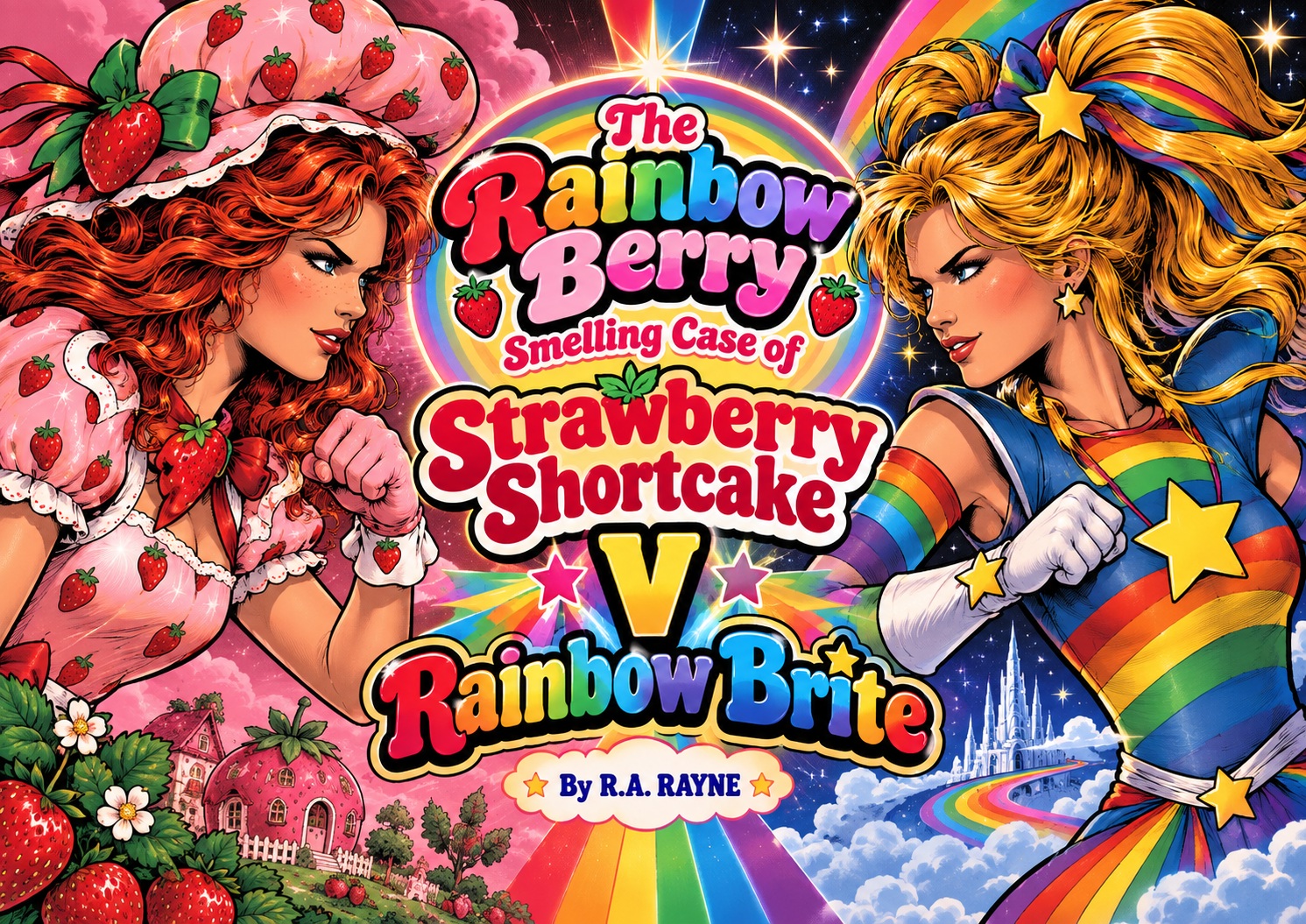
The Rainbow Berry Smelling Case of Strawberry Shortcake V Rainbow Brite
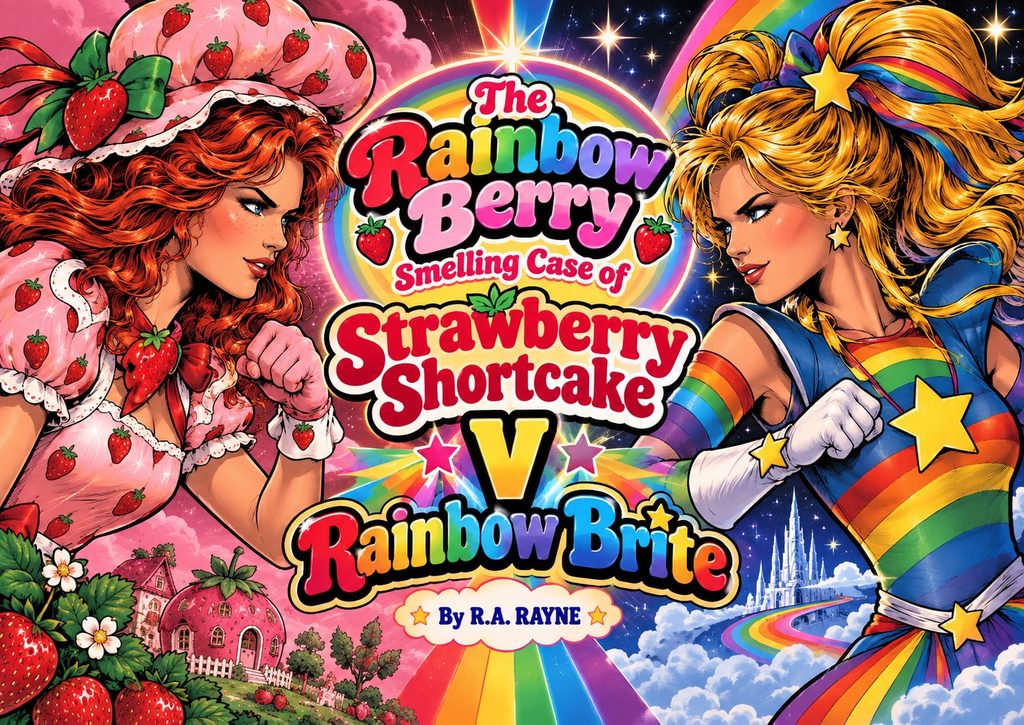
By R.A. Rayne
Move over, Harding-Kerrigan, Perry-Swift, Jem-Barbie. The biggest female celebrity rivalry started in the greeting card industry.
This all started way back in 1972, when American Greetings published a Laurel Valentine’s Day card created by Barbi Sargent. The first image, titled Girl with a Daisy (Strawberry Girl), showed her holding a daisy and wearing an orange hat with a strawberry pattern.
The card was a big hit, so popular that Rex Conners, the staff art director at American Greetings, asked Sargent to create more cards featuring the girl in the strawberry outfit. By July 1977, Sargent sent American Greetings four full-color “leader cards” featuring the Strawberry Shortcake character for consumer testing. This was the first time the public saw Strawberry Shortcake’s new design, and people liked it.
During the late 1970s, Muriel Fahrion, an illustrator working in American Greetings’ Juvenile & Humorous card department, designed another 32 characters for Those Characters From Cleveland (American Greetings’ toy and licensing design division).
By 1979, Kenner Toys secured the merchandising license for the characters and released the first Strawberry Shortcake doll. The first doll was a classic rag doll, complete with freckles, a mop of red yarn curls, and dressed in a red dress with a white apron, green-and-white striped socks, and a pink bonnet with a strawberry print.
On March 28, 1980, the first animated television special featuring Strawberry Shortcake and related characters premiered as we were welcomed to The World of Strawberry Shortcake, where we became “berry best friends” with Strawberry Shortcake and her friends. And of course, the Purple Pieman from Porcupine Peak. “A-ra-ta-ta-ta-tata, a-rata-ta-ta!”
Following the massive success of Strawberry Shortcake, Hallmark decided to cash in on the ever-growing merchandise-driven “half-hour toy commercial” animated toyetic shows. On June 27, 1984, the first syndicated prime-time Rainbow Brite television special, “Peril in the Pits,” aired. That same year, Hallmark licensed Rainbow Brite to Mattel for a range of dolls and other merchandise. At the 1984 North American International Toy Fair, they introduced the character and launched a $15 million marketing campaign that predominantly focused on television advertisements.
Neither character took shots at the other, which, in my opinion, is unfortunate. I, for one, would have loved to see a Twitter war between two of the cutiest characters ever created. With catchphrases like “Bake the world a better place,” “Growing better all the time,” “You’re my berry best friend,” “Anything is possible,” and “Spreading color and happiness everywhere!” “Chasing away the gloom!”, “Powered by star sprinkles and color!”, and “Kindness is magic!” These two little darlings would be at each other like Kristy McNichol and Tatum O’Neal. Okay, actually, it would be like a Care Bears and My Little Pony smackdown. ( A lot of fluff and more glitter than a 1st-grade art project).
But don’t get me wrong. While there weren’t little girls knifing each other at the mall and no one was trying to jump onto Team Berry or Team Brite, these two brightly colored, fruit-scented dolls were intense rivals. Kenner and Mattel fought for shelf space, airtime, and the attention of girls worldwide to make sure their small wonder was the favorite doll on the toy aisle.
At its peak in the early 1980s, Strawberry Shortcake generated roughly $500 million in annual consumer product sales. Between 1980 and 1985 alone, the brand generated well over $1 billion in total retail sales from its numerous dolls, books, records, and other licensed merchandise. While Rainbow Brite is also estimated to have generated $1 billion in total retail sales across the 1980s from dolls, books, cereal, and other licensed merchandise, it took much longer to reach that mark than Strawberry Shortcake did. And despite both Strawberry Shortcake’s and Rainbow Brite’s success, Strawberry Shortcake ultimately earned more throughout the 1980s.
This rivalry was never as big or as devious as the case of Jem, Barbie, and the Rockers. It was still a source of contention among adolescent girls, much like Star Wars and G.I. Joe were for adolescent boys. For girls, Rainbow Brite came out after Strawberry Shortcake had been out for a while. Rainbow was quite literally the new shiny toy, causing girls to move their Strawberry Shortcake dolls to the bottom shelf while Rainbow Brite got the more prominent upper shelf. The same thing happened with boys. Star Wars was getting lost in space as G.I. Joe was initiating their ground assault. I know the whole thing sounds like Woody and Buzz, right? (But where do you think the idea for it came from?)
While this rivalry ended more like a Swiftie Katie-Kat fund than a Harding-Karrigan fund, it will still go down as one of the biggest animated slap fests of its kind.
So, let me ask you. Were you Team Berry or Team Brite?